Writings of the general word's body

Showing posts with label African Cinema. Show all posts

Sunday, July 17, 2011

Souleymane Cisse in retrospect

I promised to post my 2005 article on the Souleymane Cisse film retrospective, and how British Consulate officials rained on the Malian director's parade and denied him a visa to attend a screening of his modern classic, Yeelen, at the Barbican in London.

This below was originally published in The Guardian, Lagos, on November 27, 2005...


Souleymane Cisse Film Season… in Retrospect
By Molara Wood

A film retrospective on Souleymane Cisse at the Barbican Centre, London, was much anticipated, coming as it did on the heels of Ousmane Sembene’s appearance in the city earlier this year. Although not nearly on the same scale as the Sembene programme at the National Film Theatre, the short season of five films by Cisse was nevertheless significant. It was to include a stage appearance by the director, following the special screening of his international hit film, Yeelen (The Light).

Winner of the Cannes Jury Prize 1987,
Yeelen is one of the most acclaimed and widely seen African films ever made.

Born in Bamako, Mali, in 1940, Cisse studied in Moscow under the Soviet director Mark Donskoi, and on return to his country, worked as a documentary filmmaker for the Ministry of Information before embarking on his own cinematic career. The director’s first short film, Five Days in a Life, was made in 1972; his first feature length movie, Den Muso (The Young Girl), followed in 1975.

Den Muso - about a young mute woman who is raped and becomes pregnant, with disastrous consequences for her family - formed part of the Barbican season of Cisse’s work. Also on the programme were: Baara (Work, 1978), about the condition of workers in the city; Finye (The Wind, 1982), about a love affair between an army commander‘s daughter and the grandson of a tribal chief; and Waati (1995), a rarely-seen work about racial politics in South Africa. The season was to kick off with Yeelen, then the director would take the stage to discuss his work.

Africa at the Pictures, an organisation that seeks to promote and enhance the distribution and exhibition of African films in Europe - organised the event. The Barbican described Cisse as someone who “crafted a body of films that combine visual elegance with Marxist ideology and allegorical storytelling. Drawing on traditional indigenous lifestyles and Malian folklore, Cisse attempts to explore the conflicts in Mali society, particularly the conflicts that emerge between the desire for change and the need to preserve tradition.”

The first sign that all might not be well, came on the Thursday on which Cisse was due to be making his Barbican appearance. The venue’s website confused matters, indicating that the event would take place on the following day - Friday. Those who turned up on Friday, were in for a disappointment. Indeed, Yeelen would be shown, but the director himself would not now appear - an assistant at the ticket desk informed. He revealed that this was because Souleymane Cisse had not been granted a visa to travel to Britain. One wondered whether the assistant had gone beyond his brief, and went into the cinema hall hoping the report would turn out to be a piece of misinformation.

Another sign that perhaps all was not well, was an unusual sign just at the entrance to the auditorium. Unusual, because one does not normally encounter such at a prestigious venue like the Barbican. The sign apologised in advance for the ‘poor print quality’ of the film we were about to see. Inside, a sizeable audience awaited the entrance of Souleymane Cisse, only for another man to saunter onto the stage, looking like he would have preferred to be elsewhere. It was Keith Shiri, the director of Africa at the Pictures. An apologetic Shiri informed that Cisse would not give the Screen Talk as expected, due “to a lot of complications with getting people from Africa, especially from Mali.” The ticketing assistant had been right afterall: a Cannes Award winning filmmaker, one of Africa’s best, had been refused a visa to enter Britain - in the year of Africa 05.

A clearly disappointed Shiri said: “We wanted him to be here. This (Yeelen) is one of my favourite films and Cisse is one of my favourite film-directors, one whose work I always refer to.” He explained further, that African filmmakers always carry their own films when they travel, and Cisse was to have done the same. His inability to travel scuppered the whole arrangement. Africa at the Pictures therefore had to get a less-than-perfect print of the film as a last resort, from distributors Artificial Eye, and Cisse consented for this to be shown instead, hence the poor quality of the film we were about to see. Shiri hopes he will succeed in bringing the director over to the UK next year.

"Knowledge is built and consolidated by one generation, it is destroyed by another, and recreated by a new generation," Cisse once said, on the role of indigenous film and culture. And in Yeelen, a young warrior, Nianankoro, must face his destiny by destroying a corrupt older elite represented by the secret Komo cult. A leading figure of that cult is Nianankoro‘s own father and his greatest enemy, Soma. Often described as “an oedipal story mixed with magic,” Yeelen is an adaptation of an ancient oral legend from Mali.


Cisse takes his audience to the powerful Mali Empire of the 13th century, where Nianankoro and his aged, wizened mother have been on the run for ten years from his father, an evil sorcerer who does not want his son as an equal, and so seeks to destroy him. With the aid of a magic post (used in ancient Mali to find lost things), Soma goes up and down the land in search of the son he wants to kill. Two bumbling servants carry - or are driven to distraction - by the wilful post, to great comic effect. Nianankoro too, is sent to seek the help of his blind uncle, Soma’s twin brother. Along the way, the young warrior learns to use his magic powers for good, discovers himself, and acquires a wife in traumatic circumstances.

All the while, he readies for the confrontation with the father, which may end in the “luminous death” of one or both of them. “I think one can die without ceasing to exist,” goes a line in the film; and Souleymane Cisse, in depicting the death of one culture, makes way for the birth of a new one.

Nianankoro is played by Issiaka Kane, an actor whose stark physical grace carries the film - through scenes of war, magic, hallucinations and full-frontal nudity. But the real star of the film is the West African landscape, as the warrior journeys through arid lands of the ancient Bambara and Fulani peoples. Not even the ‘poor print quality’ could detract from the landscape, which, thanks to the excellent cinematography, astonishes the viewer with its parched beauty.

Yeelen is regarded by some as Africa’s greatest film. Pity the British Consulate in Africa was not impressed enough to grant its maker a visa. At the end of the Barbican screening, the audience gave the absent director a respectful applause. By this simple gesture, cinema goers gave their own verdict - both on the director and his work, and those who would not allow him into Britain.


Keith Shiri (right) photographed with actress Kate Henshaw-Nuttal at the Africa Movie Academy Awards Nominations Night in Nairobi on February 25, 2011 - Photo by MW.

Saturday, February 26, 2011

Aramotu leads Nigeria's AMAA Nominations

Nollywood star power with more than a little Ghollywood help last night in Nairobi at the Africa Movie Academy Awards' Nominations event . L-R: Jackie Appiah, Joke Silva, Kate Henshaw-Nuttall, Ini Edo, Rita Dominic, Ramsey Noah, Mike Ezurounye and Majid Michel.

And so, the nominations are out for the films that will vie for AMAA glory on March 27 in Bayelsa State, Nigeria.
The big contender for Nigeria is the forthcoming film, 'Aramotu', a Niji Akanni directed film entirely in Yoruba and starring Idiat Shobande as the eponymous heroine. Aramotu garnered 6 nominations including Best Actress, Best Director and Best Film! Aramotu premieres in March in Lagos.

Perhaps the strongest film overall is Sinking Sands, by Ghanaian director Leila Djansi and starring Ama K. Abebrese and Haitian actor, Jimmy Jean-Louis. All three are rewarded with nods in the Director, Best Actress and Best Actor category. Altogether, Sinking Sands has at least 8 nominations.
Other strong films in the nominations are Viva Riva! (Congo), A Small Town Called Descent (South Africa), Izulu Lami (South Africa), Hopeville (South Africa) and Shirley Adams (South Africa).

There are respectably showings for Nigerian films like Mahmood Ali-Balogun's 35mm film, 'Tango With Me', for which Genevieve Nnaji gets a Best Actress nod; Tunde Kelani's 'Maami' (nomination for young newcomer, Ayomide Abatti); A Private Storm and Yoruba film, Yemoja (Best Actor nomination for Antar Laniyan).

As everyone here is saying, see you in Bayelsa March 27.

Photo by MW

Tuesday, December 07, 2010

Snapshots from AFRIFF

3 outstanding scripts from Tyger Williams' lab were selected for AFRIFF's Script-to-Screen project. Pictured here with Williams (in white) are, from left, Adeyemi Ayoyemi Adeniyi (for 'One Window'), Abiola Hameed ('Task') and Iliyasu Kassim (for 'Tsangaya'). They will be assisted with funding by the festival organisation to turn their scripts into short films that will be shown at next year's AFRIFF.

Tyger Williams wrote the script for 'Menace II Society', a fact that made me go 'Wow!' when I discovered. In the background is Soledad Grognett, Technical Director of the First African Film Festival. Along with Sandra Obiago and Jahman Anikulapo, I was on the Scriptwriting Advisory Board for AFRIFF. Our task was to select the 12 short scripts that made it into Tyger Williams' scriptwriting lab, which he taught for 3 days.

Actress Omoni Oboli, last seen in Kunle Afolayan's The Figurine, is out with a new film, 'Anchor Baby'. She's seen here with the film's director, Lonzo Nzekwe. 'Anchor Baby was shown at AFRIFF. It premieres in Lagos on December 9 and opens to the public on the 10th.

After the screening of the festival's opening film 'Relentless' on December 2, its stars, Gideon Okeke and Nneka Egbuna sit down for a Q&A with Kunle Afolayan and the film's director, Andy Amadi Okoroafor.

Saturday, December 04, 2010

Blogging as a bourgeois pipe dream


Hello, patient blog readers, who have watched uncomplainingly while Wordsbody took a long snooze.

The failure to update this blog is never intentional. It's just that Lagos life throws a lot of challenges in one's way, like you get home and there's no light and you have to power your generator, which breaks down sometimes, leaving you clutching in the dark for rechargable torches or candles. Other times, there's no fuel because you've exhausted your supply or there's a fuel crisis. At times you get home very late at night after battling through traffic. Or you've paid for a month's unlimited internet supply and it just won't connect or it will take till tomorrow morning to upload the smallest file. At times like this, the furthest thing from your mind is the updating of a blog.

What am I trying to say? In the unending struggles of day-to-day existence in Nigeria, blogging can become a bourgeois pipe dream...

Lagos is an amazing city and there's always stuff happening on the arts scene there. One never has enough body or legs to make all the events. Like last Saturday I attended two art exhibtion openings: Resurgence, a two-man show by artists Gbenga Ajiboye and Ayoola Mudasiru at the Wangbojes Gallery in Ikoyi; and Ablode by Beninoise artist Midahuen Yves (known as Midy for short) at Quintessence. After the exhibitions I caught a play, Ahmed Yerima's 'Little Drops', produced by Lufodo Productions in collaboration with TW Magazine (Tosan Edremoda-Ugbeye, Joke Silva, Ropo Ewenla and Kate Henshaw-Nuttal gave their all in the play, which is about the plight of women in the Niger Delta crisis). Earlier in the week, November 22, I was at the ArtHouse Contemporary auction at the Civic Centre when Demas Nwoko's sitting wood sculpture of 'The Wise Man' went for a cool 9 million naira. Gotta love it. There was a hush as the bidding went into 5, 6, 7 million; and we all clapped when the hammer went down. Exciting stuff, and it happens in Lagos every day - pity one can't blog it all.

For a fortnight however, it seems many are going Rivers way, myself included. I'm posting this from Port Harcourt and my internet modem is cooperating. Above is the view of Port Harcourt from my sixth floor balcony at the Hotel Presidential.

I'm attending the Africa International Film Festival, which started on December 1 and ends tomorrow.
Taking over will be the Garden City Literary Festival which will have in attendance Wole Soyinka, J.M.G Le Clezio, Helon Habila and scores of others (December 8 to 11).
After that will be the CARNIRIV, Rivers State's own carnival, from December 13 to 18. I'm here till the close of the Garden City Literary Festival at least. I'll have to read about the carnival.

Tuesday, December 02, 2008

Filmfest


Seen Abouna? Simply one of the most touching films you'll ever see. Following the journey of 2 brothers who run off in search of a father who walks into the sunset in search of God-knows-what and never looks back, Abouna will charm your heart and break it at the same time. After their mother dismisses the absent father as 'irresponsible' in French (irresponsable, or something like), the younger brother asks the older the meaning of the word, in one of this gentle film's funnier moments. A bit like the Asian girl asking Rambo in one of the muscle-bound movies asking, "What means expendable?" Abouna is much more human than that blockbuster, and is one of the finest examples in African films about the search for a father figure ("Yeelen" is another).
  • Abouna is on tonight (6.30pm) at the Renoir Cinema, London - as part of the London African Film Festival - in a screening attended by the director. You can see Tunde Kelani's Arugba on 7th December; and Abderrahmane Sissako's Bamako is a The BFI Southbank on 6th December.

Wednesday, January 30, 2008

Blog from the past


Even before news broke of the untimely death of the actor Heath Ledger, I'd been intending to recycle this minor blog classic of mine earlier this month, 2 years after I first posted it. The Ledger connection comes from the fact that I wrote 'Drifting in the West End' on the night I watched Brokeback Mountain. Posted on 20 January 2006, here it goes...
*
Drifting in the West End
~
What a night I’ve had. I was to attend the Manthia Diawara talk earlier tonight - at the British Museum. It would have been my first event on the Art beat this year. Unfortunately, I’d neglected to arrange my Press Pass in advance but, since it was a free event anyway, I thought I’d just book myself a place like everyone else. And so I let things slide… until the last day when I rang and rang the British Museum’s box office in order to book my place for later in the evening. But every time I got through, I was put on hold for such unbelievable lengths of time that I always had to hang up in the end.
~
Getting to the Brit Museum just after 6pm, the Information Desk said: yes, there were still lots of seats available for the event but I would have to join the long queue at the Ticket Desk to secure a place. Joined the queue, along with those wanting to see a film about Julius Caesar and last minute viewers f0r a Samuel Palmer exhibition, which ends on Sunday… I could hear those hoping to make these two events being turned away at the top of the queue with the words: ‘sold out’, ‘sold out’. Gosh, the British Museum is busy tonight, I thought. The museum’s magnificent Great Court looked strangely empty to me. But then I realised why. The Tree of Life - made from decommissioned weapons from the Mozambican war - which stood in the Great Court for the best part of last year (as part of Africa 05) - is gone. It’s now on permanent display in the museum’s Africa Galleries; hope to view it there sometime soon.
~
I eventually reached the top of the queue and… disappointment. The event was full! There goes one whole article! I thought. Deflated, I walked out of the museum, heading towards Totteham Court Road, wondering what I should now do with myself. At an Oxford Street traffic light, I looked down the road, thinking of whipping out my camera for a picture, but then the lights turned green so I gave up the idea and proceeded to cross. As I did so, this guy next to me said: ‘Don’t worry love, I’ll protect ya.” On hearing what he said next, I regretted having laughed politely at his first remark. “I’m your gangsta.” He was English and looked like no gangsta to me. On Charing Cross Road, the guy caught up with me and somewhat unexpectedly, apologised: “I’m sorry for saying that to you, love. I didn’t mean to say that.” He sounded drunk, so maybe it had been the drink talking. I accepted the apology, wished him a nice evening and continued on my way.
~
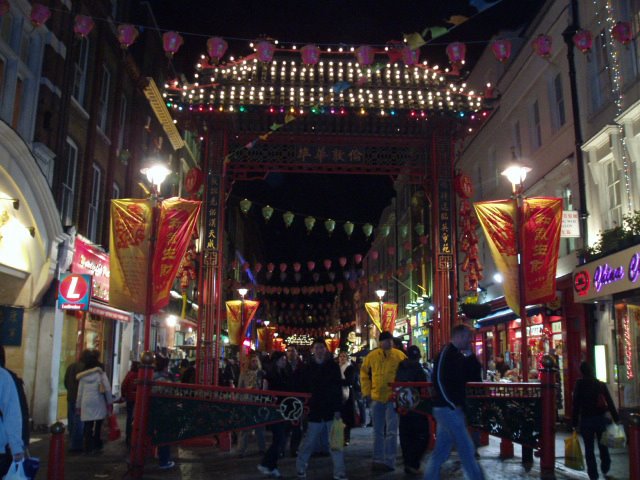
I’d decided to just walk, not knowing quite where it would end. I’d not walked down Charing Cross Road for a while, and it was nice just to see all the bookshops, old and new. Sex also came out forcefully from under all the books, so to speak. The Soho Bookshop boasted “a fully licensed sex shop downstairs”; I went into Foyles but my aimlessness drove me out earlier than would normally be the case. I reached Cambridge Circus from where I connected Shaftesbury Avenue. On seeing the Curzon cinema there, I settled on seeing a film; this particular one wasn’t showing anything I wanted to see. Then Chinatown winked at me from Gerrard Place… I crossed over. I took a leisurely stroll down Gerrard Street, through the heart of Chinatown… taking in the many Chinese restaurants, shops and the tourists busy with their cameras.
~
Then it was back onto Shaftesbury Avenue and more walking, until I landed smack in Leicester Square - London’s moviedom. By now it was a case of ‘what to see’. The main Odeon cinema there was showing King Kong; I decided to hold on to my cinematic memory of Fay Wray and Jessica Lange as Kong’s desired blonde, and left Naomi Watts' own portrayal for another day. Jarhead was showing at the Empire… tantalising as the name of Jamie Foxx on the cast list was, this wasn’t the kind of movie I wanted to see tonight, so I gave it a miss. At the Vue, Memoirs of a Geisha and Brokeback Mountain looked interesting.
~
Brokeback Mountain won the day. I purchased a ticket for an 8.30pm showing, but it was only just past 7. My stomach needed attention, so, more browsing round the many eateries… another aimless stroll to the National Portrait Gallery and back, then sat to some noodles in some tiny place called Chopstix. 8.30, and I was in the Vue’s packed auditorium no.5 for Brokeback Mountain, starring Heath Ledger (playing Ennis Del Mar) & Jake Gyllenhaal as cowboys who fall in love - yeah, with each other - and then spend the rest of their lives trying to work through their feelings. ‘Jack Fxxxing Twist!’ Ledger’s character likes to say of Gyllenhaal’s character. Very involving film, breathtaking scenery.
~
I was back on the street just past 11pm, heading towards Piccadilly Circus station. Leicester Square was teeming with people… the club crowd were out and queueing to get into some nitespot or other. I was heading for home. One man aimed a playful kick at the backside of a woman walking ahead of me; she had the good sense not to respond. “I love you, honest!” he shouted drunkenly after her. It dawned on those around that he didn’t even know his ‘lover’, something that really amazed another woman behind me. “I was sure he knew her!” she exclaimed.
~
Getting into the station, I was about to get on the escalator leading to the Bakerloo line when I saw another set of strangers made lovey-dovey by alcohol. Two girls at the top of the Piccadilly Line escalator blew kisses at a man you could just tell they’d only met earlier in the evening. “We love you, we’ll miss you,” they said, as the escalator ferried them away from him. He turned round to go his own way, but then two policemen who’d been standing by decided to have themselves some fun, and pulled the man to one side. He was hopelessly drunk, I observed, as my escalator descended, taking him out of view. Who knows what they’ll find on him? I wondered. Who knows what they’ll ‘do’ him for? Who knows if he’ll end up in some cell? And wouldn’t that be the final kick up his ass?
.
  • Image: Chinatown, London; 20 January 2006

Monday, April 23, 2007

'Art is Important'

Nigeria has been at the polls and we look anxiously on. I've had so many worrying sms messages from Lagos and Ibadan in the last week, and one can only read and sigh - or shake one's head in quiet amazement at some of the unbelievable goings on. Many bloggers have filed in post after post on the elections, one of whom is Sokari Ekine of the Blacklooks blog. She has a list of the bloggers who have posted on the Nigerian elections here. These bloggers are doing a wonderful job of bringing the Nigerian polls to the blogsphere. Wordsbody will keep up the loose focus here, on the arts, because as Nicole Kidman once declared and I agree, "Art is Important".
~
Above is a newspaper cutout (Metro, 22nd February) that I've been meaning to post. Just as well, that the 'Africa on Trial' headline should be blogged during the aforementioned elections... Metro included Abderrahmane Sissako's film, Bamako, on its list of films Londoners must see. But something struck me. Africa on Trial's accompanying text reinforces the misrepresentation of the header. No mention of the fact that it is actually the West and her financial institutions that go on trial in the movie. An indication, perhaps, of the West's inherent unease with the message of Bamako.

Sunday, February 18, 2007

Bamako


13th February, and I attended a screening of Abderrahmane Sissako's Bamako at the very arty Renoir Cinema in Russell Sq. The director took questions from the audience after the film, in a Q&A moderated by Imruh Bakari (in red cap), former director of the Zanzibar Internation Film Festival. Sissako spoke largely in French. His wife and co-producer of Bamako - Magda Abdi Gonji - translated into English. Later, husband and wife met film fans in one-to-one discussions. African on Screen continues till March 18; Sissako's Waiting For Happiness is also on the programme.


Monday, February 12, 2007

Africa On Screen


Tonight @ the Curzon Mayfair in London, the actor Danny Glover attends the Gala screening of Abderrahmane Sissako's Bamako. The event is sold out - if you don't already a ticket then don't bother.

Bamako is described as an African parable of injustice in which a civil trial is set up in a courtyard to try the World Bank and IMF. Bamako opens a new season of films by African film-makers. Tagged Africa On Screen, the season is ongoing until March 18th.
At 3 London Cinemas - The Curzon, The Renoir & The Ritzy - you can catch Bamako and films including: Abouna, Ousmane Sembene's Xala, Touki Bouki, A Letter From My Village and Waiting For Happiness.

~