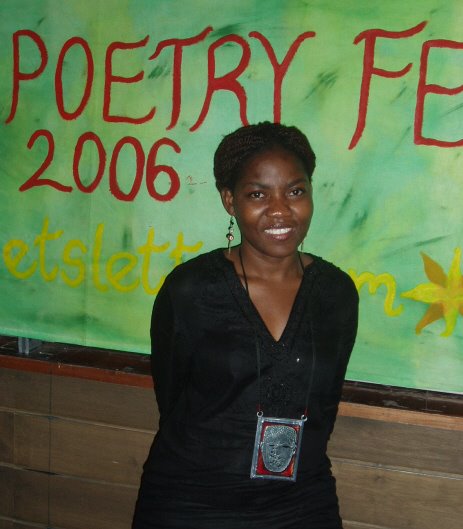
 It was with great sadness that I learned today, regrettably late, of the death of Dr. Roi Kwabena, poet, activist, editor and all round writer. I was on the same programme with Roi Kwabena at the London Poetry Festival, held at RADA, London, on 23 August 2006. He took the stage much later than me and gave an arresting performance, delivering uncompromising political poems that made listeners sit up with their backs straight. I wanted to talk to him as soon as the event was over, but the programme was still on and it was late and I eventually had to go. Kwabena later contacted by email, asking me to send a poem or story for inclusion in Dialogue, the journal he edited. We exchanged email correspondence off and on; and met perhaps for the last time on 16 May 2007 at the October Gallery. He had pictures taken of himself with several artists, including me (I was looking the worse for wear on the day in question). He was going to publish these in a future issue of Dialogue. He joked that he tended to put pictures of himself with writers in the journal, all with the same caption: "The editor with -"; "The editor with - "
 .
Roi Kwabena was born in Trinidad but he saw the black predicament as one. A true African.
.
This below, from a tribute by Andrea Enisuoh
Yes he was an artist: a poet, a musician, a storyteller etc but that never overshadowed what he really wanted out of life. ‘Art is a part of struggle,’ he told me, ‘It is our form of expression, a way of seeing our face in the mirror, whether it be visual art, music literature or any other form.’ Quite simply what he wanted was liberation for his people - physical, spiritual and economic liberation. Something he had been fighting for almost all his life. He was just 14 when he published his first poem, Why Black Power?
I remember asking him once what he thought formed his ideals – and kept him going, ‘I grew up in a very eventful period,’ he revealed, ‘I grew up during the Civil Rights Movement, a time of people being lynched and shot. I’ve lived in Sudan, Ethiopia and Egypt. I’ve met and worked with great ancestors such as Walter Rodney, Maurice Bishop and Eric Williams’. He reeled off other names too, like Betty Shabazz and Stokely Carmichael. I knew then that the spirit of art and activism coursed through his veins.
Born in Trinidad where he was immersed in political and cultural activity, Roi came to Britain in 1985. For a long time he based himself in Birmingham where between 2001-2002 he was the city’s appointed Poet Laureate. Though he still spoke fondly of the city and was always promoting their rich arts scene to those that were not aware, he continued to travel extensively and in the mid-nineties even returned to Trinidad to serve in its parliament.
As a performer he utilised a distinctive style of dialogue, drama and rhythm that enthralled people of all ages. He published numerous poems and spoken word CDs that covered a multitude of subjects. And as a mark of his commitment to the arts internationally he founded the magazine Dialogue that celebrated indigenous cultures around the world.
It was last year, at the opening of the International Slavery Museum in Liverpool that he was given the credit that many believe he deserved when he featured on a wall celebrating the world’s black achievers, past and present. It was a proud moment for him. I often teased him later that I was sitting in the presence of greatness.
Even in poor health Roi’s commitment to the arts shone through. At one stage just out of hospital for treatment for pneumonia and clearly still not well, he rushed to North London to host an evening with dub-poet Mutabaruka, it was something he had committed before falling ill and didn’t want to let anybody down. That was one of the last times I saw Roi, he looked thin and weak and I told him he should be resting. ‘I’ll rest later.’ was his reply.
.
May he now rest.








.jpg)


 Posts
Posts


