Writings of the general word's body

Showing posts with label Farafina. Show all posts

Tuesday, June 28, 2011

Farafina Trust Literary Evening, July 2nd

The Farafina Trust Literary Evening is upon us again. Only once a year, the 2011 edition will close the latest Farafina Trust Writing Workshop.

Details are now out for a literary evening the highlight of which is an interaction with Njabulo Ndebele (author of 'The Cry of Winnie Mandela').


Tash Aw, Faith Adiele and Binyavanga Wainaina and the initiator of the workshop, Chimamanda Ngozi Adichie, will also read.


A 'New Nigerian Writers' segment will feature Eghosa Imasuen and Jumoke Verissimo. This bit also includes, puzzlingly, Odia Ofeimun. Why a poet who published his seminal collection 'The Poet Lied' as far back as 1980 will be classed a 'new' writer, is beyond me, but there you have it.


Farafina Literary Evening


Grand Ballroom, Eko Hotel, Lagos


Saturday, July 2, 2011


Time: 3pm

Sunday, June 27, 2010

Pilgrimages

Press release from Farafina

Pilgrimages: Thirteen African Writers. Thirteen Cities. Thirteen Books

The Pilgrimages Project
Pilgrimages is a ground-breaking, pan-African project organised by The Chinua Achebe Center, Bard College, in partnership with Kachifo Limited in Nigeria, Kwani? Trust in Kenya, and Chimurenga in South Africa, in celebration of Africa’s first world cup.
The project involves 13 African writers visiting 12 cities across the continent and one in Brazil for two weeks during the World Cup. At the end of the project, each writer will produce a book of non-fiction travel literature based on their experiences, forming a series to be published next year.

The Writers
The writers and cities involved in the project are Funmi Iyanda (Durban), Alain Mabanckou (Lagos), Abdourahman A. Waberi (Salvador, Bahia), Akenji Ndumu (Abidjan), Doreen Baingana (Hargeisa), Chris Abani (Johannesburg), Uzodinma Iweala (Timbuktu), Billy Kahora (Luanda), Kojo Laing (Cape Town), Binyavanga Wainaina (Touba), Yvonne Owuor (Kinshasha), Victor Lavelle (Kampala), Nicole Turner (Nairobi) and Nimco Mahmud Hassan (Khartoum).

Alain Mabanckou in Lagos
Alain Mabanckou from Congo-Brazzaville is considered one of the most talented writers in Francophone African literature today. His most notable works are Verre Casse (Broken Glass), Bleu-Blanc-Rouge (Blue-White-Red) and The African Pyscho. His work, Memoirs of a Porcupine, won the Prix Renaudot, one of the highest distinctions in Francophone literature.
Alain visits Lagos from the 25th of June to 2nd of July 2010, during which time he will crisscross the city, from the ‘highbrow’ to the ‘slum’. Each day of his stay will alternate stops at football viewing centres, local bukkas and beer parlours, upmarket bars and relevant cultural events, and will include interviews with local denizens, artists, writers and other social commentators. Alain will be guided around the city by architect, writer and publisher, Ayodele Arigbabu, who will also blog about their daily experiences on the Pilgrimages website.

The Website
A dynamic and state-of-the art multimedia website has been launched as part of the Pilgrimages project. During the 13 Pilgrimages the writers and their local guides will blog on the website. Correspondents, artists and photographers in each city will also post topical content on the site.

The Books
The Pilgrimages Project will culminate in the launch of twelve books in four African cities in January 2012 during the African Nations’ Cup. The collection promises to be the most significant, single addition to the continent’s archive of literary knowledge since the African Writers’ Series of the 1960s. The books will be published by Kachifo Limited in Nigeria, Kwani? Trust in Kenya, Chimurenga in South Africa and a francophone publisher to be announced.

For more information on the Pilgrimages Project, please visit the website.

For more information on Pilgrimages and Alain Mabanckou in Lagos, please email info@kachifo.com
rayosword@gmail.com
or call
07084344856

Thursday, December 04, 2008

Farafina's Arts & Lit Eve


Farafina's afternoon of Photography (Adolphus Opara's exhibition), Film (MW's interview with Ben Okri) and Readings (Nnedi Okorafor; winner of the 2008 WS Prize; and Eghosa Imasuen - author of the debut novel, 'To Saint Patrick').
.
@Bambuddha Restaurant
1310 Karimu Kotun, Victoria Island, Lagos
.
On Saturday 13 Dececember 2008
@2pm

Sunday, May 25, 2008

Farafina on America


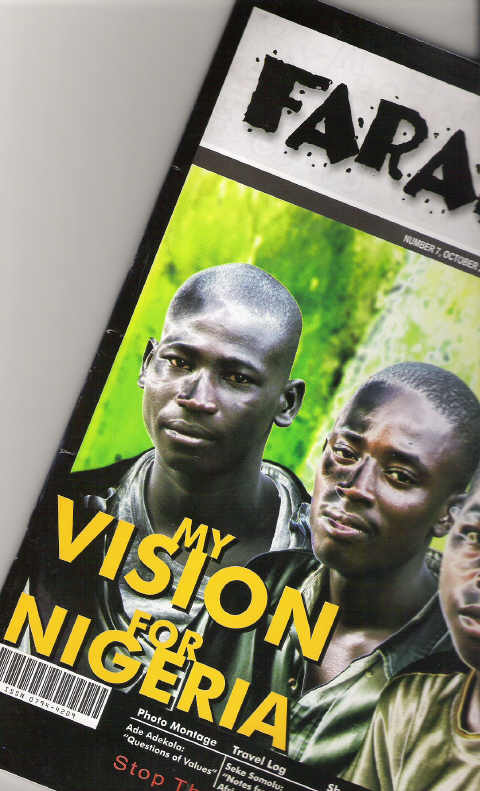
View the YouTube webvert for Farafina Volume 13, guest-edited by Adichie. I'm still reading through the edition, comprised mainly of essays by over 30 contributors on theme of [Africans looking at] America. My own thoughts may come later...

Meanwhile, here's an excerpt from Sunday May 11th edition of Toyin Akinosho's Artsville column (in The Guardian, Lagos)...
~
Farafina Hits The Mother Lode
The current issue of Farafina, the literary magazine,is enjoying a round of earnest conversation among the Lagos arthouse crowd. Everybody, it seems, has something to say about the edition, which is guest-edited by the novelist Chimamanda Adichie. Still, one of the more interesting takes on the publication comes from a cyberspace input by the architect Ayo Arigbabu, who contributes a “design sleuth” column in Guardian Life, the pull out in this newspaper. Arigbabu starts by recalling Adichie’s main motive for choosing America as theme for the edition.“She insists she wanted 'to create a messy montage ofsorts, inspired by those Nigerian Sunday Newspapers in which the answers of ordinary people to a question, often a ridiculous question are printed on a two page spread". But then, according to him “there were just too many essays, which got repetitive (and thus tiresome considering the theme: 'America' - of course everybody would write about the land of plenty that still manages to dash the tallest dreams) after a while”. In spite of that, Arigbabu says that the magazine “does come together though”. He then does some sort of review:, “Teju Cole's reparte with a cab driver in New York is my favourite. Karen King's piece falls flat but there are enough other interesting bits and pieces to make up for it...Like Ogaga Ifowodo's Shock Jock country. Biodun Jeyifo goes on and on...a whole essay to say America is the best place for African academics? I would have been more interested to read little anecdotes about him toasting some hispanic chic in between lectures... I mean, do you really go to America and spend all your time blowing grammar? The design is simplistic, (though I'm still attracted to the title design for Ndidi Nwuneli's 'A Common burden'...cool!) but works for readers who just want to get on with it and can't handle complex visual gymnastics, the content is robust with 29 contributors, Gado's cartoons were witty and mature and the magazine seems like it could have done with a few more interludes like his to break the monotony of all those 'centre spread essays'. Perhaps Miss Adichie should have asked the contributors to tell unusual stories about their experiences in / about America, if she had, instead of asking for 'essays', it might have turned out more of a lurid expose and less of a predictable scrap book...but then, that's exactly what she wanted...a'int it?” The magazine is on sale at Nu Metro Stores in Lagos.

  • Farafina 13's cover is actually blue, but by some magic it came out orange on this blog. Go figure!

New Read 2


Here's another new/ish read. Newly published in Farafina volume 13 guest-edited by Chimamanda Ngozi Adichie. A version of Victor Ehikhamenor's story, 'Passport to Heaven' is available online as earlier published by Eclectica.
~
Excerpt
"You greet everyone with a toothy, cauliflower smile. Even your shylock landlord gets a good greeting from you. Your co-tenants in the Face-Me-I-Face-You house know your expression has lightened. They are suspicious. Something is fishy. Christopher is a tight-ass-son-of-a-bitch who does not laugh. Christopher is a yam head who wears the Nigeria misery look of no-petrol or food on his face. Christopher is spokesperson of the downtrodden masses of the earth who curses the Obasanjo administration at any given time. "Maybe he has a new girlfriend," they whisper to each other. You keep smiling. You cannot risk telling them the source of your joy. Someone might come calling in the night with a machine gun, demanding your passport to heaven. You have to keep your secret like an un-hatched egg. Even Fatima, your off-today and on-tomorrow girlfriend, cannot hear this. You will tell her a day before your departure, or maybe not at all. Femi has sworn an oath of silence, and except for the mechanic and panel beater who will contribute to the ticket fund, no one else will know.
The days go by slowly. You call Pius, your friend in Washington, D.C., to tell him the good news. He will be your host till you find your feet in an unknown land. He is happy for you and at the same time cursing the consular officer in Kaduna for the extra burden added to his already debilitating American load. But he will not tell you that. You will see for yourself.
~
  • Farafina magazine is available by subscription for direct delivery all over the world for $79.99 for 6 issues a year. Email Farafina (subscriptions@farafinamagazine.com) for more information.

Monday, March 24, 2008

Farafina Now


.
Farafina Vol. 12, guest edited by Akin Adesokan, carries on its Letters page a note from the hilariously named Dingwo Normality. You read it and think: someone's having a laugh. Jim McConkey (who writes about Ayi Kwei Armah), Afam Akeh, and Omowunmi Segun (read her story, Homecoming) - are among the contributors. I am also in there, with my review of the film Bamako. As is Tade Ipadeola, who in the essay, Adedibully, casts a critical eye on Lamidi Adedibu, a man who gives a bad name to the term political godfather.
.

In the previous edition, guest edited by Petina Gappah (and with contributions from the likes of Darrel Bristow-Bovey, Chris Abani, Kuzhali Manickavel and Tinashe Mushakavanhu) and published before the ethnic violence unleashed after contested elections in Kenya - I spotted this quote, illustrated by a misbehaving monkey. A certain Mrs Njeri expresses concern about rampaging monkeys destroying crops and killing livestock. It wouldn't have seemed possible, but soon, human beings would behave worse than the monkeys...

Monday, September 03, 2007

Book Places on the net

Visit the stylish new website for the book, Celebrated - Nigerian Women in Development, written by Ayona Aguele-Trimnell (Toyin Sokefun Bello took the portraits in the book, published by Kachifo Ltd).

Kachifo also publishes Farafina. The magazine's website has been redesigned and is worth a visit. The last edition out, Farafina no 9, is now downloadable in pdf format.

The website for Abuja's chapter of the Association of Nigerian Authors has gone live. ANA Abuja's site was launched at the end of August, same time as the branch kick-started plans for creative writing workshops. There will also be a new prize for Hausa Literature, to be overseen by ANA Abuja. More details on the site, where you can read short stories, poems and other outputs of Abuja writers, led by the branch chairman, the poet Emman Usman Shehu

Monday, June 04, 2007

Farafina's Woman Issue

The current edition of Farafina Magazine (vol. 9) is the ‘Woman’ Issue, and marks a refreshing departure from recent outings, design wise. The cover is simply stunning.

Edited by Toni Kan, Farafina 9 boasts an army of women contributors including poet Nike Adesuyi (making a welcome Farafina debut); the late Lynn Chukura; Kaine Agary - author of ‘Yellow-Yellow’ (who co-wrote an interesting piece with Kan on the Ogogoro Women of Lagos’ 3rd Mainland Bridge. Kan’s review of Agary's book is also in this issue); talk show host Funmi Iyanda; and Chika Unigwe (now a regular contributor, her story Sugar in my Bowl is part of the short-fiction content); and there’s an excerpt from Marie Fatayi-Williams' book, For The Love of Anthony.

Conmpleting the trio of males who get a look-in in this 'Woman' issue, are writer/artist Victor Ehikhamenor who contributes a humorous photo-essay on a dancing female, Ariya Unlimited; and Tolu Ogunlesi, whose well appointed short story, Husbands Abroad Anonymous, completes the fiction.

But with other pieces including one on breaking the ‘glass ceiling’, etiquette (presumably for women) and a whole 5 pages devoted to light-and-frothy pictures of Nollywood starlet Dakore Egbuson - Farafina no. 9 strays dangerously into the realm of ‘lifestyle/pep-talk fare' beloved of women’s mags like Genevieve. What with Farafina being a 'Culture' journal and not Marie-Claire. But because it’s the ‘Woman’ issue, Farafina no.9 pulls it off. But only just.

Farafina’s Website is currently being redesigned, but it should up and running, soon.

Sunday, January 14, 2007

Have you read...?


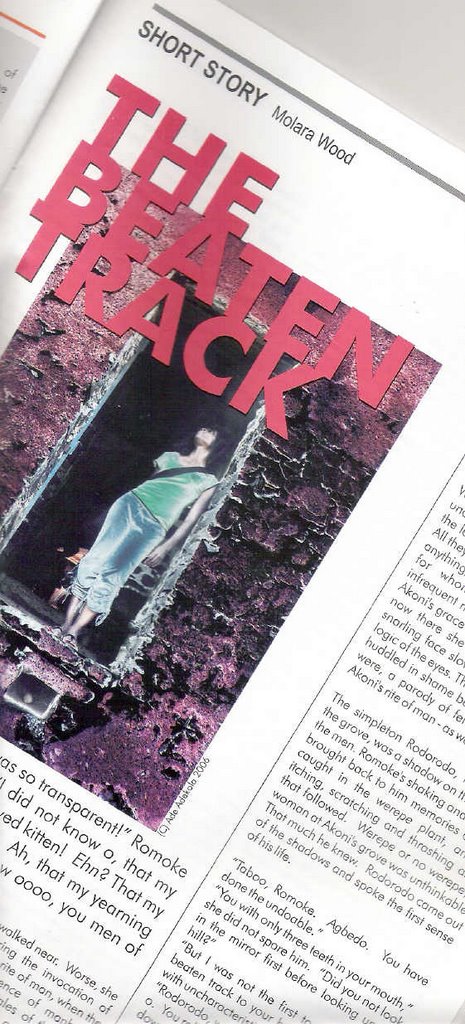
This is Farafina vol 7, guest edited by Okey Ndibe and with a pack of contributors including Ogaga Ifowodo, Patrice Nganang, Marcia Kure, Helon Habila and Patrick Wilmot. And there's myself in there too (with my story The Beaten Track).

Published in Lagos, Farafina (meaning 'Africa' in Bambara) is doing from West Africa what the journal Chimurenga ('liberation struggle'/'revolution' in Shona) does from South Africa - and which Wasafiri ('Cultural traveller' in Kiswahili) has been doing from London for over 20 years. And let's not forget Kwani? (meaning the equivalent of the Yoruba/Nigerian 'bawo ni?' - how is it?).

Interesting names, all - but must reads. Definitely.

Friday, November 24, 2006

Farafina

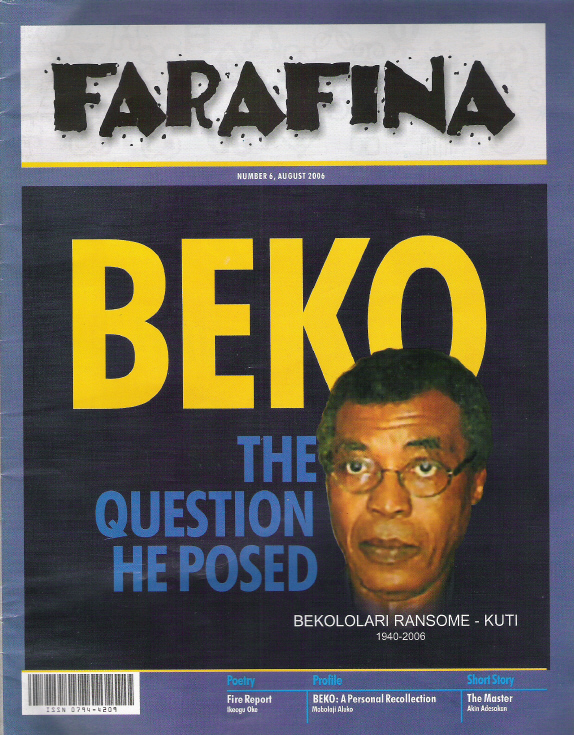
Here's an excerpt from The Master by Akin Adesokan, published in Farafina (edition no. 6, August 2006).

In The Master, Alfred, a Geography teacher, goes on a long journey, crossing the border from Nigeria to Cameroon - in search of an enigmatic, reclusive writer he worships, named Dankor. On the road, the narrator encounters this woman making a hell of a scene:

"Do you know who I am?"

"No, and I no wan know!"

"Na lie-o. You go know today. Not tomorrow or day after. Go ask anybody on Iweka Road, you pig-mouth! Talking to me like that? Are you crazy? In fat you're more than. Idiot!"

Her cartons and luggage had made it out of the women's stalls, but now a transport union official wanted to prevent her from unloading at the frontage. As she spoke, she handed out each porter's fee and dismissed them.

"Go anywhere and ask about Mama Success. That's me! I have been trading for this market before they born you in the village. Calabar, Bakassi, Malabo. Everywhere. Po. Do you know who built this shop, you goat in slave uniform? Where is Obasi?"

"I dey here-o, Mama," said a stocky man chesting up a bench.

"Who hire this monkey?"

"Nobody, Mama."

"Clear him out of here one time."


Sunday, September 24, 2006

Muhtar Bakare's ASAUK Paper

Panelists were asked to consider some of the key themes in the recent literature produced by migrant African writers such as leaving, journeying, and managing cultural difference. They also debated the broader context of Diasporic writing. To what extent has this new literature eclipsed or erased writing emanating from the African continent itself? Does the difficulty of publishing within Africa mean that we will only learn about contemporary African experiences as the Diaspora mediates them? What kind of connections are emerging, or might in the future emerge, between publishers in Africa and writers in the Diaspora?

I will start by providing an overview of our business and against that background, attempt to look at the challenges of publishing in Nigeria, from the perspective of an entrepreneur who takes up the task of making culturally useful and commercially viable books available to the reading public. I will draw largely from my own experience over the last two years, to comment on the specific questions posed to the panel.

Background – Starting Out
We started as a free online magazine, publishing prose and poetry by contemporary Nigerian writers. It proved to be a useful strategy. This was how we first made contact with Chimamanda Ngozi Adichie, Sefi Atta, Aniete Isong, Molara Wood, Akin Adesokan, Igoni Barret, Tolu Ogunlesi, Ike Oguine, Chika Unigwe, Toni Kan and many others. These writers were not only scattered all over Nigeria, but also all over Europe and America. Start-up costs were low and we had an immediate global reach. Which would prove useful later on, in commissioning new articles or titles, and in contracting out editorial work.


We established a presence among literary enthusiasts and started building up a reputation as a credible outlet for good quality contemporary Nigerian writing. It is interesting to note that as far back as 2004, we had published online, an earlier version of a short piece called Fide by Chimamanda Ngozi Adichie. Another version of Fide was published earlier on this year in The New Yorker. When her first Novel, Purple Hibiscus, was later released in the US, we built on our existing relationship, to persuade Harper Collins to sell the West African rights to us. We had an initial print-run of 13,000 in late 2004 and have since sold over 12,000 copies. A year later, we released our second book, Everything Thing Good Will Come by Sefi Atta, whom we also met on the Internet. Sefi recently won the first Wole Soyinka Prize for Literature in Africa. We printed 5,000 copies of Everything Good Will Come in late 2005 and have sold over 4,000. We are about to order an additional 5,000 copies of each novel.

Today, we are set to release six new titles before the end of the year. Two of them; Half Of A Yellow Sun by Chimamanda Ngozi Adichie and The Activist by Tanure Ojaide are works of fiction. I am particularly proud to say that for these two titles we negotiated the rights directly with the authors. The other four, which are non-fiction, are: The Architecture of Demas Nwoko by John Godwin and Gillian Hopwood; Celebrated: Nigerian Women In Development by Ayona Aguele-Trimnell; June 12: The Struggle For Power In Nigeria by Abraham Oshoko; and Social Studies For Nigerian Schools by Adisa Bakare, Ayisha Belgore and Eniola Harrison, in collaboration with the faculty and staff of The Corona Schools Trust Council.

In all, we plan to release about 50,000 books into the market this year. In 2007 we plan to do no less than 200,000 books depending on how the elections go.

Background - Historical Summary
Book publishing in Nigeria is a colonial legacy with which the legatees have not yet come to terms. Although the industry was established to serve colonial commercial and political interests, Nigerians quickly embraced it for their own benefit. There existed at that time and in immediate post-colonial Nigeria, an active and growing reading public. The educational system was good. The university system produced and nurtured world-class talents in the arts and sciences. It was not unusual for novels to sell in tens of thousands. Authors such as Chinua Achebe, T. M. Aluko, Ngugi Wa Thiong’o, Chukwuemeka Ike, Cyprian Ekwensi, Naiwu Osahon, Wole Soyinka and Kole Omotosho were household names. The highest circulation newspapers sold as many as half a million copies daily.


Things began to fall apart for the Nigerian publishing industry when the military first intervened in the political arena in the early sixties. They went on to destroy all social infrastructure. They mismanaged the economy and entrenched a culture of corruption. They added little to the infrastructure of commerce and allowed whatever existed hitherto to fall into disrepair. Of particular significance was their destruction of the educational system. This is would have wide-ranging consequences for a country where the language of the inchoate national culture, English, was not indigenous, but learnt in school.

The universities, being the centre of opposition to the military tyranny were especially targeted for decimation. The institutions were routinely shut down, with academic calendars disrupted. Outspoken academics were harassed and hounded into exile. The result has been a long and steady migration of some of the most brilliant teachers and academics from the country, as well as an erosion of literacy and literary culture.

The Literary Landscape Today
Today, forty-six years after independence from Britain, what remains of the industry is mainly licensed from British publishers and concentrate almost exclusively on the production of textbooks. A number of Nigerian independent publishers exist, but they also focus mainly on textbooks. About 90% of all the published books in Nigeria are for Primary and Secondary education. There are over 17 million children in primary and secondary schools at any point in time. No wonder everyone is trying to corner the textbook market.


It is generally accepted that there are about 130 million people in Nigeria. 42% of them or 55 million are below the age of fourteen. The national literacy level is put at about 68%; that is; 68% of the people over 15 years old, who can read and write, presumably in English. That is 68% of 75 million or 51 million people. This is a very attractive market size indeed.

Literacy And New Materials
Regardless of what statisticians say, employers of labour have for the last decade or so bemoaned the decline in the literacy of graduates from the various educational institutions. A cursory review of the leading quality newspapers in the country gives a good idea of how well the average Nigerian uses the English language today. This is a big deal for a publisher in a country where literacy in English easily dwarfs literacy in all the indigenous languages, and where publishing in the local languages remains, a small fragmented niche.

Since the military were forced out of power seven years ago, there has been some sort of rekindling of nation-building and cultural activities. Literature usually presages such development; as people try to articulate and codify the complex interplay of social and political forces transform society around them. We certainly do not lack for submission of new materials. Majority of the manuscripts we do receive however, even if not lacking in imagination in terms of conception, are seriously deficient in their use of English. The reality facing commissioning editors, is that a great deal of editorial input is required to get the overwhelming majority of manuscripts into any publishable condition. To compound this serious problem, good quality editorial talent is no longer readily available in the labour market.

It is not that highly literate writing and editorial talents do not exist, they do, but the structure of the economy is such that they can only be employed in those sectors of the economy, such as oil and gas, finance and lately, telecommunication, with the requisite levels of investment capital to pay the kind of wages they command. Since the mid-eighties, the publishing industry has not made the necessary investments in commercial infrastructure that is required to extract its fair share of the massive value inherent in a market of 130 million people. And so, we have some of the most talented writers and editors resident in our country today, working in oil and gas, finance and the telecommunication industries.

It is not an accident therefore that some of the most insightful and engaging pieces published by our magazine have been contributed by these amateur but accomplished writers who earn their living as lawyers, financial consultants, engineers, web designers, and doctors. And of course, we are also compelled to reach out to Nigerians living abroad, who through their access to more stable creative environments, enjoy the mediation of more mature publishing industries, to produce quality work that remain faithful in their attempts to tell our own stories, on our own terms.

I must point out here, that the themes of leaving, journeying, and managing cultural difference are marginal in the novels produced by writers such as Chimamanda Ngozi Adichie, Helon Habila, and Sefi Atta who still have very strong ties with Nigeria. These writers and some others, might have journeyed, they certainly have not left. They wrote and continue to write novels about Nigeria and Africa, which are firmly rooted in Nigeria and Africa. And although the work of writers of African descent who are more rooted in the West, such as Biyi Bandele, Diran Adebayo, the prodigiously talented Helen Oyeyemi and more recently, Diana Evans may explore the theme of cultural differences, nonetheless, I suspect that, for now anyway, they are here in the West to stay. Some of them were born here in the Diaspora, and are not particularly hung up on leaving (Africa) and journeying (to the West).

My interaction with a cross-section of contemporary African writers living in the West, suggests that they are slightly irritated by this constant attempt to pigeon-hole them and thereby tele-guide their work toward certain directions pre-determined by the all-powerful gatekeepers of the Western cultural establishment.

I will leave this matter for now, to the academics who are perhaps better qualified than I am to pontificate on them, and dwell a little on the difficulty of producing and selling books in Nigeria.

Production, Packaging and Commercial Infrastructure
The greatest impediments to the growth of a local publishing industry in Nigeria include


II
The low level of investments by existing publishers in their own businesses:

Even if they know what it takes to produce good quality books at affordable prices, or what it takes to persuade the 50 million or so literate Nigerians and their 10 million kinsmen scattered all over the world in the Diaspora to buy them, or what it takes to distribute these books efficiently throughout a country four times the size of Britain, while at the same time collecting all their sales proceeds, Nigerian publishers have not been successful in marshalling all the requisite resources together. The industry is obviously not well capitalized and even if competence exists, capacity is severely undermined.

II
The dearth of the required commercial infrastructure to support the industry.

Distribution and retail networks are limited, fragmented and as challenged as the publishing houses themselves in terms of scale, capacity and outlook. Also, commercial contracts are very loose and difficult to enforce. Collection of sales proceeds is very problematic, putting severe financial strain on publishing businesses.

III

The collapse of basic social services such as

  • Electricity supply
  • Good road network
  • Reliable postal services
  • Affordable telecommunications.
These make the cost of doing business prohibitive, discourage investments and lead to the easy option of sacrificing quality for cost.

All these issues are extensively and sensitively discussed in the book, The Ordeal of The African Writer by Charles R. Larson, which I strongly recommend to anybody who is interested in the subject.

With respect to the question posed at to;

What kind of connections are emerging, or might in the future emerge, between publishers in Africa and writers in the Diaspora?

I will like to say that all these financial and infrastructural challenges will continue to make the connections between publishers in Africa and writers in the Diaspora more emotional than financial. For as long as most Africans, either by choice or otherwise remain on the continent of Africa, the most business-minded of our writers in [the] Diaspora or their agents will eventually come to understand that no matter how successful African writers may be in the West, until the Western literary establishment stops categorizing them as ethnic or minority writers, their natural markets will remain in Africa. There are strong indications to suggest that, until they are embraced by the mainstream imprints, they may have strong prospects of selling more books in Africa, especially if they work with the right publishers who are, as we say in Nigerian politics, on the ground. They must also write on themes that are relevant to, and topical in, Africa.

For us publishers to continue to engage and maintain these relationships and also to nurture home-grown talents for the potentially larger and more lucrative media markets in the West, we will have to overhaul our business models, make the necessary investments and modernize, just as other sectors of the Nigerian economy are now doing and quite successfully too.

Mobile Phones, Nollywood and Banking
Data coming from the 5-year-old GSM phone industry may give an insight into the purchasing capacity of the Nigerian consumer. With an estimated 10 million subscribers, spending an average of 10 dollars every month, Nigerians spend about 100 million dollars every month in settlement of their mobile phone bills. Those of us in publishing are being compelled to ask ourselves, how come the average Nigerian is willing to spend about ten dollars every month on phone bills and yet not willing or able to spend a comparable amount on books? The Home Video industry is even more comparable to publishing. However, despite the fact that it is barely 13 years old, and totally homegrown, it is already reputed to be the third largest film industry in the world. The industry sells units of its products in millions, all over the world, wherever there are African people. A conservative estimate puts the annual income generated by this industry at over $250 million. The commercial success of this industry suggests that there may be a disconnect between contemporary Nigerian literature and its natural markets. In the words of award-winning novelist Sefi Atta Nigerians will buy novels in their hundreds of thousands if they see their own stories or aspirations in those novels. Ntone Ejabe who edits the very cool and admirable literary magazine Chimurenga, out of Cape Town, sums it up thus: The most authentic Nigerian stories are best read on video.


It is commonly argued these days that Nigerian videos are so successful because they tell our stories, unapologetically, on our own terms. And those stories resonate deeply with the millions of black people all over the world who watch them every day. This for me, answers succinctly the following questions put before this panel:

To what extent has this new literature eclipsed or erased writing emanating from the African continent itself? Does the difficulty of publishing within Africa mean that we will only learn about contemporary African experiences as the Diaspora mediates them?

Speaking from a Nigerian perspective, I do not think there is any chance of any literature produced outside Africa eclipsing those produced inside Africa. What is important in my view is how relevant the contents of the works are to the target audience and the capacity of the publisher to push the product in the target markets. The current popularity of the so-called contemporary Nigerian Diaspora writing is due mainly to the relevance of those novels to the Nigerian situation and also to the very focused marketing activities of their Nigerian publishers. After all, there are many very successful African writers who are celebrities in the West but are barely known or read outside the literary circles in their home countries.

How the West chooses to learn about contemporary Africa is the prerogative of the cultural gatekeepers in the West. I will concede though, that those of us publishing in Africa can certainly do more to push the best of our wares out here in the West. And this will be easier to accomplish, once we have made the necessary investments and the appropriate structural changes to our businesses.

In conclusion, in terms of sheer ambition, chutzpah and achievement, the Nigerian industry that its publishers have the most to learn from is banking. When Nigerians first entered that industry 16 years ago, foreign banks and the local remnants of colonial banking interests dominated. (Very much like in publishing today) Within 16 years, Nigerian entities have invested about 5 billion dollars in the industry, which they now dominate, pushing the banks with foreign interests to the margins. They have grown beyond the shores of Nigeria, through West Africa and are even looking beyond. They did these by investing the necessary capital, buying the requisite technology, hiring qualified, talented business expertise and adopting business models that have been proven elsewhere, while remaining sensitive to Nigerian peculiarities.

These steps taken by the nascent investors in the Nigerian banking industry 16 years ago are my same recommendations to our publishers today, to see us to an equally glorious future. Thankfully we never really have to re-invent the wheel.
  • Muhtar Bakare of Farafina, Kachifo Limited, Lagos Nigeria, presented this paper at the African Studies Association UK Biennial Conference 2006, held at The School Of Oriental and African Studies, University Of London, on September 12, 2006.