Writings of the general word's body

Showing posts with label African Literature. Show all posts

Friday, September 16, 2011

Achebe floors 50 Cent

The literary world has been abuzz over news that novelist Chinua Achebe forced rapper 50 Cent to change the title of his new movie, Things Fall Apart – because it’s the same as that of Achebe’s celebrated novel.

On the inside, Nigerian writers argued over what many suspected to be a hoax. After all, you cannot copyright a title, or can you? Plenty of songs, short stories, books and yes films – with same title and unrelated content. E.C Osondu has a short story called Waiting, so does Chika Unigwe. There are at least 2 films called Relentless etc.

The story gained more credence, for me at least, when the Guardian (UK) reported it, informing that Fiddy offered Achebe one million dollars to hold on to the title, but the author took it as an insult. Achebe’s legal team retorted, "The novel with the said title was initially produced in 1958 (that is 17 years before [50] was born)... [It is] listed as the most-read book in modern African literature, and won't be sold for even £1bn." But as a commenter under the Guardian story observed, novelist Muriel Spark and Lawrence of Arabia actor Peter O’Toole both have books titled Loitering With Intent.

Was 50 Cent right to have capitulated by offering $1m in the first place, since we don’t know whether or not Achebe copyrighted his book’s title? If he did, it would have been a highly unusual move to pull off. Highly unusual to have scuppered 50 Cent in this way, although admittedly Things Fall Apart has a highly unusual reputation as a work of literature. Achebe himself got the title of his novel from a poem by W.B Yeats, The Second Coming, so how can he lay sole claim to it?

Of particular concern to writers, I suspect, is what this dangerous precedent portends for creative works, especially writing, from now on. Someone has just published a novel the title of which is strikingly similar to my planned collection of short stories; will I have to change my title? I hope not.


Whatever one makes of 50 Cent’s declaration that he’d never heard of Achebe’s book, particularly troubling is the fact that many of the rapper’s fans – even some of Nigerian descent – were not aware of Achebe’s existence until he clashed with 50 Cent. A bizarre situation that has a gangster rapper ‘validating’ one of the world’s greatest novelists. Still, the rapper is to be commended for writing a whole movie himself, a story about an American football player diagnosed with cancer, directed by Mario Van Peebles. Because of Achebe’s objection, the film has been renamed All Things Fall Apart, reports say.

Now, I hinted that I believed the story because the Guardian published it – a stance that comes with its own problematic, since the UK Guardian can be hoaxed. The paper did a further piece on the ‘title fight’ yesterday, crediting a Nigerian news website for breaking the story. This had the curious effect of leading some to hold on to the hoax theory – it’s a Nigerian website after all. Another problematic, since a story broken in the Nigerian media is not by definition a 419 scam.

The news did not strike me as a hoax; the Guardian has unimpeachable contacts with Achebe’s representatives, agents and so on, I’m sure, to verify its story. As for the Nigerian media, lots of people have direct links to the novelist’s inner circle. Besides, if a hoax, who stood to gain from it? Certainly not 50 Cent; extra publicity for his film is hardly worth the dent on his ego. And Achebe needs the column inches like he needs a million dollars.

There are reasons why Fiddy’s people would want to remain silent on the embarrassment. The unease among the literati also means that, demonstration of his might aside, Achebe does not come out smelling of roses either. “Hawkish” is how one observer described the novelist’s action over a title he would not have been able to use had Yeats taken a different view – a title he raised no objection to The Roots using for an album years back.

Meanwhile, further confirmation of the veracity of the story: Hip-Hop bible VIBE magazine has reported it, (referencing a Ghanaian website). And the Hollywood Reporter reports from the Toronto Film Festival that Image Entertainment has picked up US rights to 50 Cent’s movie. The title? All Things Fall Apart.

Tuesday, July 19, 2011

Soyinka Child of the Forest


Akin Omotoso's 2008 documentary film, Soyinka, Child of the Forest, once shown on DSTV as part of the Great Africans Series, is showing at The Life House, Lagos, this Thursday.

I'm actually in this film... Details of Thursday's screening, below.

EVENT- Screening of The Great African Series - Wole Soyinka
DATE - 21 July 2011 Thursday
TIME- 7.30pm
VENUE - The Life House, 33 Sinari Daranijo Street, off Ligali Ayorinde Street, Victoria Island, Lagos.

A film is shown at The Life House every Thursday evening as part of their Reel Life programme, often in collaboration with the Alliance Francaise.

Saturday, December 18, 2010

Nwaubani, Ngugi and the Nobel

The literary event of the last week has to be not so much the op-ed piece written by Adaobi Tricia Nwaubani for the New York Times, but the reactions to it, of which there are many, the tones of which have been of the almost universally aghast kind.

My own reading of
Nwaubani’s ‘In Africa, the Laureate’s Curse’ was predictably complicated. I am a great admirer of Mario Vargas Llosa (a worthy 2010 laureate) and many other Latin American writers, people in whose works I’ve found a world closest to that of the Yoruba, from among whom I’ve sprung.

That said, I wanted Ngugi to win the Nobel, it meant a lot to me. He has written great, visionary works. He’s an ideological writer, and without ideological grounding, a writer is just piffle, in my view. He has also demonstrated great courage over many decades and suffered terribly for his art and convictions. Ngugi’s ‘Decolonizing the Mind’ is one of the great theoretical works of African literature, or any literature for that matter. After reading it, you cannot be indifferent; you must take a stand, either you are for or against. I have always had great sympathy for Ngugi’s insistence that we should write in our mother tongues, controversial though the larger body of African writers say it is. And one cannot take from Ngugi the fact that he has put his writing post-1986 where his mouth is: writing first in Gikuyu then translating into English (he’s written his latest memoirs in English, but that is a matter for another day).

Ngugi has produced indestructible works in many genres: drama, novel, essay. ‘The Trial of Dedan Kimathi’ was a memorable playtext in my secondary school days. And what of ‘Weep Not Child’, which apart from introducing Njoroge and co, made me want to discover Walt Whitman’s ‘On The Beach At Night’ for myself? These are among the foundational works of my formative years. We used to chant the titles of Ngugi’s books as though they were mantras. I once thought that if I ever saw Ngugi, it would be like seeing man on the face of the moon. Great, almost mythical writer, who one later had the privilege of seeing in the flesh; and to see the radical writer so human, so aged, almost frail (from the detentions and cigarette torture burns). A beautiful mind surpasses the limitations of the physical body.

And to later discover 'A Grain of Wheat', ‘Petals of Blood’, ‘The River Between’ and of course, ‘Decolonizing The Mind’. Had Ms Nwaubani read enough Ngugi, she would never have written the following: ‘There’s actually reason to celebrate Mr. Ngugi’s loss.” There’s nothing to celebrate about Ngugi missing out on the Nobel, and it’s difficult to see how the prize going to someone else becomes a “loss” for Ngugi.

Furthemore, it’s baffling that, nearly 25 years after Nigeria bagged her own Nobel through Soyinka, a Nigerian writer saw nothing wrong in suggesting that a Kenyan should not get the prize. Ngugi, Soyinka and Achebe have since the 60s formed the great tripod of the humanising literature of Black Africa. Soyinka has his Nobel, Man International Booker winner Achebe has been celebrated to the heavens for ‘Things Fall Apart’, and suddenly it’s a Nobel for Ngugi that will spell the death of African writing?

Nwaubani’s argument is deeply flawed; and it is regrettable that someone with a platform like the New York Times to postulate about Africa, chose to use her new-found international voice in this manner. The author of ‘I Do Not Come To You By Chance’ must realise that it will not be by chance that her argument will play into Western prejudices about Africa and African writing. ‘Oh, let’s not give another African a Nobel because, knowing no better, they’ll only copy themselves.’ Might as well go the whole hog and cite Shakespeare’s Iago: “These Moors are changeable in their wills."

Arguing for the emergence of new styles of writing, Nwaubani lumps Achebe, Soyinka and Ngugi into a questionable sameness, purveyors of what she calls “an earnest and sober style”. But what is so “sober” about Soyinka’s plays, or his prison memoirs, ‘The Man Died’? Or indeed Achebe’s ‘A Man of the People’? Have the likes of Helon Habila, Chimamanda Adichie, Sefi Atta, Lola Shoneyin and Uzodimma Iweala come to prominence simply because they ‘copied’ Achebe and Soyinka? And which of these two has Nwaubani herself copied? Of the supposed sobriety of the triumvirate, Kinna says on the blog,
“Soyinka is far from sober. And what of Ngugi’s ‘Wizard of the Crow’, which successfully mixes humour, satire and fantasy and is, in my opinion, one of the most entertaining books by an African author. Is sober the new word for old?”

The part of Nwaubani’s argument that has provoked the most consternation, is the suggestion that literature in the indigenous languages serve only to exacerbate “tribal differences”. She declares, “This is not the kind of variety we need.” Chielozona Eze issued an early rebuttal to Nwaubani’s “cowardly ideas, the core of which sought to suggest that it is separatist for a writer to write in his native language or even to claim that he is a writer from his ethnic group.” As for Carmen McCain, a Hausa literature enthusiast, writing in indigenous languages “is exactly the variety we need.”

My own imaginative universe has been formed to a significant extent by the works of D.O Fagunwa, which I devoured as a child and still marvel to read today, novels that form the bedrock of Yoruba literature, books which might not have had the same power written in English. And what of Dostoyevsky, Tolstoy and others, whose immortal works were not originally written in a Western European language? What of ‘One Hundred Years of Solitude’, ‘Love in the Time of Cholera’ and other works by Gabriel Garcia Marquez? Their initial publication in Spanish has done nothing to prevent them being read the world over through translation.

I suspect Adaobi Tricia Nwaubani could not have intended to be understood as saying a writer should not identify with an ethnic group. The bio on the UK edition of ‘I Do Not Come To You By Chance’ informs that the author “grew up in the eastern part of Nigeria, among the Igbo speaking people” – a construction that reads more like an ethnography citation from 70 years ago, but which nonetheless serves the purpose. But if Ngugi must be denied just so we don’t write Igbo, Hausa or Yoruba literature, it’s fairly standard that Nwaubani’s New York Times piece is a hard sell.

*

Thursday, April 01, 2010

Odia's Award

Scholar Tejumola Laniyan (right) presents the 2010 Fonlon-Nichols Award to poet Odia Ofeimun earlier today in Lagos.

Ofeimun had been due to receive the award last month during the 36th ALA annual conference at the University of Arizona, Tucson, but was unable to fly to the United States. He however graced major celebrations in honour of his 60th birthday, organised by the Centre for Black and African Arts and Civilisation in conjunction with the Odia Ofeimun Committee of Friends. The events included the Mamdani Lecture, held at the Nigerian Institute of International Affairs in Lagos on March 16.

Laniyan, a newly elected executive member of ALA (which gives out the annual award) was representing the Association. Also at today's presentation was journalist Kunle Ajibade, head of the Odia Committee of Friends.
  • Photo by MW

Monday, May 26, 2008

Word From Africa - 31 May


News Release
Africa Beyond presents
Word from Africa
A celebration of African literature and languages
In collaboration with SABLE LitMag
Saturday, 31 May 2008, 13.00-20.15
British Museum, London
Free admission

Word from Africa is a celebration of African literature, music - and most of all language. Taking its lead from the successful 2007 event, Word from Africa will bring to London audiences diverse talent in the literary and musical fields from across the African continent, including Nigeria, Kenya, Ghana, Somalia, Sudan, French Cameroons, Madagascar, Zimbabwe, South Africa and The Gambia.

Presented by Africa Beyond, in collaboration with SABLE LitMag and with support from the British Museum and Arts Council England, London, the free one-day event will take place at the British Museum in central London on 31 May, from 13.00 till 20.15.

The idea behind Word from Africa arose from the immense literary talent and number of languages found on the African continent. Africa is home to up to 2,000 languages, many of them also spoken in homes and neighbourhoods across London. Each one of these languages is a door into a different world. Each language unlocks its own state of mind – its own music, literature, rhythms, history, sayings and stories. Yet you don't need to speak any of these languages to enjoy Word from Africa – everything takes place either in English, or with English translations or commentary.

Throughout the day, there is a chance to see performances with leading African writers - such as Karen King-Aribisala (Guyana/Nigeria), the Commonwealth Book Prize Winner for the Africa region for The Hangman's Game (2008), Sade Adeniran (Nigeria), the Commonwealth First Book Prize Winner for the Africa region (2008) and Molara Wood (Nigeria), the winner of the inaugural John La Rose short story competition for 'Written in Stone' (2008) - as well as musicians, poets, storytellers, translators and thinkers. There will also be a reading and discussion on Sozaboy by Ken Saro-Wiwa, with Ben Amunwa (Nigeria), Biram Mboob (The Gambia) and Uchenna Izundu (Nigeria).

Word from Africa will incorporate the launch of a new book, Dreams, Miracles and Jazz - New Adventures in African Fiction, published by Picador Africa in the spring. Edited by award-winning Nigerian novelist Helon Habila and literary activist and SABLE LitMag publisher Kadija Sesay, it is the most contemporary anthology of new African voices this decade. Readings from the book will include two of the contributors visiting from Africa especially for the launch, Tony Adam Mochama (Kenya) and Mamle Kabu (Ghana), touted as two hot new African writers to watch out for.

A creative writing workshop will be held in the Sainsbury African Galleries, and there will be a rare opportunity to get inside knowledge and advice from two of Britain's top people in the business of publishing African writers, Ellah Allfrey, senior editor at Jonathan Cape, and David Godwin, of David Godwin Associates.

The day will also feature discussions (on literary and language), storytelling in Twi (Ghanaian), Ndebele (Zimbabwean), Arabic (Sudanese), French and English, as well as poetry readings. An African market place, in the Clore Center, BP Foyer of the British Museum, will include stalls selling books, artifacts and textiles, and there will be an African arts and crafts workshop in the Great Court, suitable for all ages.


The event will close with an acoustic live music set from sublime guitarist and singer Modeste Hugues from Madagascar. His music, a 'hypnotic carpet of sound', is unique to the Betroka region of Madagascar and is influenced by the traditional sounds of the area as well as some softer South African dance rhythms. Modeste plays the acoustic guitar, but his style has been very much influenced by the rhythms and sounds of traditional Malagasy stringed instruments.

Word from Africa promises to be an exciting and inspiring day, not to be missed. So see you at Word from Africa – or should we say Lizwi La Africa (Tonga), or Amazwi aveli Africa (Zulu), or Jambo Kutoka Afrika (Swahili), or Magana a kasan Africa (Hausa), or Eray Kaagia Yimid Afrika (Somali)!

Thursday, July 05, 2007

Enter the Titans

You've never had it so good, all you lovers of African writing. What were the chances of 2 heavyweight websites serving up addictive doses of African literature being launched round about the same time? Well, it's happened. Wide-ranging, seriously ambitious and already amazingly vibrant. Welcome 'African Writing' & PONAL....
African Writing - incorporating a website as well as a print edition (going monthly in print from September). There is already so much to read on this website - new short ficiton from Helon Habila, lots of poets, cartoons, literary news and more.
Behind 'African Writing' is the publisher/editor team of Chuma Nwokolo Jr & Afam Akeh.
~
Here's what Nwokolo Jr had to say about the publication: "African Writing is a literary paper, which also has an online presence. It is the first open sales publication of its kind with an All-African perspective, offering new writing from, and information on, the literatures of the continent. African Writing is interested in the literary lives, literary work and thoughts of those who make writing happen in the African world... We will reflect the faces, controversies and peculiar flavour of the African writing world, a world increasingly inclusive in the processing of its familiarisation with other world writings and writers.

PONAL - The brainchild of Pius Adesanmi and Amatoritsero Ede, PONAL (Project On New African Literatures), this features photo galleries of literary events, writing news, resources and information on conferences, audio of authors reading their works; while also highlighting the more 'obscure' gems by under-appreciated African writers. And that's not all. There's a Gboungboun ('Loudspeaker' in English) Magazine, edited by Ede.
~
Here's a bit about what PONAL has in store: "We present exciting new and emergent African literatures, especially those trapped within the ideological, political, economic, and institutional contexts of the Postcolony, and excluded by the canonising mechanisms of the metropolitan academy... we will disseminate, archive, and comment on the works of well-known, emergent and relatively unknown but equally engaging writers of the third generation from the entire continent."

Sunday, September 17, 2006

Salih on the Sudan


I'm sorry, I don't feel able to blog the usual stuff today. I've been thinking about Darfur in Southern Sudan.

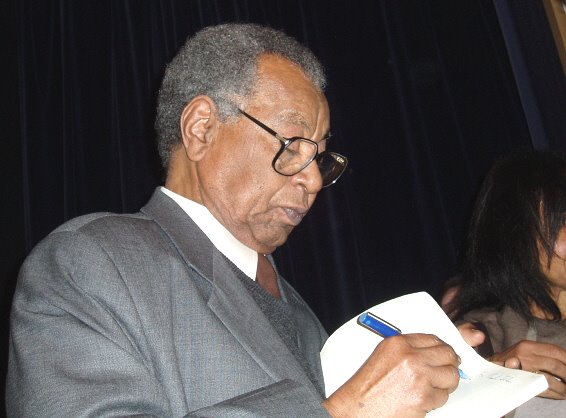
I'm reminded of Tayeb Salih, Sudanese writer of Season of Migration to the North - the book considered to be the most important Arab novel of the 20th Century. I photographed him (above) During African Visions at the British Library last October. My article on the Salih event was published in The Guardian, Lagos, on Sunday 9th April 2006. He had some things to say about the Sudan. The piece is reproduced below...


Recalling Tayeb Salih at African Visions
By Molara Wood

The 5th African Visions Literature tour, organised by the Africa Centre in London, took place at the British Library over a weekend late last year. With diverse writers from across Africa taking part in various events, timetable clashes were inevitable. And for an hour on the afternoon of the second day, one could either hear Malawian poet Jack Mapanje reading from his collection, The Last of the Sweet Bananas - or catch a discussion with Sudanese writer, Tayeb Salih.

The Salih event was a rare opportunity during African Visions to hear a writer that straddles the divide between Africa and the Arab world. And with the situation in Dafur, Salih, an Arab from Northern Sudan, would come with a particular perspective. Any disappointment at missing Jack Mapanje was soon forgotten by members of the audience as they fell under Tayeb Salih’s considerable gift of the gab. Salih would often speak on and on in mesmerising tones only to then stop and ask: "What was the question?"

Born in 1929, Salih is the author of Season of Migration to the North, the book selected by a panel of Arab writers and critics in 2001 as the most important Arab novel of the 20th Century. In an event tagged in Arabic as ‘Hiwar Ma’a Al-Tayyib Salih’, the author was in conversation with Dr Ahmed Al-Shahi, a social anthropologist and author who specialises in Sudan and the Middle East.

Introducing Salih, Al-Shahi observed that: "Some people say, is he Sudanese, an Arab or an African; he is very international… We can all be grateful to Salih for enabling us to know how it feels to be Sudanese." He added that in Salih’s books "we are told that life in the rural area is graceful and beautiful."

Tayeb Salih discussed what he called the "mosaic of the Sudan", asserting that: "The Nubian civilisation was not an echo of the Arab civilisation; it was a civilisation in itself. Then the Arabs came, [then] the English, the Ottoman and God knows what. Sudan is really a mound of civilisation and I approach it like an archaeologist… layers of civilisation. I am very grateful to have been born in this area."

"The favourite colour of the Northern Sudanese is not white or brown - it is black. Akhbar is black. Later in America they said: ‘black is beautiful’. With us, beauty is in being black. Sudan was Christian for centuries. Then Islam came - it was not imposed [but spread] over time through inter-marriage. They have never thought that religion is something to fight about." Salih argued that the Sudan was "a harmonious society - no exaggeration. Anyone who lived there in the 40s, 50s, and 60s will agree. Sudanese Jews - we didn’t know they were Jew until they emigrated to Israel - we’d always thought they were Sudanese!"

"I was re-reading Achebe recently. I was amazed at how much of the rituals had crept to the Sudan. The Sudanese get the essence - the African essence. What is Africa anyway? We tend to oversimplify; the oversimplification comes because of political conflict." Chinua Achebe had been instrumental in getting Salih’s work published in the African Writers Series, and the Sudanese spoke of his friendship with his Nigerian counterpart. "There is a great fondness between my humble self and Achebe," he disclosed. "It’s the same world in my work and Achebe’s. Of course there are differences, but deep down, it’s the same society."

Salih returned to the Arab/African question. "People these days fuss too much about whether one is Arab or African. The Northern Sudanese have solved this problem; to them, one is either blue or green." The Arabic language, he pointed out, has a wonderful approach to the racial issue when it comes to its treatment of colour in people. "The words ‘black’ and ‘white’ do not exist in Arabic… people are red, blue or green, which is a very good way of solving the issue. We don’t conform to the stereotype of the Arab. [When you read the] history of Arabs in the Peninsula, they were not white or black; they were blue and green. I hope the day will come when people will move away from stereotypes."

However, having declared that: "I don’t believe in Arab superiority," Tayeb Salih was somewhat controversial in his view of the conflict in the Sudan. "Our brothers in the South wanted to make a case that they were oppressed but [they were] not oppressed in the way they describe. Then they went on to say that the Northern Sudanese is intrinsically racist, which is not true." He added that: "We are Africans because we are in Africa - we also have Arab blood. We look African, for God’s sake." A member of the audience probed further about Southern Sudan. "The word is racism, really," the author cut in. "You are trying to say the Arab in the Sudan are racist. I don’t believe so. If you believe that, then you are very mistaken, my friend."

Asked how he got his first break with the BBC by a lady in the audience who complimented his voice, Salih replied: "I am very flattered that you liked my voice." He had been working as a teacher in Rufah when he saw a BBC advert for an announcer and, having had problems getting higher education, he "felt London could help, I got a letter and so here I am." He continues to write in Arabic because "English is not my language. In Arabic, I can take risks, so why bother, when there are good translators?"

Growing up in his home country under British rule, "we didn’t know the British were our masters - can you believe it? - because they were so rare, we only saw one in a blue moon." The author said he would have liked to go back and live in the Sudan, but "we know that something unattractive has occurred. With due respect to the [Sudanese] Ambassador (in the audience), I don’t want to say anything nasty, but something horrible was done."

Nevertheless, Salih remains very proud of being Sudanese. "It is a matter of principle to me - what some would call a question of identity. I have lived [in Britain] for a long time, married here and I have never asked for British citizenship - and I hope the British don’t feel insulted. But it is really a stupid thing on my part because the Sudanese passport has become very difficult, with all due respect to the Ambassador - it’s not his fault! The Sudanese passport - it changes colour - sometimes it is blue and yellow."

Tayeb Salih then went on to share a traveller’s experience that would ring true to most Africans - Nigerians especially - who travel through Western airports. "The worst is when you try to enter America. They do horrible things to you. They make you go naked into paradise!"

Sunday, September 03, 2006

Endnotes...

“Do you remember? How quickly the memories are slipping away. What do you want? To chant? Or just call out? To whom? For what? There’s a voice speaking inside of you. Do you hear? Do you see? But where? There’s nothing. Nothing. Darkness and more darkness. A gentle motion’s pushing with the regularity of the ticking of a clock. The heart is flowing with it. There’s a whisper accompanying it. The gate of the garden. Isn’t that so? It’s moving in a fluid, rippling way and slowly dissolving. The towering tree is dancing gently. The sky… the sky? High, expansive… nothing but the calm, smiling sky with peace raining from it.”

Palace Walk, Vol 1 in The Cairo Trilogy (Black Swan edition, 1995).

Naguib Mahfouz (1911-2006)

  • BBC Radio 4 will broadcast a reading of Naguib Mahfouz's Cairo Trilogy in the Classic Serial programme slot, starting on 15th October 2006.

Monday, August 21, 2006

Literary Wizard

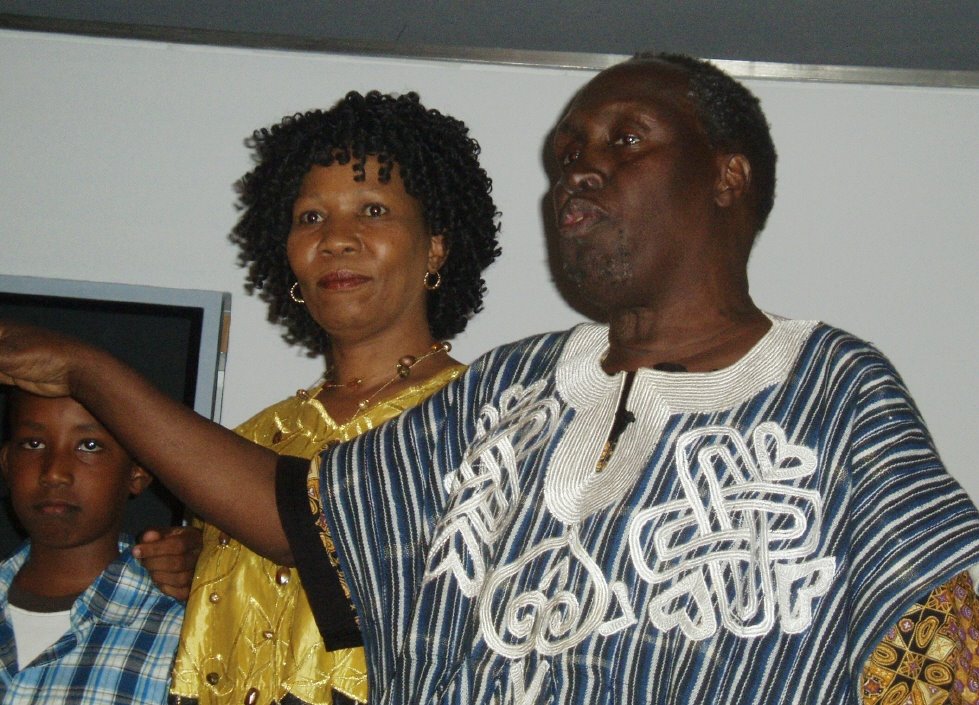
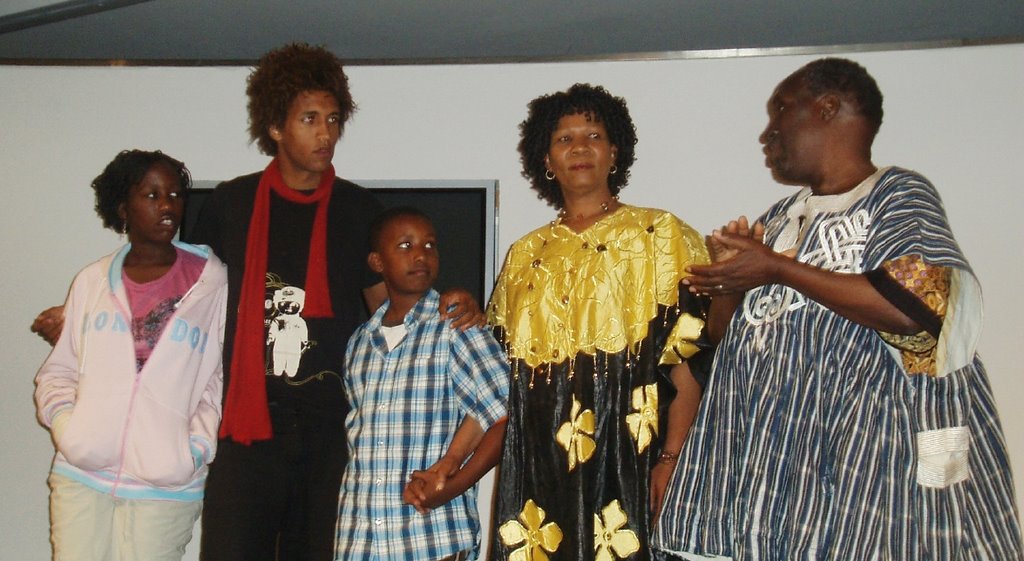
Ngugi wa Thiong'o at the book reading of Wizard of the Crow on 10th August. The author considers England his second home, and was once a resident of Islington, North London. Here he is with his wife Njeeri, a day before the 2nd anniversary of the attack they suffered on return to Kenya. The author's young son, Thiong'o (who got to say a few words on the night, thanking the audience in an American accent for coming to honour his father) is next to Njeeri. Ngugi seemed to want to make the event a celebration of life and survival, bringing his family along to the event. Lucky for the audience, they got five Thiong'os for the price of one. Ngugi explained that his younger children had only been spared the attack because, as luck would have it, they had chosen to go and spend the night with a relative.

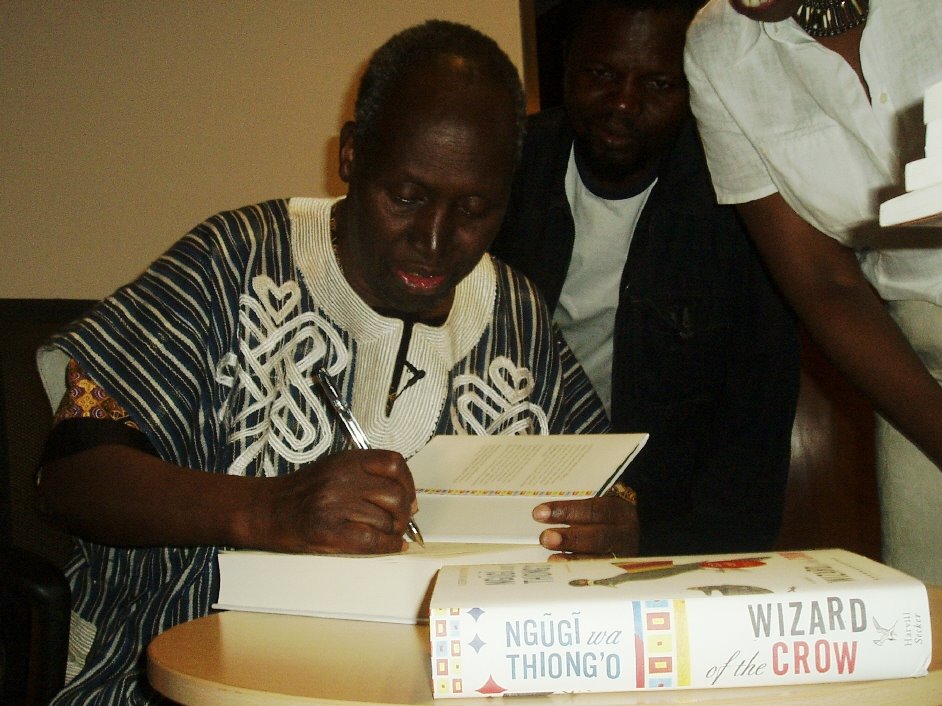
Ngugi autographs a copy of Wizard of the Crow for a reader lucky to be the first in line, a neverending queue for autographs at Congress Hall.


Thanking the blog reader who sent me the link to this piece on Ngugi...

"Moi used to say, 'I can forgive anybody but Ngugi'," says the 68-year-old novelist today at his home in Irvine, where he is a professor of English at the University of California. At just over five feet tall, with a ready giggle, he is hardly the portrait of a steely revolutionary. When Moi agreed to abide by term limits, and his hand-picked successor lost in the presidential elections, Wa Thiong'o realised that he had a chance to come home. It was good timing. Wa Thiong'o had just completed a six-volume satirical novel called Murogi wa Kagogo, a ribald satire of a fictional African dictator. It was also the longest novel ever written in his native Gikuyu language.
-read the article.


  • Images: taken @ Congress Centre, London, 10 August 2006; by MW