Writings of the general word's body

Showing posts with label Literary Life. Show all posts

Monday, June 02, 2008

A prick named Willie


'Rhyme and punishment' - is what The Observer calls it, as Derek Walcott gives VS Naipaul a taste of his own medicine in verse. Before reading out his brand new poem, 'The Mongoose' at the Calabash Literary Festival in Jamaica, Walcott is reported to have told the audience, "I think you'll recognise Mr Naipaul... I'm going to be nasty." I wonder what 'Sir Vidia' would have thought of being called 'Mr'. From what Walcott has to say, it appears 'Mr' is the least of Naipaul's concerns, for Sir Vidia is indeed the 'Mongoose' of the poem.

The joy of supplements, his minstrel act
Delighting editors endorsing facts
Over fiction, tearing colleagues and betters
To pieces in the name of English letters
The feathers fly, the snow comes drifting down
The mongoose keeps its class act as a clown
It can do cartwheels of exaggeration
Mostly it snivels, proud of being Asian
Of being attached to nothing, race or nation
It would be just as if a corpse took pride in its decay
After its gift had died and off the page its biles exude the stench
of envy, "la pourriture" in French
cursed its first breath for being Trinidadian
then wrote the same piece for the
English Guardian
Once he liked humans, how long ago this was
The mongoose wrote "A House for Mr Biswas"

For good measure, the poem also says of its subject:
"He doesn't like black men but he loves black cunt."

Ever wondered if Nobel laureates talked dirty? Wonder no more. VS Naipaul, according to his biographer, 'settles all his accounts'. All indications are he will fight back. For now, many a reader will take the view that Naipaul has been sniping away at Walcott for a long time. As The Observer concludes, Sir Vidia had it coming.

Monday, May 26, 2008

14th Street & Serenity


Here's a blog you should be checking out over the next few weeks. And thanks to Catwalq for drawing my attention to this web project, a sort of pass-the-baton story relay involving 12 bloggers-writers lasting about a month. The bloggers will write about something that takes place in the urban center known as 14th Street and Serenity Avenue. One starts the story, and the next blogger takes it up from there, taking his/her narrative cues from what the earlier contributor/s have written. Interesting. With contributors as diverse as Catwalq herself, our beloved UKNaija and the sassy Waffarian, there promises to be a variety of styles and perspectives. Something for everyone, so check it out.
The first instalment, 'Scorned', goes up on the blog today Monday.

Monday, March 31, 2008

At Nnorom's do


Here we are clawing a small literary event out of Nnorom Azuonye's son's birthday party, yesterday in London. L-R:
  1. James Henshaw (son of the late playwright James Ene Henshaw); he is heading to Nigeria early next month to inaugurate a N100,000 prize in memory of his father - the ANA/James Ene Henshaw Prize for Playwriting. The winner of the prize (to be given for unpublished plays) will work with an experienced director to bring the play to production.
  2. Nnorom Azuonye who brought us all there. Nnorom is the publisher of Sentinel Poetry Online (acknowledged by the Arts Council as 'a Poetry Landmark of Britain) & the Sentinel Literary Quarterly, and a host of other art initiatives too numerous to mention.
  3. Author and current President of ANA (Association of Nigerian Authors), Wale Okediran, who never forgets to touch base with his constituency of Nigerian writers in the UK when he's in town. Okediran is being interviewed today lunchtime by Elizabeth Idienumah of BBC Radio Scotland on this years 50th Anniversary of the publication of Chinua Achebe's Things Fall Apart - for which the Nigerian leg of the commemorations begin 12 April.
  4. And there's me, MW.
  5. Ike Anya, writer and consummate book lover. There was a time Ike and I ran into each other like clockwork on art beats where no one sent us; we just went for the love of it, and wrote about it. Google him for his writings. He is also a medical doctor and blogs at Nigeria Health Watch.

Monday, June 25, 2007

Achebe, the 'Man International Booker'

"Chinua Achebe... is the dignified elder statesman of African letters. Long considered a favourite for the Nobel Prize in Literature, the revered Nigerian author is snubbed year after year... This despite being the most translated African writer in the world, as well as the author of Things Fall Apart (1958), widely considered to be one of the finest novels of the 20th cnetury... The rap on Achebe, a self-described "cultural nationalist," is that his groundbreaking essay "An Image of Africa," which elegantly slams Joseph Conrad's novel Heart of Darkness for dehumanizing Africans and Africa... has made him no friends on the Nobel committee." - Vanity Fair Africa issue.

No sooner had I read the above, and news broke of the award of the 2007 Man International Booker to Achebe, who will not now attend the award ceremony due to ill health. The £60,000 award, coming only a week after Chimamanda Ngozi Adichie's Orange prize, sent the Nigerian literary community in euphoria - and has been hailed as a long overdue "vindication" by critics.

Sunday, May 27, 2007

People Are My Clothes


Niyi Osundare and Malawian poet Jack Mapanje in Leeds in 12 May. Mapanje revealed for the first time his role in the 1986 Commonwealth Poetry Prize, where he had to defend Osundare's book which was Africa's entry for that year. Osundare only heard the behind-the-scenes story at the reading in Leeds, and he joked to Mapanje, "You are a very wicked man! All these years, you never told me how it came about." Mapanje (who teaches at the University of Newcastle and introduced Osundare to his student, Nigerian Peter Adegbei; top right) also praised the Nigerian poets efforts in campaigning for his release from imprisonment by the Malawian authorities. Osundare's reply: "The effort we made to get you out; it wasn't me, it was you."


Osundare’s Tender Moments in the UK
By Molara Wood

Poet and scholar Niyi Osundare breezed through Britain earlier this month, making links with readers and writers, on his first visit to the country for several years.

Sandwiched between appearances in Huddersfield (Friday 11th May) and Plymouth (Sunday 13th May) was the city of Leeds, where Prof. Osundare studied for his Masters degree during 1973-74.

He spent Saturday 12th May as the guest of Peepal Tree Press (a publishing outfit devoted to Caribbean writing). The day was packed with activities including a workshop, reading and talks, as well as media interviews - organised by Kadija Sesay, literary activist and publisher of
Sable Litmag of New Writing. Sesay first met Osundare when she chaired his reading at The Commonwealth Club in London in 2001. The poet featured on the cover of a 2003 edition of Sable.

First on the agenda in Leeds was a workshop with the Inscribe Writing Group, led by Osundare. Inscribe provides support for writers of African and Asian descent. Among those taking the workshop was writer Rommi Smith who had introduced Osundare to his audience in Huddersfield the night before.

In attendance for the evening reading was Malawian poet Jack Mapanje, who paid tribute to his Nigerian counterpart. Mapanje was chair of the Africa panel when Osundare was up for the Commonwealth Poetry Prize in 1986. "I want to show off about it, that’s why I came," joked Mapanje, who had to defend Africa’s entry, when it tied with Vikram Seth, the contender for Asia. "I said, ‘There’s no African poet using orality who is as good as Osundare. This poet is going to go far in Africa.’" The Commonwealth Foundation raised the cash prize to £6,000 that year, so it could be shared between Osundare and Seth.

After Mapanje’s arrest by the Malawian authorities in 1987, Osundare served as his contact in Nigeria. "He got me on the Association of Nigerian Authors (ANA) who adopted me as their prisoner of conscience." 62-year-old Mapanje reminded Osundare that "he is not the only one" who has recently turned 60. The Malawian’s fifth collection was ‘The Last of the Sweet Bananas’ - so called because "I thought it would be my last." But he has surprised himself, and another collection, ‘Beasts of Nalunga’ - will be published in June. He presented an advance copy to Osundare, saying, "There are seven of us in Africa who belong to the so-called 3rd Generation who use orality - and [Osundare] is the best of us."

"This is a historic trip in many ways," Osundare told the audience, recalling his days at Leeds University. His links with the city have been kept up through Professor Emeritus Shirley Chew. Also in attendance, she edits the journal, Moving Worlds. Osundare has a long association with Peepal Tree, whose books are on his teaching lists. "The first batch of books I got after Katrina took my library was Peepal Tree titles sent by Kadija." He praised the "great facilitator" Sesay, telling her, "Immediately after Katrina you were the first person to talk to me from the UK, and I think our voices were tear-laden. Next time we talked, you said a computer was on the way." Peepal Tree is to publish Karen King Aribisala’s novel, ‘The Hangman’s Game.

Mapanje laughed when told that he was "a very wicked man" for keeping the inside story of the 1986 Commonwealth Prize from Osundare for two decades. Then it was on to the reading, which the Nigerian poet said should be a two-way process. So the audience sang the chorus as he performed a piece from his volume, ‘The Word is an Egg - title derived from a Yoruba saying. "I took it from orality, of course not forgetting the written and electronic tradition."

Osundare discussed Hurricane Katrina, which hit New Orleans in August 2005. "Katrina came, saw and nearly conquered. It threatened me and my family with two kinds of death - material and physical." He lost all his possessions. "We didn’t see the American government; till now we haven’t seen the American government." The American people, however, have been wonderful. "I came out of my house with only shorts, no shoes. The Red Cross gave us clothes." The second poem rendered, ‘People Are My Clothes, means so much more, post-Katrina.

Letter from the Editor’ touched on the dilemma of the African writer seeking recognition in the West. "Many African writers have ended up the kind of writers they never wanted to be, in order to be published Europe," Osundare observed. "In the end, they don’t make it here and they will not be read with any respect back home." Osundare is "old fashioned" in the sense that he believes art should have a purpose. "Growing up, my parents, though uneducated, used to say, ‘It is book we didn’t read; we read our inside’ - which relates to wisdom."

The poet is concerned that morality has become "a dirty word" - often dismissed as sentimentality. He recalled a writers’ meeting in the US where the Americans had "pretty poems" about nothing. They insisted that they had no issues. Right outside was a soup kitchen where the hungry waited on a long queue to be fed by charity. Osundare told his fellow poets, "That is a long issue!" This anecdote led to another poem, ‘The Large Heart.

‘The Battle of Hastings’ is one of few surviving poems written for Jack Mapanje. "Katrina took all the poems I wrote for him," Osundare informed. ‘Waiting for the Rain (taken from a Hugh Masekela song and devoted to the singer) followed. "I never went to South Africa all the time it was under the Apartheid yoke. I couldn’t stomach it." However, the poet reminded that people like Ruth First show that it wasn’t just a black struggle.

Osundare’s new book, ‘Tender Moments, is his first post-Katrina collection. It surprised many who see him as a political poet. But he insists, "I have a lot of love poems - written first in longhand - Katrina took them all." Afterwards, "I had nightmares, trying to remember the poems I lost. I had parapsychologists writing me to say, ‘We’ll make you remember.’" The healing process came naturally, and ‘Tender Moments’ is the result. Osundare read ‘Breaking Bread’ from the collection.

The poet’s home was submerged in nine feet of water during the Katrina. "I was there when my shelves were falling one by one." In the aftermath, all his books were buried in mud. The cover page of one of his collections was floating on water. Another book had swollen to four times its original size. "I felt the book was talking to me," hence the inspiration for another poem read in Leeds. ‘The Weeping Book is rhymed. "I don’t often rhyme," he said, "but when I am touched, I do."

Music (including Yoruba songs, Blues and Jazz) is a huge source of inspiration for Osundare, who comes from a singing family. He loved American popular music as a young man. "Otis Redding had a particularly strong impact on Nigerian youth in the 60s and 70s. He had such fantastic control over his voice. When we heard he had died in plane crash, we celebrated his life and mourned his death." Osundare ended the performance with his "favourite poem" - the one he wrote for Redding.

Asked how much lost property has been replaced since the Katrina, Osundare revealed that he and his family live in "a sort of dormitory." But, "It’s the books, the manuscripts and letters" written to him by students all over the world - that are the greatest losses, "because they cannot be replaced." Osundare had moved his manuscripts from the university to his home for ‘safekeeping’ prior to the devastation. "The university escaped the flood. Water has its own logic." He wrote many poems about Lake Pontchartrain, all now lost. "I wrote the poems for the lake and the lake came to take her poems away!"

It was a life-changing experience, one that needs to be written about. But the detail is proving very difficult in prose; poetry has been relatively easier. Osundare confided that, "I am learning about the process - on how poetry and prose play on the mind." Jack Mapanje is in a similar situation. "I still haven’t finished my prison memoirs in prose," he said.

Prof. Osundare discussed his recent birthday celebrations in Nigeria. Most touching were his students who raised an organising committee around the events. "In March, I was commandeered to come to Nigeria to celebrate my 60th. I know it wasn’t me they were celebrating, but the fact of survival." The poet was moved. "These are the people who are my clothes."

Niyi Osundare’s poem, I Sing of Change, will display on London Underground tube trains for 8 weeks from next month. He is one of 6 African poets whose works by will be seen by thousands of commuters.

Next to Mapanje at the ALA Conference in California in 2002 (picture taken by Kadija Sesay and featured in a 2003 edition of Sable Litmag for which Osundare was the 'spotlight' writer) . Osundare recalled the occasion, "I was afraid to sit next to this man - Africa's most famous prisoner after Mandela!"

Wednesday, December 27, 2006

Stamped Sealed Delivered

This postage stamp arrived with a recent mail from Lagos and was my first sighting of the much talked about series of stamps honouring Nigeria's literary giants.

The Phantom


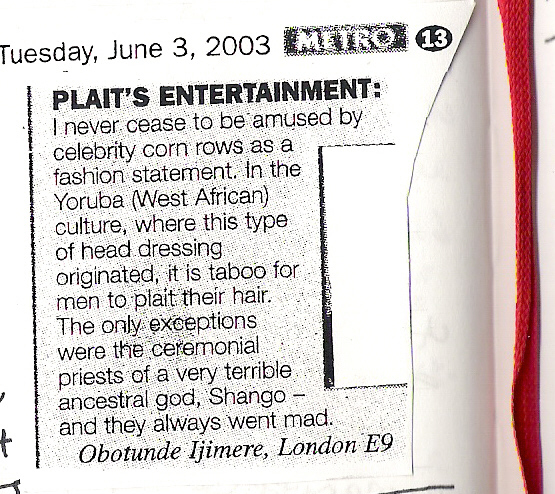
Reading the 'Letters to the Editor' section of the free Metro newspaper on the morning of June 3, 2003, a letter about the British public's fascination with David Beckham's then short-lived corn-rowed hairstyle - caught my eye (see on the right, as cut out a pasted into my notebook). I read the correspondent's name and it was signed by none other than Obotunde Ijimere whose book - The Imprisonment of Obatala and Other Plays - I bought in Nairobi, Kenya in 1995 and have treasured since.

The Imprisonment of Obatala carries on its inside cover an image of the 'author', a Yoruba man with facial marks, said have been a member of Duro Ladipo's theatre troupe, who was then encouraged by Ulli Beier to write in English. Or so it goes... But popular lore has since led one to understand that Obotunde Ijimere is the pseudonym used by Beier himself, and that some notable others (of the Mbari Mbayo Group) are said to borrow the name now and then. All of which make the letter in the Metro all the more fascinating.

I should have known from the start that the name is a pseudonym anyhow, since both the first and last names - 'Obotunde Ijimere' are very poetic references to Yoruba names for monkey species.

Obotunde Ijimere has been called the phantom of Nigerian literature, having the agility of a monkey or a trapeze artist, the cunning and the trickery.

Now you see him, now you don't.

Flora Nwapa's Blue Lake


I read Flora Nwapa's books Efuru and Idu as a child and I was fascinated by her descriptions of a blue lake. Last year, I visited relatives in Ogwashi Uku, Delta State. My uncle took me to see many of the different rivers and lakes surrounding Ogwashi. This reawakened a desire to see Flora Nwapa's blue lake, Lake Oguta. After some arm-twisting on my part, a few days later, I set out for Imo State with 3 others in my uncle's old 504. We arrived at the lake and it was even more beautiful than I'd imagined. Since we were in Oguta I felt I had to pay my respects to the woman who opened doors for many African women writers. We visited the Nwakuche compound and although none of the family were home, the groundskeeper listened to the story of how we came to Oguta and let us see the grounds and take a picture of Flora Nwapa's final resting place.


Monday, December 11, 2006

Lamenting the Index

The Index Bookshop in Brixton was one of those places that existed as a reassurance to lovers of Black (African, Caribbean and African-American) writing. It can be so very difficult to find books by African writers in the main book chains in London. Getting to buy a copy of a book by Yvonne Vera in Books etc and such like, can be a hit and miss. In fact, I'm prepared to wager that you will not find Vera in these places at all. At the Index Bookshop, you would find Vera and countless other wonderful titles that would otherwise be obscure in the UK. At the Index, sitting on the corner of Electric Avenue and Electric Lane smack in the middle of Brixton market, you could find all of the speeches of Kwame Nkrumah in one volume if that was your thing; History of the Shona, Swahili or Yoruba Grammar, plus all there is to read of WEB Dubois and his ilk. This bookshop has been a place of pilgrimage to me, a sanctuary in the beehive of Brixton Market. I have gone there countless times, some out of a wish to see what one could find, and other times out of sheer necessity. When I couldnt find Adichie's Purple Hibiscus in the heady days after its Orange short-listing back in 2004, I ran at the last minute to the Index Bookshop - and there the book was.

The Index ranked among few precious others - New Beacon Bookshop on Stroud Green Road in Finsbury Park is the one that comes readily to mind. The Africa Book Centre in Covent Garden was a well known one (like the others much too small to stock everything in their specialised area); it has closed up shop and they only sell by mail order only.

And now the Index Bookshop has closed. It closed down last year and I only found out today - the hard way. I can't believe I had stayed away from the shop up to a year. And I have been in the Brixton area recently without looking over to ensure the store was there; I suppose I always thought it would be there. Well, today, I went looking for the Index Bookshop (I sometimes deliberately stay away from such places for the same reason I sometimes go; I'd end up staying too long in there and I'd spend more than was prudent) - just to browse, to marvel, and maybe buy a book or two if they proved irresistible.

I got to where the Index was and - the horror! A brand new fishmonger had opened where it used to be! Yet another fishmonger in addition to the countless others in Brixton market, and no Index Bookshop! When the fish-sellers asked if I needed help (to buy fish), they must have been taken aback to hear me ask for books, the bookshop, instead.

It was a sad walk back to Brixton Station in the rain. I guess I'll have to make my way to The New Beacon more often then. Long may the New Beacon stay open, but the closure of the Index Bookshop is a big loss.

Remembering Chukura

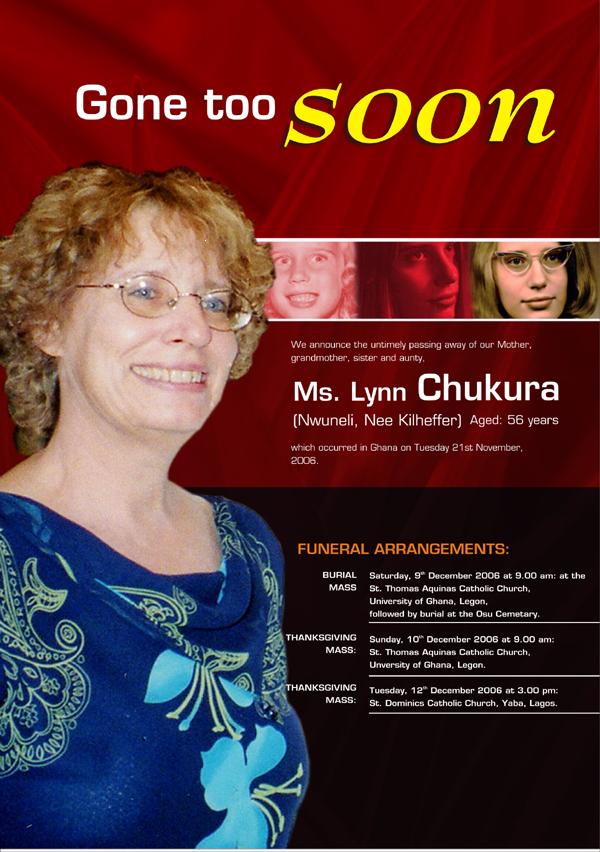
Writers honour late ANA judge, Lynn Chukura
By Uduma Kalu http

GRADUALLY, and unexpectedly, a white body of a woman washed ashore. The crowd at the Labadi beach, Ghana, took a close look at it. It was the body of the poet, lecturer and former literary judge of the Association Nigerian Authors, (ANA), Lynn Chukura. She was teaching English at the University of Legon, Ghana.

Just recently, a member of a listserve had inquired about her. Lynn had also sent a poem, "Identity" for an anthology being edited by a Nigerian lady living in the United States of America. She was thinking of publishing her novel, "The Man", in the United States of America. Her earlier collection of poems, Archetyping, got an ANA honourable mention.

If there was any doubt among the onlookers at the beach that it was Lynn, the press statement that followed entitled" Obituary Notice: Re: Ms. Mary Lynn Olisa Chukura", wiped all that thinking away.

The statement, released by Kofi Anyidoho, Professor and Head of the English Department, University of Legon, Ghana remarked that "It is with deep regret that I write to announce the death of our colleague Ms. Mary Lynn Olisa Chukura, Senior Lecturer in the Department of English. Ms. Chukura drowned in the ocean at Labadi on Tuesday 21st November 2006.
"Ms. Chukura joined the English Department of University of Ghana as a Senior Lecturer on 17th February, 2003, from Nigeria, where she had had a long and active career at the University of Lagos. She has been a very dedicated and effective member of the faculty, with responsibility for a number of our core courses. Her death comes as a great loss to the department and the university.

"An American citizen from Lancaster in Pennsylvania, Ms. Chukura was born on 14th June, 1950, at Carlisle, Pennsylvania, with Kilheffer as her family name. She is survived by Mr. Udemezuo Onuora Nwuneli of Lagos, aged 32, and his two sisters Nkem and Nancy Nwuneli, currently living in the USA."

Arrangements for the funeral, he continued, showed that Lynn's body was laid in state last Saturday, December 9, from 7:00 - 9:45 am, at the St. Thomas Aquinas Catholic Church, University of Ghana, Legon. Burial Mass was at the same day at the St. Thomas Aquinas Catholic Church, University of Ghana, Legon, while the Final Funeral Rites held same day also, at The University Guest Centre, Legon. The Thanksgiving Mass was yesterday, Sunday, December 10, at 9:00 am. St. Thomas Aquinas Catholic Church, University of Ghana, Legon.
Another press statement also appeared last week. Entitled, "Tears Drop..." the message came from Lookman Sanusi and Nike Adesuyi, For The Lynn Chukura Committee.

The duo while announcing "Ms. Lynn Chukura (Nee Kilheffer) writer, literary critic and university teacher, mother, grandmother, sister and aunty, who passed away on Tuesday 21st November 2006 in Legon Ghana," went on to say that Lynn served for several years on the selection panel for Association of Nigerian Authors Literature Prizes where she contributed in no small measure in advancing the cause and course of Modern Nigerian writing.

"A Thanksgiving Mass will hold in her honour in Lagos Nigeria, on Tuesday, 12th December at St Dominic Catholic Church, Yaba Lagos. All friends, well wishers, former students, colleagues , most especially the Lagos/Ibadan literary community are enjoined to attend and pay their final respect to this great woman who gave so much of herself and her endowments towards the development of literature in Nigeria."

Lynn was a good swimmer and would often boast about it. She preferred to swim in the open sea because she felt natural waters have spiritual effect.

Since these announcements, writers, the world over, as expected, have been paying tributes to her. Some of the tributes remember the assistance she rendered to the writers and their associations. One in particular mentioned her political activism. Lynn resigned her appointment at the University of Lagos because her branch of Academic Staff Union of Universities, (ASUU), betrayed the struggle of the union in 1996.

Also Dr. Wumi Raji was sacked along with his colleagues by the University of Ilorin in 2001, Lynn tried her best to get Raji placed at the University of Lagos.

The bulk of the tributes to Lynn emphasise her literary contributions and achievements. She reviewed Maik Nwosu's Alpha Song at the French Cultural Centre, at the presentation some years back. ANA former scribe, Nduka Otiono, remembered "that Lynn just wasn't one of the most reliable judges ANA ever had, she lived a life of sacrifice for others, and was always ready to help. As Gen Sec of ANA, I sought and received her co-operation to prepare that comprehensive Guidelines for ANA Prizes on ANA website, which was adapted for the NLNG Prize and other prizes. And when she relocated to Ghana while her tenure as Judge was still valid, she accepted to complete her term if I could ship entries for the year's ANA Prizes to her in Accra.

"Clearly, she deserves an honour from ANA and WRITA for her selfless contributions to new Nigerian writing--as Judge, teacher, mentor, thoroughbred Editor, exemplary membership, etc, " he wrote.

Lynn was a regular presence at most literary activities. She was an executive member at the Women Writers of Nigeria (WRITA) and Lagos branch of ANA. Some of the national conventions she attended are also remembered by some of the writers. The writers expressed her commitment to literature, literary meetings in Benin City, Jos, Asaba, Kaduna, since 1994, and her editorial helps and as MUSON judge. Lynn shared some of her writings too, one of them said. One of the works was "The Man".

Those that were teachers also said they read and taught Lynn's story at the University of Jos, adding that Lynn would be remembered for her feminist vision in Nigerian literature.

Monday, December 04, 2006

Lynn Chukura 1950 - 2006

The death is announced (and noted on page 78 of today's Guardian, Lagos) of Lynn Chukura - the end coming at it did in the sea in Ghana on November 21st.

Chukura taught Literature at the University of Lagos for about 24 years before she moved to Ghana. A contributor to the 2005 anthology, Short Stories by 16 Nigerian women (with her story, Birds of Darkness), Ms Chukura was on the staff at the University of Ghana at the time of her passing.


From Nigeria to Ghana, the literary community mourns.

The Obituary notice from the University of Ghana, below....


Obituary Notice:
Ms. Mary Lynn Olisa Chukura


It is with deep regret that I write to announce the death of our colleague Ms. Mary Lynn Olisa Chukura, Senior Lecturer in the Department of English. Ms. Chukura drowned in the ocean at Labadi on Tuesday 21st November 2006.

Ms. Chukura joined the English Department of University of Ghana as a Senior Lecturer on 17th February, 2003, from Nigeria, where she had had a long and active career at the University of Lagos. She has been a very dedicated and effective member of the faculty, with responsibility for a number of our core courses. Her death comes as a great loss to the department and the university.

An American citizen from Lancaster in Pennsylvania, Ms. Chukura was born on 14th June, 1950, at Carlisle, Pennsylvania, with Kilheffer as her family name. She is survived by Mr. Udemezuo Onuora Nwuneli of Lagos, aged 32, and his two sisters Nkem and Nancy Nwuneli, currently living in the USA.

Arrangements for the funeral are as follows:

  • Laying in State: Saturday, 9th December 2006, 7:00 – 9:45 am, at the St. Thomas Aquinas Catholic Church, University of Ghana, Legon.
  • Burial Mass: Saturday, 9th December 2006, 9:00 am, at the St. Thomas Aquinas Catholic Church, University of Ghana, Legon.
  • Final Funeral Rites: Saturday, 9th December 2006: The University Guest Centre, Legon.
  • Thanksgiving Mass: Sunday, 10th December 2006 at 9:00 am. St. Thomas Aquinas Catholic Church, University of Ghana, Legon.

Kofi Anyidoho
Professor & Head of Department

Monday, August 21, 2006

Literary Wizard

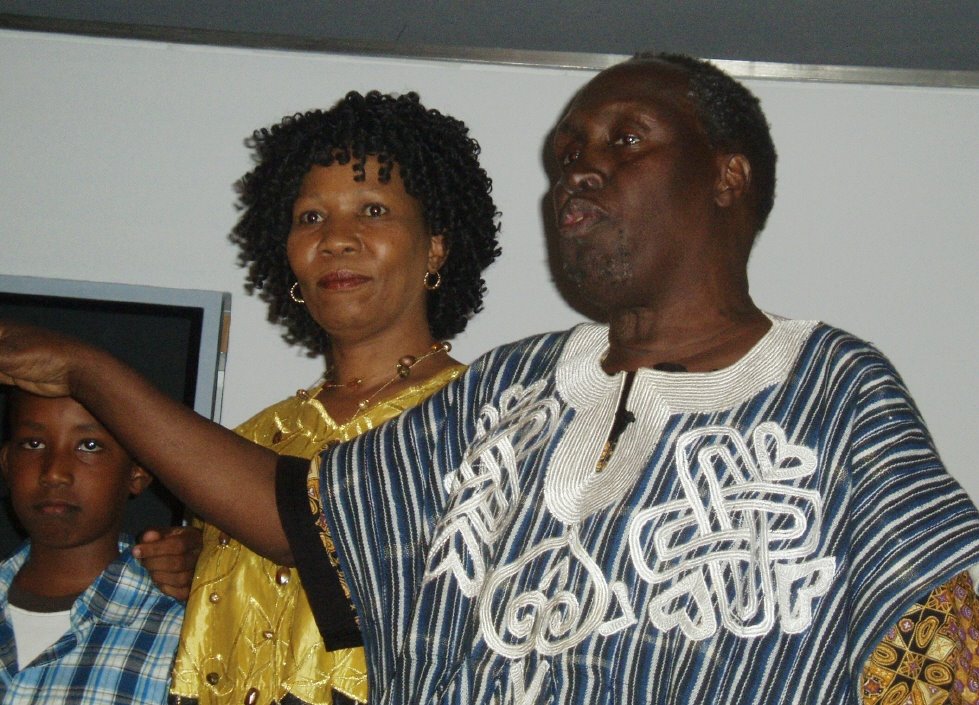
Ngugi wa Thiong'o at the book reading of Wizard of the Crow on 10th August. The author considers England his second home, and was once a resident of Islington, North London. Here he is with his wife Njeeri, a day before the 2nd anniversary of the attack they suffered on return to Kenya. The author's young son, Thiong'o (who got to say a few words on the night, thanking the audience in an American accent for coming to honour his father) is next to Njeeri. Ngugi seemed to want to make the event a celebration of life and survival, bringing his family along to the event. Lucky for the audience, they got five Thiong'os for the price of one. Ngugi explained that his younger children had only been spared the attack because, as luck would have it, they had chosen to go and spend the night with a relative.

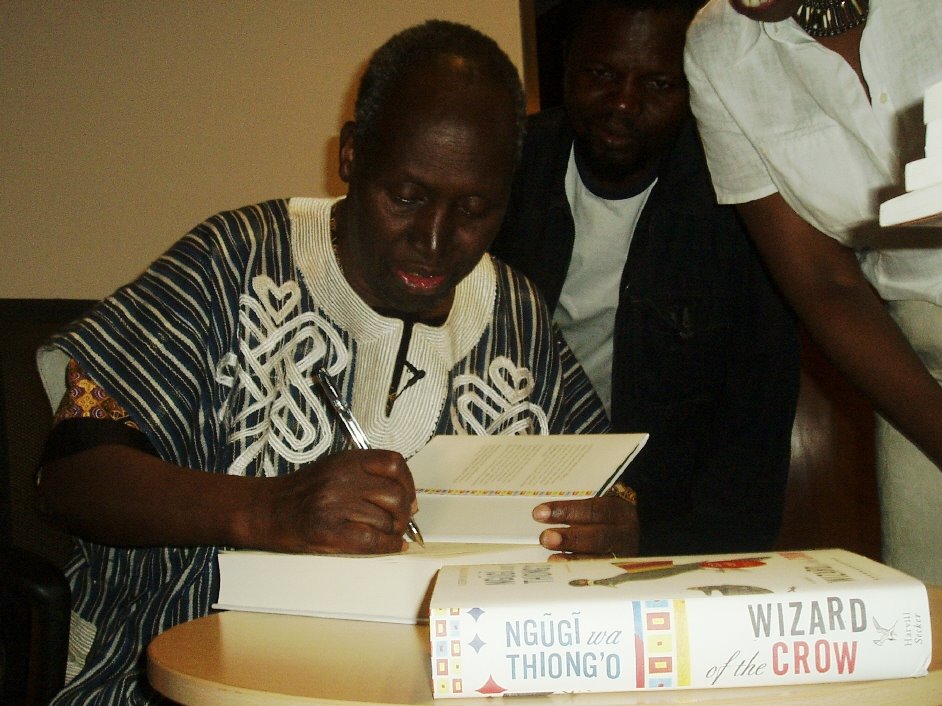
Ngugi autographs a copy of Wizard of the Crow for a reader lucky to be the first in line, a neverending queue for autographs at Congress Hall.


Thanking the blog reader who sent me the link to this piece on Ngugi...

"Moi used to say, 'I can forgive anybody but Ngugi'," says the 68-year-old novelist today at his home in Irvine, where he is a professor of English at the University of California. At just over five feet tall, with a ready giggle, he is hardly the portrait of a steely revolutionary. When Moi agreed to abide by term limits, and his hand-picked successor lost in the presidential elections, Wa Thiong'o realised that he had a chance to come home. It was good timing. Wa Thiong'o had just completed a six-volume satirical novel called Murogi wa Kagogo, a ribald satire of a fictional African dictator. It was also the longest novel ever written in his native Gikuyu language.
-read the article.


  • Images: taken @ Congress Centre, London, 10 August 2006; by MW