Writings of the general word's body

Showing posts with label Poetry. Show all posts

Sunday, April 18, 2010

New poetry from Blessing Musariri and Mamle Kabu

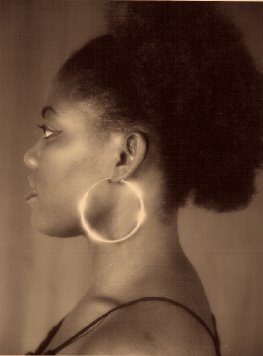
Blessing Musariri (shown here with with Binyavanga Wainaina in the Gambia in 2oo7) was in yesterday's UK Guardian, her poem that is. Here's a few lines from Mitu's Spice Tour:

Stop four – in single file we are baking in the sun.
Cloves cure diarrhoea and stomach-ache,
the neem is very bitter but better than malaria parasite.
Boil bark or leaves and drink te
a for seven days.
Cures up to forty ailments.


Mitu's Spice Tour is taken from Sunflowers in Your Eyes: Four Zimbabwean Poets, edited by Menna Elfyn (Cinnamon Press).
Musariri will do a promotional tour of the UK in June (along with another poet in the anthology, Ethel Irene Kwabato), with appearances at the Hay Festival, Hay on Wye (6 June), Trinity Ffrinj Festival, Trinity University College in Carmathen, Wales (7 June) and at the Aberyswyth Arts Arts Centre, also in Wales (8 June).
~
And here on the right is Mamle Kabu, reading at the CDC Caine/Kwani literary eventing in Nairobi on March 24. Kabu has new poetry online.

Orange Juice is published on Groundnut Soup World Writers Blog on the PEN America website.

A few lines...

My dying wish?
Orange juice
From oranges that are yellow
Not orange,
Oranges from the forests of Ghana
Grown wild in cool shade
And careless beauty


Laban Hill on the Groundnut Soup World Writers Blog
"Over the past year, I have been travelling around the world meeting writers on almost every continent. This blog is meant to celebrate not only these writers, but also all writers. Please feel free to submit a short piece of fiction or nonfiction or a poem along with a short bio to: labanhill@yahoo.com. I look forward to reading your work!"
  • Blessing Musariri photo by MW/Mamle Kabu photo courtesy MO

Friday, April 09, 2010

Lesego Rampolokeng reads in Lagos

Wednesday April 7: Lesego Rampolokeng, one of the headliners in a large retinue of poets and performers at the Poetry, Song and Memory event laid on at the Agip Hall of the Muson Centre, reads, in one of the more riveting performances on the stage. Rampolokeng hopped onto the stage, moved, talked and read his poetry at breakneck speed, and the crowd loved it. "If I'm going too fast please stop me," he said. "Ah, no," many said in the audience; they were loving it too much. The poet said Nigeria was the only country so far where he's had to bribe a customs officer in order to be let into the country. The bribe was a copy of Rampolokeng's book, so who knows, maybe the corrupt official could go get himself some enlightenment. The largely Nigerian audience did not have to squirm too long at the mention of the bribe; Rampolokeng did not leave his native South Africa out. One had to be black, he said, to be considered a 'foreigner' in SA. "There are no white foreigners in South Africa."

Rampolokeng's performance was over all too soon and he left the stage the same way he came on - he hopped off.

Lesego Rampolokeng reads with the Association of Nigerian Authors' Lagos Chapter in Lagos tomorrow, Saturday, April 10. Details below.

ANA Lagos Reading With Lesego Rampolokeng
Under the Samarkand Tree
Near Aina Onabolu Hall
National Theatre
Iganmu, Lagos
*
Time: 12 noon.

Thursday, June 12, 2008

Epitaph for the Bully

(far cry from Auden)

When at last he died
Market-women danced in the streets

Instant owambe
Thick as amala
Redolent of gbegiri

Scornful of the new edict
Lawful crowds partied in the streets

Gege in fireworks
Jubilations at Agbeni
Feferities at Foko

Mournful they dared not be-cause
Awful Lamidi held the city to ransom

© Akin Adesokan


  • For Chief Lamidi Ariyibi Adedibu, the godfather of Ibadan politics (aka the godfather of Amala politics) - who passed away on 11 June 2008 and according to Muslim rites was buried today, June 12, a not insignificant day in the fight for democracy in Nigeria.
  • Read Tade Ipadeola's brilliant essay, 'Adedibully: a dinosaur's last dance' - published in Farafina 12, edited by Akin Adesokan,
  • Epitaph for the Bully is used with permission.

Monday, March 24, 2008

Beyond Green

Through these windows,
what sees us and what we see
what cares, what scares
aware or oblivious, we have felt all.

these scattered and scarred details
have clothed our view in rainbows
and these windows,
subservient and silent
are witnesses to what we have seen.


We never run out of what’s there to see:
We'll see what massages the eye
We'll see what pricks hope
We'll see the crowns of thorns
that haunt our dreams.

Perhaps when the window gets tired

we will see what within
has always not been part of the view.
For now, the secret is:

we'll have to keep looking
Beyond the green hills of Nyanga
if ever we are to catch
up with fugitive hope.

© Emmanuel Sigauke
  • Beyond Green is used by permission.
  • Emmanuel Sigauke is the editor of Munyori Poetry Journal. Visit his blog, Moments in Literature.

Sunday, February 17, 2008

Pearshaped Blogosphere

Some friends say Let us blog,
we’ll call it Kenyablog.
They blog and blog and blog.
A member posts
This blog is tedious,
I’m gonna form a blog,
a blog called Lakeyblog
where Lakey types can blog.
The rump of Kenyablog
rename themselves TheHighlandblog
and blog about the soil,
quite unaware that other Forestbloggers
formed another blog in which
the self-same soil is blogged about.
Now keen to keep the secrecy of blog,
the lively Lakeybloggers
shift to write in bubbles
while TheHighlandbloggers
only write in cones,
a sort of hieroglyphic oath,
each to his own, each to his
non-discursive moans
until the bubbles burst with anger
and the cones erupt with hate
and all are blogging-blogging-blogging,
typing keyboards with our pangas
blogging Highlandbloggers suck
and blogging Lakeybloggers blow
and blogging Forestblogger mothers are all hoes,
now blogging rumour blogging anger
blogging gossip blogging rancour.
Local fissures rip the WorldWideWeb
as bloggers blog their cyberfoes to death.

©
Stephen Derwent Partington
Kenya, February 2008


  • Used with permission

Friday, February 01, 2008

Praise Poem


We praise the man who,
though he held the match between
his finger and his thumb,
beheld the terror of its tiny drop of phosphorous,
its brown and globoid smoothness
like a charred and tiny skull
and so returned it to its box.

So too, we hail the youth who,
though he took his panga on the march,
perceived it odd within his fist
when there was neither scrub
nor firewood to be felled,
so laid it down.

An acclamation for the man who,
though he saw the woman running, clothing torn,
and though he lusted,
saw his mother in her youth,
restrained his colleagues
and withdrew.

We pay our homage to the man who,
though his heart was like a stone
and though he took a stone to cast,
could feel its hardness in the softness of his palm
and grasped the brittleness of bone,
so let it drop.

We laud the man who,
though he snatched to scrutinise
the passenger's I.D.,
saw not the name - instead, the face -
and slid it back
as any friend might slide his hand to shake a
friend's.

And to the rest of us,
a blessing:
may you never have to be that man,
but if you have to,
BE!


© Stephen Derwent Partington
Kenya, January 2008


  • The poet is a member of the Concerned Kenyan Writers Initiative.
  • Poem used with permission.

Monday, October 15, 2007

Juffure


The mirth of June pilgrims
gladdens your century of sorrow
your old heart cloys
your household gods stir
to bless Kunta's ghost
the pains of your
bruised birth
vigorous to scoop away
the silt of your river
the rites of your disintegrated womb
once more observed.

© Mariama Khan


  • Juffure is taken from Mariama Khan's poetry collection, Futa Toro; used with permission.

  • About Juffureh

  • Mariama Khan photographed by MW in Bakau, The Gambia, 15 July 2007.

Monday, October 08, 2007

Song of our Timi to end Timidity

Seek and be found by the words of wisdom
from the fount of Fiditi
whose only son is Timi
A son with many parts
Never will the tag timidity
stick as his identity
As Baba Fiditi carries himself

with dignity
so shall his igi-iwe son
dig deeper into customs
that transforms those in want
and those wanted for standing up
when oil ‘pan-caked’ the soil
and turned the face of earth
into a frying pan

Stick together and you will find
a coalition of like minds
that will not give codeine
when cups of garri will cure hurt.
Timi, push me into huts of peasants
where hope is the alter laid
for the coming victory
like the Pope as sentry at heaven’s gate
Timi, push me till the deity of timidity
becomes the sacrifice at oritameta
and workers, farmers, writers, fishers, sellers
Prisoners, cobblers, pushers, butchers
reclaim their collective voice in the
new history of bold types.
The Slave Union and Union of Slaves
must be traded for brave Trade Unions
with words, swords and sickles
No more fickle minded minions
who bark by day and back out by night.
Tell Timi the time is right
to give the landlords a fight.
End of a people's timidity can only be now!
Sing this song in the mid-day Sun
Sling the catapult for assault if that's
all you've got
Sing, dance, cry, shout... don't
just wait for Timi

© Kole Ade-Odutola

  • Used with permission
  • Image courtesy of the poet

Monday, October 01, 2007

Enter the Vampire

"Our appeal is straighforwardly based on the need for clemency as an essential element in the attainment of that healing process which the present national leader swore to embark upon, on taking oath of office. Without being superstitious, we cannot but observe how a 10-year cycle of blood-letting appears to have become an incubus on the very life of the nation's Armed Forces - 1966, 1976 and now 1986. You possess the will to break this jinx. You have the moral duty to exercise that will."

- Chinua Achebe, J.P.Clark and Wole Soyinka
in a petition to General Ibrahim Babangida at Dodan Barracks on March 4, 1986.


11

if you are going to dodan,
dont wear flowers in your hair.

if you are gong to dodan,
dont write or chant poetry.

if you are going to dodan,
dont mention human rights.

if you are going to dodan,
dont announce consummation's cycle.

if you are going to dodan,
ride in an armoured carrier...


III

The betelgeuse of compassion
led three graying sages
to the dodan of decision.

Our three wise men
brought no gold,
brought no frankincense,
brought no myrhh,
only logos of compassion
to break cycle of consummation.

But no room in the ears
of the leader-lord
to hear professorial pleas.

If you are going to dodan,
ride in an armoured carrier...

© Emman Usman Shehu
  • Enter the Vampire is taken from Emman Usman Shehu's first collection of poetry, 'Questions for Big Brother' (ANA/Update, 1988).
  • Used with permission.

Monday, September 03, 2007

Azu Kalia Azu

Why did I shrink to think of you,
Ezinnebunor?
why did I despair for the words to describe you?
why was this world, since you left,
a large ashtray for dreams?

Come mother mine
of the canny laughter
that mellows raging beasts into wagging tails,
set that joy right here where it hurts
-I’ve been herding gloom
since your presence fled that afternoon
when the eclipse of your laughter froze in place.
The meteor strike of death
'that planted, scattered you across the earth'
has me wandering far and wide
seeking harvest from a sprouting you,
Mama:

Here is a constant sea
looking to cast a perfect wave
to cleanse her beach
of every foreign thing.
Just missing perfection,
she retreats patiently, and casts her net again;
and again, and
again... here’s a face of patient you,
looking to salving every hurt
In your chest of faith.

So curl, enfold, the waxen wick of you
deep in the lamp of memory.
You are not dead, dear Mama,
merely recoiled into the tank of earth.
Memory holds you now, Mama.
While we live, you live.
And in the bleakest darkest dreariest dawns
in which it seems the sun and moon and earth
are frozen in a black eclipse,
forgive me if I discomfit your rest
and draw you out from memory
to cast your lighted eyes,
broad like the girth of a small sea’s surf,
calm like her rolling waves that
break continually
upon the cliffs of adversity,
and heave that seismic sigh of yours
that fills the hungry with the husk of faith,
to assure me,as you always do:

‘The bigger swallows the fish, my child.
Tomorrow comes, the bigger fish.
Endure today.’

© Chuma Nwokolo Jr

  • Chuma Nwokolo Jr read Azu Kalia Azu (The Greater Fish Swallows the Smaller) during Word From Africa @ the British Museum on 2nd June 2007.
  • Used with permission

Tuesday, July 24, 2007

Gorée

We have come to the cliff, a sheer drop
cried below, death was asleep there,
snoring in the aquamarine waters.
Beneath the French fortress, ganja men
smoked on, hanging castaways on knotty trees.

We travelled a little while, a little lost.
We held the baobab trees, glistening in the dusk,
whispering how many were lost, how many never returned.
Without knowing why, we babbled like babies
in the house of slaves, smells grabbed us like memories
in this meeting of ways at the gate of no return.

We sail to the sale across the endless sea,
the medley of voices, the nights without cover
when a master’s sperm beckons, children strewn
like harmattan dust, what can the Portuguese say;
only that we too were here, trampling on men and fish.

Here, volcanoes become rock and sand,
boababs live to tell the tale to a
museum of women, hot colors wed
in the sun, brick/red for loss, turquoise for joy,
green for an elegant shoulder swathed in boubou.

In the avenue of baobabs,
griots recline, strumming on balafons.
Tell it to us, these things we forget,

the garden of desert plants
the ruins of cannon guns.

© Toyin Adewale-Gabriel

.
  • At the PEN Women Writers' literary evening earlier this month in Dakar, Toyin Adewale-Gabriel read her poems, "Safari (for Ogaga Ifowodo)" & "Goree".
  • "Goree" is used with permission.
  • Poet photographed @ the Kadjinol Cultural Centre, Dakar, Senegal - on 11 July 2007 - by MW.

Thursday, July 05, 2007

To the Queen and Her Donkeys

On a state visit in Nigeria

She was cloistered
Among her jeweled eggs,
The Fabergé. Nothing of the streets
Came in shore. Just mirrors of waving hands,
Welcoming the donkeys, laden with grief
From London.

And in the company of the queen, a young buck –
In harm’s ways – against the message
of that bloody Sunday. A strange time bears an infant
in her bosom: in Istanbul, in Fallujah, in Kirkuk,
the claws of the falcons probe the night.

But we, the oblivious,

Merry, make her bed, wave
The flag of our hospitality,
And of the dear old empire. Showed
Missus Windsor our open-hearted
Place, where nothing stirs – not in this
Night of our autumnal.

But if some noon,
The thing inside us stirs,
Beware then,
For the witch will cry,
And her time will be near.

© Obi Nwakanma

.

  • To the Queen and Her Donkeys is taken from Obi Nwakanma's new collection of poetry, The Horsemen and Other Poems.
  • Reproduced with permission.

Monday, May 14, 2007

Incantation

.
Rain does not evade the path of the runnel
Frogs do not decline the call of streams
The sponge will not refuse the voice of the river
Salt will ever heed the glad eyes of the sea…

The needle does not decline a tryst with cloth
The road does not complain at the tread of feet,
When young love meets the moon it blossoms
When eyes meet with beauty the face is glad

Let those who love this land be safe
Let those who hate this land be swallowed
And when the children lift their voices,
Let all of those who hear be glad,
Let all of those who heed rejoice.

II

Glory does not kill the morning
Splendour does not slay sunsets
Love for a child does not kill the mother
The praise of fathers does not kill their sons
When a bride kneels before her groom she's blessed
Whenever a daughter is born we know we shall not die
Whenever a son is given there is joy
Let all the daughters of this land be fruitful
Let all the sons of this land increase
And if from east or west there should be anger
If from north or south there should be rage
Let all the rage and anger dissipate
Like smoke in the breeze
Like dogdream when it comes awake.

III

What words we have spoken let them cleave
What hearts belong to us let them not grieve
Let our words find us prepared
Let all our dreams find us prepared
And our land, our country, our earth
Let them find us ready at our end.

© Tade Ipadeola


  • Reproduced with permission.

Wednesday, May 09, 2007

Alter Ego

How true it is
That today is yesterday’s tomorrow
When my nostrils ran
And I licked the dripping mucus
While you suckled on Eszhiiokwum’s nipple

You were both the canoe and the paddle
And I was the diver who stayed afloat
Defying turbulent waves…

The sea brought you an eel
And I found a shell ashore

Troubled by the glint in your greedy eyes
I stretch my worn hands
If only you’ll take it

And look upon me as your undying shadow
Secure in muted appeals
Yearning for your contentment!

© Patrick Iberi

  • Alter Ego is taken from Patrick Iberi's forthcoming poetry collection, Echoes of a Desolate Voice. Used with permission.
  • Iberi is the Art Editor of Sentinel Poetry Online.

Monday, February 12, 2007

Ogunlesi's Poetry Prize

Congratulations to Tolu Ogunlesi, who has won a $1,000 award in the 2006 Dorothy Sargent Rosenberg Poetry Prize. The prize awards 1,000-25,000 USD annually to poets under 40 judged to have written the finest lyric poems celebrating the spirit of life.

Ogunlesi is one of 12 winners in the $1,000 category, and he did it with his poem, Visiting the Yellow River - below.


Visiting the Yellow River

How can you (without a pang of conscience) my host
And guide, say that you have suddenly fallen short
Of enthusiasm? What will happen to my dreams
Of seeing the Olumo Rock; and to the beating heart
Trapped in my feet, waiting to drown
Itself in the muddy waters of the Yellow River?

From far, far away, beyond the eye of the river
Have I come, possessed with the spirit of one held host-
Age, that I might in oceans of chivalry plunge and drown;
Knowing how blest it is to be short
On fear and long on the courage that steels the heart.
For what is fear if not a song trapped eternally in a cage of bad dreams?

Perhaps you have never numbered your dreams
Nor marvelled at the joys that spring like a river
Therefrom. The overall effect is like an upgrade of the heart
Or like sanctifying yourself with the host
That proceeds from the blessed hand of a priest. Cut short
At once your song of fear. You can learn to drown

Your doubts, just as the wine that fills your cellar learns to drown
Your sorrows. It is a shame when a man has no living dreams
Left to fatten. We shall cut his silken hair short
And leave him to gnash his teeth by the rivers
Of Babylon. Do you want us to sing for you, beloved host,
That the pillars of your manhood are weak of heart?

And it is no use pleading with me to take heart,
And to give you another chance, another time. I’d rather drown
In the lake of fire than pass up this chance to join the Heavenly host
(The roll call of souls who have chosen to die dreaming big dreams).
And don’t even think of warning me that the Yellow River
Is haunted by spirits. To accept anything short

Of a pilgrimage in the Yellow River will be to short
Change myself. I will not relent. Even if my heart
Ceases to beat, my blood will continue to be a river
That never grows silent, never ceasing to drown
Cowardice. For what could be worse than a dream
Visited by slumber, but too spent to play the sprightly host?

The heart beat of the gods still animates the Yellow River
Which is why my favourite dream is of me learning to drown.
Alas, I have a host who is a bad talisman, and my time is now very short …
~


  • Poem reproduced with permission.
  • Images of Olumo Rock and River Ogun - taken in Abeokuta on 22 August 2004 © M.Wood

Monday, January 08, 2007

New Year's Eve


Beers gulped into filled bellies
Rise from human gullies headwards
Fueling the gyrations of dancers, slick as eels.
Elsewhere, old men pour libations
Fluid to earth’s ancestral thirst
Liqueur and soil sound a sacred hiss.
With dawn’s hesitant light comes the first,
A new year of kisses to the lover's face.
And new beginnings for midnight masses,
Worshipful in solemn places of prayer.
Festive déjà vu bids dying year: ashes to ashes.
Rejoice, for He will many wonders perform
As cited texts float up in hallowed layers;
Litanies to an annual amnesia, same as before.

© Molara Wood

Sunday, December 17, 2006

Songstress

You stand on the stark platform
under the lone glow
an island of attention,
a vulnerable picture –
pouring out your heart,
a river of candid songs.

How come such tenderness,
from a heart full of scars?
You teach me forgiveness
under a tungsten lamp.

O Songstress, O Songstress,
I hear this river of songs –
sometimes as fast as a flood,
now and again slow as twilight –
pouring out of your wounded heart.

How come such passion
from a soul full of fissures?
You teach me endurance
on a loney island.

O Songstress, O Songstress,
I hear this river of songs
sometimes soft as a whisper,
streaming out of your heart.


© Emman Usman Shehu

  • Published in the Sunday Sun, Lagos, on 26 November 2006. Reproduced with permission.

Monday, December 04, 2006

Letter 49

There is nothing wrong in your disagreeing with my assertions. But there is something mightily wrong when you think or feel that we must reason alike or see things the same way just because we both write poetry.

You know very well how I treasure your person and your poetry. I still do. What I now find offensive is your revealed unwillingness to accommodate another person's opinion about poetry and society.

I honestly don't think that wisdom ends on your doorstep. It is not and has never been my intention to pander to your ideological position on writing. Hold your literary beliefs for I zealously cling to my own.

As a respected figure in the poetry circuit, you ought to know the virtue of diversity in that genre. We can't and should not desire to write the same way. When you criticised Wole Soyinka and Christopher Okigbo in your various talks and articles, you did that in the light of your understanding of what poetry is and what function poetry ought to perform. Nobody as far as I know has bullied you for holding those opinions. The writing universe is a large one. It can contain all shades of styles and ideas. For you to go about carrying on as if I have insulted you or knocked your head simply because I aired my view on poetry is very disconcerting. You have been inspirational to me because of your single-minded devotion to the art of writing. You still have my admiration but please allow me to be. Allow me to react to the world in my own way. Allow me to speak in my own way. Allow me to write in my own way.

I seriously disagree with you in saying that I contradicted myself in the poem titled "In The Bullring" which I recently published in the Daily Times. Political poetry is just one among the many kinds that I write. I have never urged for the obliteration of political or socially-conscious poetry. I simply noted that the writing of political poems (many of them trashy) mainly as a means of courting acclaim and acceptance in the Nigerian writing scene as is currently the vogue is hypocritical. Screaming slogans in poems is not the only way that one can show his or her commitment to the betterment of this nation. Politics is not the hold-all of a writer's thematic thrust. I don't want to see poetry narrowed insidiously to any one form, theme or function.

©
Uche Nduka
  • Taken from Belltime Letters by Uche Nduka (Newleaf Press, Bremen, 2000). Reproduced with permission.
  • Uche Nduka's poetry appears in this month's special 4th anniversary edition of Sentinel Poetry Online.

Friday, November 24, 2006

Breaking News


I read the obituary
Of a tree, and a toddler fish

I pen a line in the condolence
Register of a cassava-stick

I attend the lying-in-state
Of a youth's dream; a fisherman's destiny

I've heard of death
By water
And fire
But death by Oil
Is new, fresh, far
From a cliche.

It is night, yet day
A streetlight of flares
In a land where electricity
Is an abomination,

Where streams are caskets
And the air is a floating pool of

Timed death. Where sea-Shells
Sing night and day in crude tongues,
Throats dried in oil slicks.

I have heard of rigged elections
In this land
But this news of Rig-ged Annihilation
Is Breaking News to me...

I lay a wreath
For a village that used to be.

And read the obituary
Of a tree, and a toddler-fish.

© Tolu Ogunlesi


  • Breaking News is taken from the anthology, Dance the Guns to Silence - 100 Poems for Ken Saro Wiwa. Reproduced with permission.

Monday, November 13, 2006

For Dele Giwa


You would not know me,
But I followed you,
We shared a similar history,
Nurtured common dreams,
Common ambitions,
Common aspirations.

Now that they've got you,
I'll go for the sword;
I'll learn the tactics of their battle
That I may fight,
And win your war.

© Wumi Raji

  • For Dele Giwa is taken from Rolling Dreams by Wumi Raji. Reproduced with permission.