Writings of the general word's body

Showing posts with label Sefi Atta. Show all posts

Sunday, January 09, 2011

Sefi Atta Interview

Now, here's the kind of writer interview you don't get to read everyday. In today's Guardian, Sefi Atta is shooting from the hip. She takes pot shots at a certain critic who reviewed her second novel, the identity of whom is not difficult to guess:

"I’m only aware of one critic who reviewed Swallow negatively, and that was in Next. Apparently, he is a bit of a joke and his reviews barely qualify as blogs. An American friend who lives in Lagos asked why he was so spiteful. I said that’s what bloggers do to get attention. They go tabloid on you. I just wondered what I’d done to Next to deserve such a debut.
Critics don’t need to denigrate writers to review our works. They only expose their own flaws when they do. They can point out flaws in our works without being rude. I mean, I’ve heard of dissatisfied readers hurling books across rooms, but really, does reading a book you don’t enjoy constitute a personal affront that justifies retaliation against the writer? It’s absurd."


The critic in question wrote a glowing review of Ms Atta's first book, 'Everything Good Will Come'... The novelist also attacks a former publisher (no prizes for guessing who they are either). Here she is talking about inconsistent publishing standards:

"After Everything Good..., I made a decision to publish my next two books, Swallow and Lawless in Nigeria first, and was very disappointed with the copy editing and production quality. One book was actually published with the wrong cover. It took months to correct them, as a result of staff carelessness. I then discovered my contract had been breached when an American reader e-mailed me to say he’d bought a copy of my book and paid in dollars. My contract clearly stated my books were only to be sold in Nigeria. I got an apology from my publisher, but no admission of guilt, and it resulted in a strained relationship that I ended in March 2009... Even if what happened was due to carelessness, Nigerian writing is now international, so we can’t afford to be lax. I’m not revealing this to embarrass anyone, nor am I suggesting that writers make public every problem they have in the course of business, but we’re often silent about violations of our rights, which only makes us part of the problem. I don’t think exposing the offending party will redress it. Nigerians have a high tolerance for bad behaviour and might even turn on the injured party if they protest too much. That said, I will speak out and take legal action when necessary. In fact, I’d be quite willing to revisit past infringements if I so much as hear any of the parties involved makes a rejoinder that rubs me up the wrong way. They have been warned."

The author also reveals that we can expect to see plays written by her on the Lagos stage, soon.
Read the full interview, 'I write for people not critics - Atta', here.
*

Sunday, April 11, 2010

Sefi Atta interviewed in Per Contra

Writer Sefi Atta is interviewed by Miriam N Kotzin in the new issue of Per Contra online.

Excerpt
I’m an African writer published in the West. I have seen how publishing industries in the West accommodate African writers. For a start, our stories are either about post-colonial traumas or human and civil rights abuses. As an American writer once said, which surprised me because he sounded so Nigerian, “For an African book to be successful here, a leg must cut.“ I laughed so much. Some writers can do whatever is necessary to get published and win awards, and the marketplace here rewards you if you meet its expectations. All I can do is keep on telling stories that interest me in honest ways. Now, it’s hard to define honest, but it’s very easy to tell when a story lacks integrity.

Monday, July 28, 2008

Ike Anya, doctor of letters

Ike Anya is something to everyone. To some, he is an astute travel writer. To others, he is a poet. He is also a good interviewer and a keen blogger. However people get to know Ike, they eventually get to know he is actually a medical doctor with one foot in the arts and the other in medicine.

Quoting Nnorom Azuonye's words on Ike Anya. "Something to everyone" - Nnorom can say that again.

Ike was recently appointed a Consultant in Public Health Medicine at the Hammersmith and Fulham Primary Care Trust. To the man who has achieved this great feat, it was just another blessing for which he was grateful, and not something to shout about. Ike's childhood friend and fellow public health doctor/co-blogger, Chikwe Ihekweazu felt differently about it, and together with his wife Ijeoma, they set up a fantastic reception in Ike's honour at the Cicada in London's Farringdon area on Friday, the 4th of July 2008. As the event kicked off I looked around. No Molara Wood. Shit! Who is going to write about this night?

No Molara Wood. But Nnorom stepped up, and wrote about it! Where there's a writer, no story goes untold. Read his account of the evening.

One always had this fear that Medicine would take Ike Anya away from us eventually, but judging from his recent showing, we need not fear too much. One of his trademark writer's interviews - a discussion with the author Sefi Atta about her recently published novel, Swallow - was in the Nigerian Guardian of 20 July. Anya also co-edited the just published Weaverbird Collection of short stories by Nigerian writers; his fellow co-editors for the collection being: Akin Adesokan, Sarah Ladipo Manyika (whose first novel, In Dependence, is out soon via Legend Press, UK), and Ike Oguine. Contributors to the Weaverbird include: Ike Okonta, Victor Ehikhamenor, Tade Ipadeola and Unoma Azuah.
  • Swallow & The Weaverbird Collection are published by Farafina/Kachifo.
  • Photo of Ike Anya (with Uzor Maxim Uzoatu) by MW.

Tuesday, March 04, 2008

New Reads

You can't get away from Barack Obama in this American election season. Asked for her favourite writers, Tsitsi Dangarembga (author of 'Nervous Conditions' & 'The Book of Not) lists Obama among. Read her interview in the new issue of Per Contra. Among the fiction fare in the edition is 'Through the Looking Glass', taken from Dangarembga's forthcoming novel, Bira. High jinks on the bus queue...

Excerpt
"But women!" Now it was a young man chuckling. “What is it with these women! Some of them just walk just like that! With everything in the open!" Some age mates of his standing nearby grinned. They slitted their eyes in speculation and let their observation, like a single gaze, meander over the young women. "Ah, they want to inflame us!" The speaker sighed, and continued with amused indignation. "Now, isn’t it known that when it’s like that it can’t be stopped! So what if we don't want to begin and be inflamed! And get a gaol sentence? We don't want! Now these hussies want to put us in gaol! People, isn’t that why! Isn't that what makes people stone them!

Also in the fiction is something from a forthcoming novel by another favourite writer of Dangarembga's, Sefi Atta. In Grief Mongers (from the novel 'Swallow', soon to be published by Farafina), a young woman comes to her overcrowded building and finds a drama of grieving unfolding. A young boy may have drowned in the septic tank...


Excerpt
The day my father’s body was found, I came home from school. A group of women were holding my mother down in her room. They were the women of her former esusu group. They saved money together and my mother had for a while been in charge of taking and keeping their contributions. "Your father is gone," one of them said, before I had a chance to walk into my mother’s room. She was my uncle’s wife called Sister Kunbi. I could tell she expected me to be sad and instead she made me furious. "I know," I said to her. "He has gone to Lagos." She seemed offended that I wasn’t crying. She reached for my shoulder. "This world is a marketplace," she said. "The other is home. Your father has gone home." "This is my father’s home," I said.
And don't miss Silver Leaves for Judah Jones by Vanessa Gebbie - newly unveiled winner of the Per Contra Annual Fiction Prize. Her collection of short stories, Words from a Glass Bubble, has just been published.

~

Per Contra's non fiction this time round focuses on the theme of 'Chaos, Terror and the Rise of the Police State' - and there are two pieces on the recent turmoil in Kenya.

Saturday, October 14, 2006

In Conversation

Isioma Daniel sends in the following snippet from her conversation with novelist Sefi Atta at last month's Stavanger festival.

Everything Good Will Come by Sefi Atta is one of the best novels written by a Nigerian author I have ever read. Atta writes from a unique point of view – a progressive, middle-class one, and most importantly, Enitan, the narrative’s main character, breaks the mould of what a Nigerian woman should be. I spoke briefly to the author during this year’s Kapittel Literature Festival held in Stavanger, Norway.
- Isioma Daniel

Now, the Q & A...
  • Isioma Daniel: Why did you choose to write about a middle-class Nigerian girl?
  • Sefi Atta: I thought it would be easier to write about what I knew. It was only marginally easier. The middle-class Nigerian experience has really not been examined in our literature and as a reader, I’d always wondered why. As a writer, I have come to realize that publishers overseas are not that interested in stories about privileged cosmopolitan black African characters--or so it seems to me.
  • ID: Would you call your book a feminist novel for Nigerian women?
  • SA: It is a novel for anyone who is interested in reading it.
  • ID: What's your writing process like?
  • SA: I finish my first drafts in three to six months and then revise for years. I wrote my second novel, Swallow, five or six years ago. I started sending it out to publishers this year and it will be published in Nigeria in 2007.
  • ID: Who is/are your audience(s)?
  • SA: I am very much aware of an audience, a world audience. I write so that someone in Ghana might understand or someone in India or someone in Norway. Nigerians are my primary audience though. I always want Nigerians to say of my stories, yes, this is realistic.

Related Post

Tuesday, October 03, 2006

More from Stavanger

The group Women's Voice performing at Kapitell's opening ceremony.


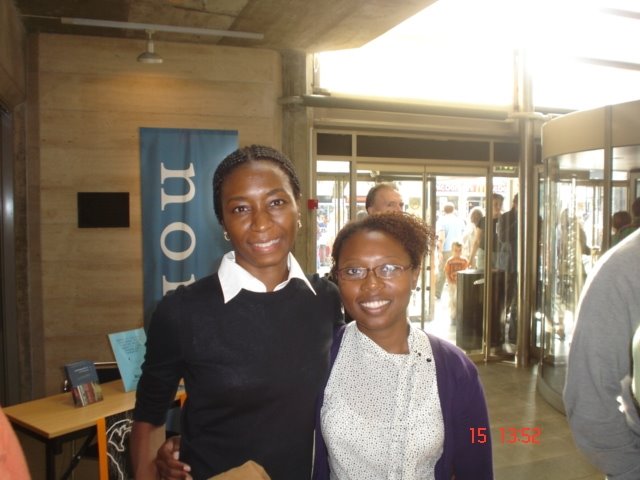
Sefi Atta and Isioma Daniel @ the Stavanger Literature Festival in Norway.

Sunday, September 03, 2006

new reads


“Bismillah,” he says, rubbing my shoulder. “No woman needs to be manhandled and that is good news about your friend. I hear you too have good news in your family. Hassan’s wife had a baby boy?”

“Last week.”

“What is his name?”

“Osama.”

“Hm. Every baby boy in this town is called Osama.”

“What’s wrong with Osama?”

“Nothing, but you would think the man is our sarki barraki the way we carry on.”

He smokes his cigarette. People name their boys Osama to make sure they will grow up fearless. The real Osama is more revered than our sarki barraki. He is so popular here you can’t find an Osama poster to buy anymore. They’re sold out. What did know-it-all Binta have to say about that? That a thousand Osama posters cannot beautify our mud walls.


-Read on...
***

“The only good thing about Father’s death,” Peter had said in his careless way, “is that we will not have to put up with his tiresome relations.” We learned soon enough that this prediction was premature. Death does not sever the ties; it binds them ever tighter, for it is in death and its attendant processes that kinship asserts its triumphant claims. He had been lent to us as husband and father, but in death the clan reclaimed him. They buried him in Shurugwi, where we had to travel for hours on uncertain roads to visit his grave. Kinship asserted itself through the funeral rites, in the ceremony to release his spirit, and in the accompanying ceremony of inheritance. His family had even attempted to speak on his behalf. They consulted a diviner who interceded between this world and the next: Father did not rest easy, was his uncompromising verdict. It appeared that the reasons for his discomfort were mainly financial.

- Read on