Writings of the general word's body
Wednesday, April 13, 2011
Fela! crew arrives Lagos
Tuesday, March 01, 2011
Fela! in Lagos at last
Fela! The Musical is finally coming home. The hit Broadway musical about the life of Fela Anikulapo-Kuti was a critical and commercial success in New York and later London, where it was sold-out for three months and got nominated for three Olivier Awards (having won 3 Tonys in the US).
Many have asked whether the world conquering show about one of Africa’s most potent icons should not have been staged where it matters most, in his country, Nigeria. Now the heavens are aligning to bring the show to the scene of Fela’s exploits, Lagos.
Fela! The Musical will be staged at the New Expo Hall of the Eko Hotel in Lagos from April 20 to 25.
This from the organisers: “The aim of FELA! in Lagos is to unite and connect Africans in spirit and unity, to serve as a catalyst for cultural revival in Nigeria, and to celebrate Fela Kuti, for the contribution he has made to Nigeria and the world. FELA! depicts the true story of the legendary Nigerian musician Fela Kuti, whose soulful Afro beat rhythms ignited the spirit of empowerment and cultural awareness in a generation. It is a tale of courage, passion and love featuring Kuti’s captivating music and the visionary direction and choreography of Tony Award winner, Bill T. Jones. FELA! in Lagos is being produced by a Nigerian production company, Broken Shackles in conjunction with Lagos State Government.”
Monday, September 27, 2010
Yeepa! Solaarin Nbo
Thursday, November 20, 2008
Robeson Play: today & tomorrow
Written by Tayo Aluko- Directed by Olusola Oyeleye
"Paul Robeson was one of the greatest actors, singers and civil rights campaigners of the 20th century. When over the years he gets progressively too radical and outspoken for the establishment' s liking, he is branded a traitor to his country, harassed, and denied opportunities to perform or travel.
Just as physical, emotional and mental stress threaten to push him over the fine line between genius and madness, he is summoned to appear before the House of Un-American Activities Committee, to give the most difficult and important performance of his career.
The play is a roller coaster journey through Robeson's remarkable and eventful life, and highlights how his radical activism caused him to be disowned and dis-remembered, even by the leaders and descendants of the civil rights movement. It features some of his famous songs and speeches, including a dramatic rendition of Ol' Man River."
Dates: Thursday, 20th November & Friday, 21st November
Venue: Oxford House Theatre
Derbyshire Street
London E2 6HG
Times 7.30pm
Tickets: £12 waged/£10 unwaged.
Bookings & info: 020 8983 9671 or 07950 735 390.
Friday, October 03, 2008
Many Rivers To Cross

posters, cartoons, drawings, prints and paintings from Zimbabwe
30 September - 25 October 2008
Oval House Café/Gallery, London
- See also "Yours Abundantly, From Zimbabwe" - a play.
Thursday, October 02, 2008
African Theatre Festival
Plays on until 5 October
Monday, March 24, 2008
Rotozaza in West Africa
JG writes in on Rotozaza's tour of Ghana & Nigeria...
Etiquette recently arrived in Nigeria from Ghana where the Rotozaza company was, it seems, hosted by the British Council for March 6, 7 and 8. Information about the visit was carried by the Accra Mail and the Ghanaian Journal, but this was ‘last minute’. In fact, the Ghanaian Journal posted details on line only after the tour had begun! This seemed to be the result of a late press release and/ or perhaps lazy arts journalism . In any case, the press releases seemed to be slotted more or less straight into the publications.
From the press coverage, it seems Rotozaza ‘(facilitated) workshops for students at the University of Ghana drama [?], Eagle Productions and NAFTI.’ I don’t think they went out to Legon, but I gather that some Legon drama students were invited to experience the work at the British Council premises in Accra. Otherwise, the Council concentrated on those concerned with acting for film / video.
It seems that the production involves participants repeating lines or responding to instructions delivered over head-phones. Etiquette is designed to be eminently ‘portable’ and will have a life of its own after the Rotozaza team have moved on. For example, the ‘show’ will travel to Kumasi so that those interested there have a chance to participate. For this is, above all else, participatory theatre.
In Nigeria , initial on-line coverage of the tour has fought shy of analysing and exploring the local reactions, but has turned up some material of interest. For example, writing in News Day on 18 March under the title ‘British Council Introduces Experimental Theatre to Students’, Funmi Ogundare, incorporated an illuminating quotation into her text:
The Director of Rotozaza Theatre troupe, Mr. Antony Hampton recalled how the experimental drama started. "There is a friend of mine in France who is a visual artist but had never been on stage before. I had a vision of him working around just in his own world, doing things on stage. But I knew he would want to perform what I was thinking of, that is getting him on stage so that he can be relaxed without having to worry about doing the job of an actor.
So we came up with the idea of listening to instructions and we proposed it to him that he should just follow it and that we would create something for him, which was not difficult to do but would be compelling to an audience. He agreed to it and it was fascinating and we started trying it with different people. After a few years we realised that this is not just one show but a whole practice and we needed to expand upon it and create new shows that uses the same strategy. We have used our strategies in a lot of ways. Sometimes with the head phones, actors on stage giving instructions live and whispering into their ears, among others."
It will be fascinating to get responses to performances in West Africa .
Taking a broader view, it is intriguing to try to see how Rotozaza fits in with the British Council’s drama policy. A brief glance at what has happened during the last sixty or so years in Ghana shows that initially the Council encouraged amateur theatre in Accra . That is to sat, the Council (founded 1944) backed a group that took the name ‘The British Council Players’ and put on a variety of British texts, including Blithe Spirit, Candied Peel, and, no doubt of greater interest to local audiences, assorted Shakespeare. In1963, the Council funded a major tour to West Africa of productions of Macbeth and Twelfth Night by the Nottingham Playhouse. Six years later, the Council promoted Judi Dench and James Cairncross on a tour of the country in a programme of scenes from classic British plays.
More recently, the British Council in Ghana has become adventurous and ‘engaged’. For example, they are currently supporting Theatre for a Change, an interactive, Boalian group.
Rotozaza, an innovative company that has been making waves at the Edinburgh Festival and elsewhere, is the latest choice.
JG
19 March 2008
Monday, January 21, 2008
Have You Seen Zandile?
"The play’s theme of the power of nurturing love and respect represents a significant shift from the persistent rhetoric of victimhood that has dominated the black experience in South Africa and other places and provides a positive and stimulating play."
Nigerian actress Joke Silva stars on the Canadian stage in
Have You Seen Zandile?
Written by South African Gcina Mhlophe and directed by Bunmi Oyinsan, the play is at 3 Toronto venues between January 30 to February 9.
Monday, October 22, 2007
Joe Guy

Tiata Fahodzi brings it's production of Roy Williams' play, Joe Guy, to the Soho Theatre, London, from 23 October to 24 November. The play is directed by Tiata Fahodzi's Femi Elufowoju Jr, who commissioned Williams to write a play about African and Caribbean tensions in the UK. In an interview with Africa Beyond, the director explains why...
What do you mean by the African Caribbean divide?
There has been a notion of inferiority and superiority between the races. We, as people, have found different reasons to not get on and there has been an intellectual debate about who sold who out. When I was growing up in the UK I was told to go back to my own country and Caribbeans told me to go back to the jungle; Africa was a prehistoric place that stood still in time immemorial.
So relations haven’t improved since you were a child over 40 years ago?
Kids think that to be African is a stigma and feel they need to be more streetwise or ‘urban’ so they recondition themselves. Brian, from Big Brother, is a modern Joe Guy. He is of Nigerian descent and had to pass the truth or dare test on the show. Big Brother asked him whether his real name was Olawale Belo and he burst into tears and asked “How could you do this to me? My name is Brian!”
My eight year old son recently came home crying “Janet called me an African!” And the girl who did that was passing herself off as Caribbean, but she’s Nigerian too like me. Somehow she thinks that being Caribbean means being a better person. There’s a problem and a need to educate our children that to come from Africa is not a bad thing. In the play Africans are victims: some of it is inflicted and circumstance also plays a role. We conform and feel we have to change our name.
Monday, October 08, 2007
Sunday-Sunday Drama
"Now, Live Drama Happens Every Sunday
- THE playwright Wole Oguntokun and the arts promoter Bolanle Austen-Peters have revived a 50-year-old idea to have a drama performance in a respectable venue in the city of Lagos at least once every weekend. Theatre at Terra is the latest incarnation of the initiative that gave rise to a period of sustained performances at the J.K. Randle Hall in Onikan in the 60s and the birthing of J. P. Clark's Pec Repertory Theatre in the same venue 26 years ago. In October, which is the second month, Theatre At Terra will feature Femi Osofisan's The Engagement (October 7), Zulu Sofola's Wizard Of The Law (October 14) and two plays b
y Ahmed Yerima: Yemoja (October 21) and The Twist (October 28). Theatre At Terra grew out of Oguntokun's Season Of Soyinka's Plays, a one off series of live drama performances over four weekends at Terra Kulture last August. At the end of the well-attended Season, produced in commemoration of the Nobel Laureate's 73rd birthday, the collaborators realised they had hit upon a do-able project. There are thousands of Nigerian plays all over the place; why not take one each every weekend and breathe life into it? Terra Kulture has always been considered a smart place to hang out, especially by the Lagos Peppersoup Elite (roughly defined as the species of middle class Nigerians who earn 150,000 plus a month and can afford to travel for holidays once a year). So, getting an audience to fill the 100 seats in the auditorium for N2,000 each has not been extraordinarily difficult. Even so, to put quality work on stage requires more than the N200,000 guaranteed by a full hall." The first in this month's Theatre@ Terra 'A Gathering of Eagles' productions, Femi Osofisan's The Engagement (directed by Sunkanmi Adebayo), was performed yesterday @ Terra Kulture, Tiamiyu Savage Street, Victoria Island, Lagos.
Coming highlights this month
- Sunday October 14 - The Wizard of Law by Zulu Sofola (directed by Gbenga Adekanmbi);
- Sunday October 21 - Yemoja by Ahmed Yerima (directed by Segun Adefila); and
- Sunday October 28 - The Twist by Ahmed Yerima (directed by Theatre@ Terra convener, Wole Oguntokun).
Monday, June 25, 2007
Drama: Kongi's Harvest
- 1 July: Who's Afraid of Wole Soyinka? - written by Wole Oguntokun
- 8 July: The Lion and the Jewel - directed by Tunji Sotimirin
- 15 July: Death and the King's Horseman - directed by Segun Adefila
- 22 July: Camwood on the Leaves - directed by Lekan Balogun
- 29 July: The Jero Plays (Trials of Brother Jero & Jero's Metamorphosis) directed by Wole Oguntokun
Tuesday, May 08, 2007
Broken Walls

Broken Walls is a new play by Wole Oguntokun. In a collaborative production with the Federal Neuro-Psychiatric Hospital (Yaba Psychiatric Hospital) , there will be a performance at the Agip Recital Hall of the Muson Centre, Onikan-Lagos on Sunday the 13th of May.
Written & directed by Oguntokun, Broken Walls explores the travails of the mentally ill, and the effects on their families and community.
- Cocktail reception @ 6pm. Play commences @ 7pm
Sunday, April 29, 2007
Talking 'Othello' with Teju Cole
Teju's blog is intelligent and thought provoking without stuffiness or posturing. Here's his post on Othello. Some of our exchange, is excerpted below, with Teju's permission.
MW: I have read Kwame Kwei-Armah's & Hugh Quarshie (who has played Othello before, I believe)'s thoughts on this matter before. Reminds me of a review I wrote of a production of Othello at the Trafalgar Studios in London back in 2004 in which I also touched on Quarshie's essay (I'll see if I can dig out my review). The production starrred Nsello Maake Ka Ncube as Othello; see a poem I wrote about meeting his eyes during the performance, as one of only 2 0r 3 black people in an audience of 300 or 400.
The saving grace, if you could call it that, was that Anthony Sher's Iago was a Heil Hitler type sniggering over-the-top character you cannot identify with at all, whatever your race; problem is, Shakepeare intended that you dislike Iago, so nothing really new there. The setting was moved to something like second World War Venice; a few of the other minor characters were played by blacks actors. Still, this overiding question of race was overwhelming in the production, for me. And if you were to cut out stuff like: "These moors are changeable in their wills" or references to the "black ram tupping your white ewe" - you would not have the play Othello. I actually love this play, for the very reason that it is not just a great tragedy, but also because it discomfits me and discomfits the person next to me.
What I feel is that, the racial connotations of Othello changes depending on (1) where it is staged; (2) the racial composition of the actors; and (3) the composition of the audience. If you had a production of Othello in Lagos with Nigerian actors playing to a Nigerian audience, the emphasis on character rather than race as suggested by Quarshie, would come to the fore. Any other way, it remains problematic. And you can't have a white (un-blacked out) actor play him because Othello is necessarily black ("Happily, for I am black").
A black actor playing Othello in a largely white cast to a largely white audience may unwittingly validate racial stereotypes. But I am of the view that it is a darn sight better than Laurence Olivier "blacking up" to play Othello, something that was once the norm. And since Shakespeare himself wrote the part for a white actor, the very notion of a black actor taking over the role is a subversion of sorts, and that pleases me. And when we think about it, some great black cultural icons (Paul Robeson, no less) have played Othello. Quarshie himself shows from his essay that he had ruminated so much about the role that (though I never saw the production that featured him) one cannot doubt that he approached the part with a great sense of responsibility. What is needed, are talented black actors with the presence of mind and self awareness to help them transcend the stereotypes.
We must carry on seeing productions of Othello, because I see shades of the moor and the societal factors that made and broke him, all around us everyday. Quarshie's examples of Dodi Fayed and O J Simpson (him especially; who lived in a white world only to embrace his blackness on a rap for the gruesome murder of his wife, someone that was a consuming passion to him - poor Nicole, God rest her) were on the ball, and I noted this in my review. I added to Quarshie's list a black boxer (I hesitate to name him still) who wasn't such a good pugilist but was adored by the British public because he was (maybe still is) the kind of black man that made whites comfortable, reinforced their sense of racial superiority. He wasn't clever, he knew his place, he made black people cringe in their seats (Caribbean or African, I am yet to meet a black person who was proud of this guy even in his glory days). The boxer was greatly rewarded for his modest talents when better black British boxers didn't fare so well. Crucially, he had a white wife. Since he's been divorced, the facade seems to have been blown and the boxer is now just a pathetic loser, though rich. So there you have it.
Othello is all around us. Long live the play, "flawed" though it is.
~ * ~ * ~
TC: Though I'd assent to some judicious editing of the play's text (it's controversial but, like Quarshie, I don't believe in being enslaved to the text--and how many people do full length Hamlets anyway?), I also hav to say a black actor in the troubling role is a damn sight better than Lord Buttermelt done up in blackface.
Blackface is its own thing, full of rotten history, impermissible to anyone except, perhaps, to teenage Japanese girls who are so far off the kooky scale they aren't any of our business.
See...
Your poem of Nsello reminds me, Molara, of one time I went to see Seamus Heaney give a talk in New York. The audience was large, but only two of us had the touch of the tar-brush, just me and another, older, man.
Five minutes before the event started, I was in my seat. The room was almost full. That was when two white women walked across the room and said to me, "Could you please do something about the air-conditioning." Wit failed. And all I could say in response was a prosaic, "I'm here for the poems, too" and thank the gods these fools hadn't approached Derek Walcott instead.
~ * ~ * ~
MW: "Could you please do something about the air-conditioning"?!
What a cheek! I'd have to say they're a lot more polite and reserved in England, to say such.
Derek Walcott, ehn? You were in esteemed company, mai broda.
An English colleague who worships black Jazz gods told me he's noticed some serene sense of joy that shows upon the bearing of black jazz musicians when they spot their kind in the crowd during concerts at the Queen Elizabeth Hall or such places, since the audience is mostly white for these shows. I admire white audiences for turning up purely for the love of the arts (they turn up for Malian & Yoruba musicians too and clearly enjoy themselves, even as they don't understand the lyrics). There's been a slight increase in black attendance for Nigerian/African artists in recent years - but I remain baffled as to why blacks generally stay away.
As someone who goes to art events a lot here in London, one regularly feels like an endangered specie in the audience, especially in the theatre (must be even worse at the opera, though I must confess I'm as guilty as the next woman when it comes to opera!). Your skin colour suddenly becomes so magnified. You wear it loose on you, like an oversized cross. And it's so lonely. Then think how it is for the black player who can't find anyone he/she can identify with in the audience.
Much as any player loves to play to all of God's children, it helps sometimes if you can get that specific identification allowed by your kind. That was what happened when Nsello saw me in that audience. The loneliness of the black in Elizabethan period Venice was in that theatre filled with white people in 2004. I felt some racial angst. It wasn't just about Othello anymore; it was about me too.
That's what I love about theatre. The danger.
- Teju Cole's book, Everyday is for the Thief, will be published later this year by Cassava Republic.
Monday, March 19, 2007
Anatomy of a Woman
Monday, February 19, 2007
John Kani's Play
Written by John Kani and starring the man himself, Nothing But The Truth is at the Hampstead Theatre, London, until 24 February.
Monday, February 12, 2007
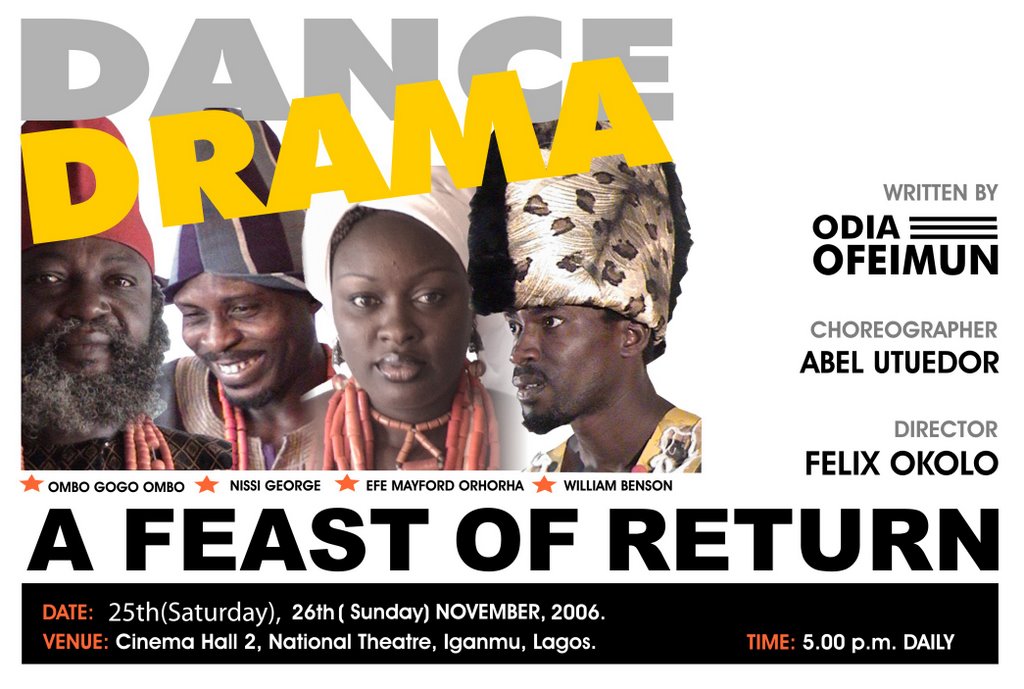
Odia's Abuja Feast
Monday, December 18, 2006
JasonDrama

A scene from Jasonvision's production of Ola Rotimi's play, The Gods Are Not To Blame. Directed by Wole Oguntokun, the play was staged in Lagos as part of the Muson Arts Festival, on October 28.
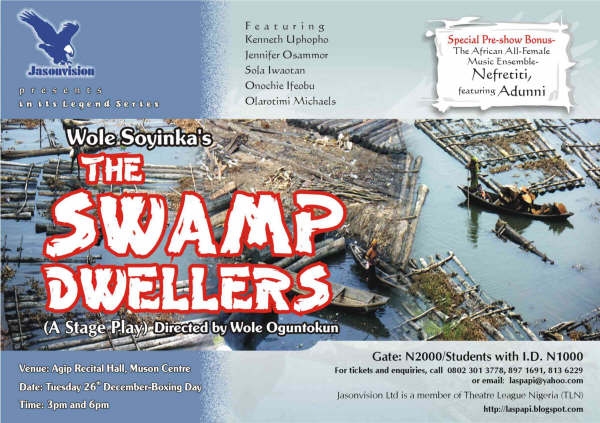
Wole Oguntokun is in the directorial mode again on Boxing Day. He directs Wole Soyinka's The Swamp Dwellers - as part of the Jasonvision Legend Series.The Swamp Dwellers is on at the Agip Hall, Muson Centre, Lagos, on Tuesday December 26 @ 3pm & 6pm.
Tickets cost N2000 for Adults/ N1000 for students (with ID).
There is a musical pre-show with the group, Nefretiti feat. Adunni.
For information & tickets, please call: 0802 301 3778 / 01- 897 1691 / 01- 813 6229.
- The Gods Are Not To Blame image - courtesy of Wole Oguntokun