Writings of the general word's body

Showing posts sorted by relevance for query bandele. Sort by date Show all posts

Monday, June 04, 2007

Bandele's Burma Boy

From Giles Foden's review of Biyi Bandele's new novel, Burma Boy...
Another pleasure is the sheer exuberance of Banana's own rhetoric. Here he is discovering, on arriving in India, that he is to be a muleteer: "'Mules?' Ali gasped as if he'd been stung by a driver ant. 'Do you know who I am? I'm the son of Dawa the king of well-diggers whose blessed nose could sniff out water in Sokoto while he's standing in Saminaka. I'm the son of Hauwa whose mother was Talatu whose mother was Fatimatu queen of the moist kulikuli cake, the memory of whose kulikuli still makes old men water at the mouth till this day. Our people say that distance is an illness; only travel can cure it. Do you think that Ali Banana, son of Dawa, great-grandson of Fatima has crossed the great sea and travelled this far, rifle strapped to his shoulder, to look after mules?'"

- Foden's review was published in the Guardian's Review of Saturday 2nd June. Read it here.

Femi Osofisan, James Gibbs & Biyi Bandele - photographed @ the British Library, 16 October 2005 © MW

~

In my article published last year (July 30, 2006; The Guardian, Lagos)Bandele talked about Burma Boy. Excerpt...
Bandele’s novel, The Street, is set in multi-ethnic Brixton, South London, where he once lived. "A lot of novels about Brixton tended to be by people living elsewhere," and ended up being "superficial takes" on the area. "When I lived in Brixton, there were a lot of creative people there who couldn’t afford to live elsewhere." Bandele wrote about such people.

His upcoming novel, Burma Boy, is set in Burma. "It is about my father’s generation during World War II (WWII)." It will focus on Nigerians but will not dwell much on Nigeria itself. "I don’t write about the Nigerian government anymore because I don’t live there; it would be hypocritical." Set in 1943, Burma Boy features two flashbacks, one to 1936 and the other to 1896. "I find I keep going back to the past to make sense of the present."

Bandele described the novel as "the story I’ve been preparing to write for a long time." An account of WWII as told by his father, was probably the first story Bandele ever heard. The author’s father returned from the war on April 1st 1945 and often talked about the experience. "It took control of him till the day he died," the writer informed. "I suppose listening to him made me want to write."

Sunday, August 05, 2007

Nollywood Or Bust


At the reading of his new novel Burma Boy on 21 June, Biyi Bandele disclosed that he was flying to Lagos in a number of days, to write a piece for the Observer on Nollywood. And today the result of Bandele's trip appeared in a 4-page spread in The Observer Film Magazine.
Bandele took a ride to the heart of the Nollywood industry, the suburb of Surulere in Lagos and interviewed 'prolific' directors who in just over a decade have knocked out 150 films; who talk of having stripped the 'excesses' of Hollywood (baffled at why a film takes 60 days to shoot when a Nollywood video-film takes far less) - who dream of attaining Hollywood standards regardless.
There's a brief run-through of the birth and ascent of Nollywood across Africa, and mention of a Nollywood classic, Living in Bondage. Bandele's piece is also very up-to-date, touching on a very public spat between Nollywood star Zeb Ejiro and an actress, Ibinabo Feberesima over a film titled - wait for it - "A Night in the Philippines." Bandele arrived for his pre-arranged interview with Ejiro to find the premises closed. A call to the star led nowhere, and then the line went dead. Even well known playwright-novelists can get the run-around in Nollywood.

Wednesday, May 09, 2007

Bandele on Goodbye Lucille

Segun Afolabi's first novel, Goodbye Lucille, is now out in the UK by Jonathan Cape. The novel was reviewed by fellow Nigerian Biyi Bandele in last Saturday's Guardian Review. Bandele, playwright and author of The Street, was born in Northern Nigeria to Yoruba parents from the Southwest - like Afolabi.
~
Caine winner Afolabi's collection of short stories, A Life Elsewhere, was published in 2006. And Bandele's second novel, Burma Boy, will be published this summer.
~

Monday, November 05, 2007

Wasafiri 52

The new edition of Wasafiri dropped in the post a couple of days ago and, though I am yet to read much of it, I can already tell this is going to be my best issue for a long time. The theme is 'The Book in the World' and features readers, writers and publishers.

15 writers talk about the books that changed them. Hence Biyi Bandele and his editor, Ellah Wakatama Allfrey share the same page as they discuss the books that changed things for them. I reasoned very much with Bandele's choice of early 80's Nigeria reading of numerous titles by James Hadley Chase - "an English writer now completely unknown in England (in nearly twenty years of living in London, I'm yet to meet a single British person who admits to having heard of him)." Tell me about it, Mr Burma Boy! Coulda said the same meself! Who'd have thought it, all those years we were chomping down James Hadley Chase? Still we were hooked on the stuff (my own early teenage reading went in stages: some 400 Mills & Boon titles from which I graduated to James Hadley Chase from which I graduated to Harold Robbins - with Sidney Sheldon and Jeffrey Archer stuck in-between; and when I left each stage, I could never bear the novel that marked that stage again. It's a good thing I read my fill of populism before the age of 16, because I couldn't abide populist novels from then on). I digressed. We were talking of Bandele's impression of James Hadley Chase novels, some of which he names: Like a Hole in the Head, You're Lonely When You're Dead, This Way for a Shroud, The Doll's Bad News, The Way the Cookie Crumbles, Well Now My Pretty, An Ear to the Ground, & The Vulture is a Patient Bird. Funny, I read them all too, though I don't recall the 'Vulture' one at all. I was somewhat disappointed Bandele didn't mention, Tell it to the Birds, Miss Shumway Waves a Wand and the one that had me completely gobsmacked all those years ago, 'Believe This and You'll Believe Anything'. Ah, bless!

Blake Morrison's choice would probably be mine, if asked - Midnight's Children. And here's how I discovered Salman Rushdie's 'Booker of Bookers'. The writer was just someone I knew from TV bulletins including words like 'blasphemy' and 'fatwa'; none of which particularly made me want to rush out to buy his books. And so I was on a Bakerloo Line tube train in January 1992 and there on the seat beside me in an empty carriage, was a brand new copy of Midnight's Children. Finders Keepers, ehn? Dear blog reader, I alighted the train with the book, and it's as if I've seen the world through perforated sheets from then on. I still have the copy.

Anyway, back to Wasafiri, which embraces all of those Journals any reader worth his or her salt in Africa ought to read these days: Kwani?, Farafina... there's even an interview with Chimurenga 's editor, Ntone Edjabe.

And there's a short story by Nigerian Uzor Maxim Uzoatu, 'Cemetery of Life'. I've read the story and I'm intrigued by it, seeing as I love all that magical-mystery stuff. I remember E.C Osondu telling me in an interview, that 'Jimmy Carter's Eyes' was his own "attempt at allegory". Perhaps 'allegory' would describe Uzor Maxim Uzoatu's offering in Wasafiri. Loved it, but still scratching my head as to what it really means...

Meanwhile, I'm off to read more of the magazine.

Thursday, July 05, 2007

Bandele Reads 'Burma Boy'


Biyi Bandele read from his new novel, Burma Boy @ the Lewisham Library, London - on publication day, 21 June. The author later discussed the book, about West African involvement in World War II - possibly the first novel on the theme. It was inspired by (but not based on) his own father's experience in Burma. Some in the audience also had African/Caribbean fathers who served in WII, and whose contribution and sacrifice has largely been overlooked in writings on the war. Wale Okediran (President of ANA - Association of Nigerian Authors) was at the reading as was Ellah Allfrey, Bandele's editor. She knew the author always wanted to write Burma Boy, so she pushed and encouraged him until he did. If everyone had an editor like that.

To the left is Alan Morrison of the Lewisham Library who organised the event. The library is laying on regular book events, many of which will be of interest to blog readers here. Malika Booker launches her book, 'A Storm Between Fingers' at the venue tonight. So those who can make their way to Lewisham High Street, London for 7.45pm, should do so.
Wale Okediran with Bandele at the reading. Okediran also held a meeting with
Book Aid International at their offices in London during his brief visit to the UK (BookAid pics at the next blog update).
  • Images by MW

Friday, December 21, 2007

Wasafiri Reading


Biyi Bandele...
the long
and the short
of it


Seeing a shaven headed Biyi Bandele at Wasafiri’s reading event of 22 November wasn’t all that shocking, as I’d run into him days before, on the 17th, at an Imperial War Museum event about African Soldiers who fought in the World Wars. One has gotten used to Bandele with flowing dreadlocks and seeing him without, takes some getting used to. The author doesn’t know what the fuss is about. He grew the locks while writing his last book, Burma Boy, and now that it’s finished... (a new book in the works? Hmn...)

Wasafiri Magazine launched its 52nd edition with an evening of readings and wine, and the venue was Foyles Bookshop on Charing Cross Road, London. The Magazine asked: “Why do some books make a particular impact on our reading and writing lives? In what ways do they return to us? When, why and how did we first encounter them?” These are the questions posed in the new issue, in which writers and publishers talk about the book that made them. Chaired by Robert Fraser, readers on the night grappled with the same questions after reading from the books that ‘made’ them.

The readers were Maggie Gee (who on learning that Lily Allen is to be a judge of the 2008 Orange Prize, has asked: “Where is the seriousness here?”); Rana Das Gupta (whose talk centred around the fact that he actually doesn’t read novels, though of course he writes them!); Biyi Bandele and Pauline Melville (author of The Ventriloquist’s Tale). Melville started her reading with the line that lured her into writing, the opening of Gabriel Garcia Marquez’s One Hundred Years of Solitude. I patted myself on the back for recognising it, even before Melville reveal the book and author from whence it was taken.

In the audience: Linton Kwesi-Johnson, Bernadine Evaristo and many more.
Images © MW

Wednesday, June 20, 2007

In London, 21st June

In Ali, I tried to capture the innocence of the African soldiers, set apart from an ideology that forced them to fight a war about which they knew nothing. But Ali is not angry; he is a boy excited by the prospect of war and a new country. Isolated by his youth and keen to impress, he allowed me to explore the humour that surrounds a group of young men and the horror that comes with being African Chindit soldiers in Burma.

The story I wanted to tell is not just the story of my father. It is the story of every African soldier who fought, of everybody who was touched, however unknowingly, by the exploits of the Chindits.

- Biyi Bandele on his new novel, Burma Boy. Read more on his Myspace page.

Monday, March 31, 2008

Biyi Bandele Tours Nigeria


Biyi Bandele tours Nigeria with his WWII novel Burma Boy, published in a West African edition by Kachifo.

  • He's in Lagos on 5th April
  • Kano - 8th April
  • Abuja - 9th April
  • Port Harcourt - 11th April

Tour co-sponsored by the British Council. Click on the below for more information.


Monday, September 03, 2007

On Afolabi's 'Goodbye Lucille'

Excerpt from Toyin Akinosho's Artsville Column...

Goodbye Lucille - Is This The Same Writer?
Segun Afolabi's Monday Morning, the short story which delivered the Caine Prize to him in 2005, feels like a slow, tentative story of an immigrant uncertain of his new space. With another deliberative short story in The Obituary Tango, an anthology of Caine Prize entries, it is easy to assume that Afolabi would come
to be known as a "soft", carefully measured stylist. The publisher Muhtar Bakare actually describes the Kaduna born scribe as "restrained and.. subtle". But first impressions aren't always a complete take. Afolabi's just published first novel, Goodbye Lucille, about another immigrant in Europe, begins with a furious pace, such that four distinct characters had shown up by the second page; Vincent, the struggling photographer who is at the heart of the story; his girlfriend Lucille who he left behind in London to hustle in Berlin; Marie, the magazine editor and Henrich Henkleman, the politician whose murder sets much of the tone of this 308 page narrative. And in less than 1,000 words, all of these characters are already sufficiently described we can picture what they are. Farafina's decision to publish Goodbye Lucille is in sync with its tradition of seeking out Nigerian winners in publishing houses in Europe and America and giving them audience at home. The same principle informs the company's release of the Nigerian version of Biyi Bandele's Burma Boy and much earlier, Chimamanda Adichie's Half Of A Yellow Sun. Such strategy certainly serves a socially responsible purpose; a growing tribe of Nigerian writers live and write abroad and they are getting the attention of European and American critics as they beat western writers hands down in contest for some of the most important literary awards. But it is easy for these authors not to be known in their home country, as the publishing houses don't think very highly of having outlets in the supposedly dark continent. To the extent that most of these stories are essentially Nigerian, Farafina fulfils the need of letting the home audience get more than a glimpse into life in the diaspora. In November, these sort of stories will form the basis for a panel discussion: Writing In: Tales From The Diaspora, which will feature readings, reviews and discussions around Afolabi's Monday Morning, Biyi Bandele's The Street, Chimamanda Adichie's That Thing Around Your Neck, Diana Evans' 26A, Helen Oyeyemi's The Icarus Girl and Diran Adebayo's Some Kind Of Black. This conversation is one of the main events of the 9th Lagos Book And Art Festival, holding at the National Theatre from November 9-11.

Monday, September 11, 2006

Brixton Stories


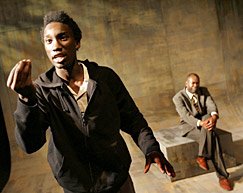
Biyi Bandele's play, Brixton Stories, opened at the Lyric, London on 5th September. It follows Ossie and his daughter as they walk the streets of Brixton - also the setting of Bandele's novel, The Street.

Brixton Stories is @ The Lyric until September 23.

  • Photo: Production image

Sunday, September 16, 2007

LABAF

9th Lagos Book & Arts Festival
Theme: Literacy As Democracy Dividend


November 9-11, 2007
National Theatre, Iganmu, Lagos

Key Literary Events

Panel Discussions. Diaologues. Conversations. Artshouse Parties

Artshouse Parties

(a.)Opening Reception-50 Years Of Things Fall Apart Groundbreaking ceremony for the series of worldwide events starting January 2008: 10am, Friday, November 9, 2007

(b.)Book Presentation-A Voyage Around Wole Soyinka, by Gerd Meuer

Colloqium

12 Noon on Friday, November 9, 2007


  • Theme: Constructing a Nation: 40 Years after the first shot in Biafra.
Reviews, readings and discussions of Civil War Literature; Novels, Drama and Non Fiction Works including Ekwensi’s Divided We Stand, Chimamanda Adichie’s Half Of A Yellow Sun, Dulue Mbachu’s War Games, Olusegun Obasanjo’s My Command, Eddie Iroh’s Toads Of War, Chukwuemeka Ike’s Sunset At Dawn and Rasheed Gbadamosi’s Echoes From The Lagoon.


  • (2)INTERNATIONAL DIALOGUE 2.30PM ON FRIDAY, NOVEMBER 9, 2007
    Theme: Challenges of Liberal Democracy In Africa
    William Mervin Gumede, author of Thabo Mbeki and The Battle For The Soul of the ANC spars with Dare Babarinsa, author of House Of War

  • (3.)PANEL DISCUSSION 12NOON ON SATURDAY, NOVEMBER 10, 2007
    Theme: MENDing the damage: Literature and the Niger Delta Crisis
    A panel discussion on Literatures borne out of the Niger Delta crisis Discussants include Oronto Douglas(Where Vultures Feast), Ken Wiwa (In The Shadow Of A Saint), Ahmed Yerima (Hard Ground), Nicholas Shaxson (Poisoned Wells), and Kaine Agary(Yellow Yellow)

  • Arthouse Parties-Part 2 2-3PM Saturday, November 10,2007. Music, Wine and Dance For Fatai Rolling Dollar at 80, Femi Asekun at 75, Tunde Oloyede at 60, Yemi Ogunbiyi at 60. Bandstand: Fata Rolling Dollar, Seyi Solagbade, Adunni Nefretiti

  • (4.)SYMPOSIUM 3PM ON SATURDAY, NOVEMBER 10, 2007
    Theme: Writing In: Tales from the Diaspora
    THE EMERGING Nigerian literature outside the borders of Nigeria Features discussions of Segun Afolabi”s Caine award winning short story Monday Morning, Biyi Bandele’s The Street, Chimamanda Adichie’s The Thing Around Your Neck , Diana Evans’26A, Helen Oyeyemi’s The Icarus Girl and Diran Adebayo’s Some Kind Of Black

  • 2PM ON SUNDAY, NOVEMBER 11, 2007 ART STAMPEDE
    *The Myth and Realities Of A Golden Age Of Book Reading.
    Chair: *Uncle Steve Rhodes Panelists: *Rasheed Gbadamosi,*Mobolaji Adenubi, *Akin Adesokan*Dulue Mbachu.

* Not yet confirmed.

Sunday, December 23, 2007

Books of 2007


My compilation of Writers' Books of 2007 has been published in the new 'Holiday' issue of African Writing. Biyi Bandele's Burma Boy and Helon Habila's Measuring Time - are 2 of the hot picks this year.

Here's how E.C. Osondu introduces his chosen books:
"It was a cruel, gray, typical upstate New York winter. I was teaching in a small college in the outskirts of the city. It was a long forty-five minutes’ commute and the only thing of interest en route was the burial place of a female missionary Laura Maria Sheldon who had tried to convert the Seneca Indians. And of course there was the sprawling Onondaga cemetery where I once counted ten tombstones with the name Muldoon as the bus crawled past."

Already a story there, no? Other contributors include: Brian Chikwava, Blessing Musariri, Wadzanai Mhute, Aminatta Forna, and Akin Adesokan.

~ ~ ~

I have also contributed images from the PEN Women's Conference in Dakar to the new issue of Ponal.

Tuesday, September 25, 2007

Blood in the streets?

I am currently reading Biyi Bandele's novel, 'Burma Boy'. I asked my son to fetch me the book from the room some days ago and the child corrected my pronounciation. "BURMA - it's got an 'R' in it!" Insult upon injury, I thought as I rolled my eyes at him...

But seriously, these peaceful Burmese monks marching in their thousands for 7 days now in defiance of a repressive military regime - have given me my greatest inspiration this year. Herein lies my image of 2007. I keep looking at this river of red and I think of poppies. Or blood. A river of blood? The military junta has imposed a curfew and banned gatherings of more than 5 people. What happens now? Will the blood of revered monks be shed? Will this red river of humanity turn into blood?

"You can't have a massacre on YouTube" - said Tim Marshall on Sky News tonight.

Or can you?

Sunday, November 04, 2007

Okediran @ BAI

It’s ANA’s Conference season (the 26th annual convention is on in Owerri, Nigeria, this weekend) presided over by the ANA President Wale Okediran. What better time to recall some of the ways in which Okediran represents the Nigerian writers’ body on trips to Britain? And so to something that ought to have been blogged long ago (the words ‘good intentions’ and ‘pot’ come to mind). I tagged along when on 21st June Okediran paid a visit to the offices of Book Aid International (BAI) on London’s Coldharbour Lane. There he was met by Karen Edwards (Programme Manager for West Africa, the Horn of Africa & Sri Lanka) and 3 other members of BAI staff, including Nelly Temu Williams.

Book Aid International works to promote literacy by creating reading and learning opportunities for disadvantaged people with limited access to books and library facilities. The organisation works in partnership with groups in 18 countries, 16 of which are African nations.

As Karen Edwards informed during the visit, BAI’s Nigeria programme is its largest, with 52 requests for books from different organisations in the country between January to June alone. BAI has been working in Nigeria since 1964; the most populous African nation gets over 75,000 books a year – half a million in the last 6 years.

Unsurprisingly, for anyone who knows anything about Nigerian Ports, clearing the books on the Nigerian end can be a challenge. These were some of the issues on which BAI was looking to work more closely with bodies like ANA (Association of Nigerian Authors) in order to smooth the process. Okediran discussed these challenges with the team and also shared information about initiatives back home including the Nigeria Reads Project.

Nelly Temu Williams of the BAI Policy & Advocacy Team took Okediran on a tour of the Book Aid International’s warehouse. The organisation does not receive government funding and depends on private donations. Volunteers help vet the books received, and publishers who donate are asked to send high quality books covering many topic, so that the warehouse has sections for textbooks on many subjects as well as fiction. All are high quality, contrary to the popular view that initiatives like BAI are just a way to dump poor quality books on Third World Countries. At BAI, books that don’t meet the required standard are sent to the recycle bin. The tour ended with a viewing of crates reading for shipping to many counties, including Nigeria.


Sunday, September 24, 2006

Muhtar Bakare's ASAUK Paper

Panelists were asked to consider some of the key themes in the recent literature produced by migrant African writers such as leaving, journeying, and managing cultural difference. They also debated the broader context of Diasporic writing. To what extent has this new literature eclipsed or erased writing emanating from the African continent itself? Does the difficulty of publishing within Africa mean that we will only learn about contemporary African experiences as the Diaspora mediates them? What kind of connections are emerging, or might in the future emerge, between publishers in Africa and writers in the Diaspora?

I will start by providing an overview of our business and against that background, attempt to look at the challenges of publishing in Nigeria, from the perspective of an entrepreneur who takes up the task of making culturally useful and commercially viable books available to the reading public. I will draw largely from my own experience over the last two years, to comment on the specific questions posed to the panel.

Background – Starting Out
We started as a free online magazine, publishing prose and poetry by contemporary Nigerian writers. It proved to be a useful strategy. This was how we first made contact with Chimamanda Ngozi Adichie, Sefi Atta, Aniete Isong, Molara Wood, Akin Adesokan, Igoni Barret, Tolu Ogunlesi, Ike Oguine, Chika Unigwe, Toni Kan and many others. These writers were not only scattered all over Nigeria, but also all over Europe and America. Start-up costs were low and we had an immediate global reach. Which would prove useful later on, in commissioning new articles or titles, and in contracting out editorial work.


We established a presence among literary enthusiasts and started building up a reputation as a credible outlet for good quality contemporary Nigerian writing. It is interesting to note that as far back as 2004, we had published online, an earlier version of a short piece called Fide by Chimamanda Ngozi Adichie. Another version of Fide was published earlier on this year in The New Yorker. When her first Novel, Purple Hibiscus, was later released in the US, we built on our existing relationship, to persuade Harper Collins to sell the West African rights to us. We had an initial print-run of 13,000 in late 2004 and have since sold over 12,000 copies. A year later, we released our second book, Everything Thing Good Will Come by Sefi Atta, whom we also met on the Internet. Sefi recently won the first Wole Soyinka Prize for Literature in Africa. We printed 5,000 copies of Everything Good Will Come in late 2005 and have sold over 4,000. We are about to order an additional 5,000 copies of each novel.

Today, we are set to release six new titles before the end of the year. Two of them; Half Of A Yellow Sun by Chimamanda Ngozi Adichie and The Activist by Tanure Ojaide are works of fiction. I am particularly proud to say that for these two titles we negotiated the rights directly with the authors. The other four, which are non-fiction, are: The Architecture of Demas Nwoko by John Godwin and Gillian Hopwood; Celebrated: Nigerian Women In Development by Ayona Aguele-Trimnell; June 12: The Struggle For Power In Nigeria by Abraham Oshoko; and Social Studies For Nigerian Schools by Adisa Bakare, Ayisha Belgore and Eniola Harrison, in collaboration with the faculty and staff of The Corona Schools Trust Council.

In all, we plan to release about 50,000 books into the market this year. In 2007 we plan to do no less than 200,000 books depending on how the elections go.

Background - Historical Summary
Book publishing in Nigeria is a colonial legacy with which the legatees have not yet come to terms. Although the industry was established to serve colonial commercial and political interests, Nigerians quickly embraced it for their own benefit. There existed at that time and in immediate post-colonial Nigeria, an active and growing reading public. The educational system was good. The university system produced and nurtured world-class talents in the arts and sciences. It was not unusual for novels to sell in tens of thousands. Authors such as Chinua Achebe, T. M. Aluko, Ngugi Wa Thiong’o, Chukwuemeka Ike, Cyprian Ekwensi, Naiwu Osahon, Wole Soyinka and Kole Omotosho were household names. The highest circulation newspapers sold as many as half a million copies daily.


Things began to fall apart for the Nigerian publishing industry when the military first intervened in the political arena in the early sixties. They went on to destroy all social infrastructure. They mismanaged the economy and entrenched a culture of corruption. They added little to the infrastructure of commerce and allowed whatever existed hitherto to fall into disrepair. Of particular significance was their destruction of the educational system. This is would have wide-ranging consequences for a country where the language of the inchoate national culture, English, was not indigenous, but learnt in school.

The universities, being the centre of opposition to the military tyranny were especially targeted for decimation. The institutions were routinely shut down, with academic calendars disrupted. Outspoken academics were harassed and hounded into exile. The result has been a long and steady migration of some of the most brilliant teachers and academics from the country, as well as an erosion of literacy and literary culture.

The Literary Landscape Today
Today, forty-six years after independence from Britain, what remains of the industry is mainly licensed from British publishers and concentrate almost exclusively on the production of textbooks. A number of Nigerian independent publishers exist, but they also focus mainly on textbooks. About 90% of all the published books in Nigeria are for Primary and Secondary education. There are over 17 million children in primary and secondary schools at any point in time. No wonder everyone is trying to corner the textbook market.


It is generally accepted that there are about 130 million people in Nigeria. 42% of them or 55 million are below the age of fourteen. The national literacy level is put at about 68%; that is; 68% of the people over 15 years old, who can read and write, presumably in English. That is 68% of 75 million or 51 million people. This is a very attractive market size indeed.

Literacy And New Materials
Regardless of what statisticians say, employers of labour have for the last decade or so bemoaned the decline in the literacy of graduates from the various educational institutions. A cursory review of the leading quality newspapers in the country gives a good idea of how well the average Nigerian uses the English language today. This is a big deal for a publisher in a country where literacy in English easily dwarfs literacy in all the indigenous languages, and where publishing in the local languages remains, a small fragmented niche.

Since the military were forced out of power seven years ago, there has been some sort of rekindling of nation-building and cultural activities. Literature usually presages such development; as people try to articulate and codify the complex interplay of social and political forces transform society around them. We certainly do not lack for submission of new materials. Majority of the manuscripts we do receive however, even if not lacking in imagination in terms of conception, are seriously deficient in their use of English. The reality facing commissioning editors, is that a great deal of editorial input is required to get the overwhelming majority of manuscripts into any publishable condition. To compound this serious problem, good quality editorial talent is no longer readily available in the labour market.

It is not that highly literate writing and editorial talents do not exist, they do, but the structure of the economy is such that they can only be employed in those sectors of the economy, such as oil and gas, finance and lately, telecommunication, with the requisite levels of investment capital to pay the kind of wages they command. Since the mid-eighties, the publishing industry has not made the necessary investments in commercial infrastructure that is required to extract its fair share of the massive value inherent in a market of 130 million people. And so, we have some of the most talented writers and editors resident in our country today, working in oil and gas, finance and the telecommunication industries.

It is not an accident therefore that some of the most insightful and engaging pieces published by our magazine have been contributed by these amateur but accomplished writers who earn their living as lawyers, financial consultants, engineers, web designers, and doctors. And of course, we are also compelled to reach out to Nigerians living abroad, who through their access to more stable creative environments, enjoy the mediation of more mature publishing industries, to produce quality work that remain faithful in their attempts to tell our own stories, on our own terms.

I must point out here, that the themes of leaving, journeying, and managing cultural difference are marginal in the novels produced by writers such as Chimamanda Ngozi Adichie, Helon Habila, and Sefi Atta who still have very strong ties with Nigeria. These writers and some others, might have journeyed, they certainly have not left. They wrote and continue to write novels about Nigeria and Africa, which are firmly rooted in Nigeria and Africa. And although the work of writers of African descent who are more rooted in the West, such as Biyi Bandele, Diran Adebayo, the prodigiously talented Helen Oyeyemi and more recently, Diana Evans may explore the theme of cultural differences, nonetheless, I suspect that, for now anyway, they are here in the West to stay. Some of them were born here in the Diaspora, and are not particularly hung up on leaving (Africa) and journeying (to the West).

My interaction with a cross-section of contemporary African writers living in the West, suggests that they are slightly irritated by this constant attempt to pigeon-hole them and thereby tele-guide their work toward certain directions pre-determined by the all-powerful gatekeepers of the Western cultural establishment.

I will leave this matter for now, to the academics who are perhaps better qualified than I am to pontificate on them, and dwell a little on the difficulty of producing and selling books in Nigeria.

Production, Packaging and Commercial Infrastructure
The greatest impediments to the growth of a local publishing industry in Nigeria include


II
The low level of investments by existing publishers in their own businesses:

Even if they know what it takes to produce good quality books at affordable prices, or what it takes to persuade the 50 million or so literate Nigerians and their 10 million kinsmen scattered all over the world in the Diaspora to buy them, or what it takes to distribute these books efficiently throughout a country four times the size of Britain, while at the same time collecting all their sales proceeds, Nigerian publishers have not been successful in marshalling all the requisite resources together. The industry is obviously not well capitalized and even if competence exists, capacity is severely undermined.

II
The dearth of the required commercial infrastructure to support the industry.

Distribution and retail networks are limited, fragmented and as challenged as the publishing houses themselves in terms of scale, capacity and outlook. Also, commercial contracts are very loose and difficult to enforce. Collection of sales proceeds is very problematic, putting severe financial strain on publishing businesses.

III

The collapse of basic social services such as

  • Electricity supply
  • Good road network
  • Reliable postal services
  • Affordable telecommunications.
These make the cost of doing business prohibitive, discourage investments and lead to the easy option of sacrificing quality for cost.

All these issues are extensively and sensitively discussed in the book, The Ordeal of The African Writer by Charles R. Larson, which I strongly recommend to anybody who is interested in the subject.

With respect to the question posed at to;

What kind of connections are emerging, or might in the future emerge, between publishers in Africa and writers in the Diaspora?

I will like to say that all these financial and infrastructural challenges will continue to make the connections between publishers in Africa and writers in the Diaspora more emotional than financial. For as long as most Africans, either by choice or otherwise remain on the continent of Africa, the most business-minded of our writers in [the] Diaspora or their agents will eventually come to understand that no matter how successful African writers may be in the West, until the Western literary establishment stops categorizing them as ethnic or minority writers, their natural markets will remain in Africa. There are strong indications to suggest that, until they are embraced by the mainstream imprints, they may have strong prospects of selling more books in Africa, especially if they work with the right publishers who are, as we say in Nigerian politics, on the ground. They must also write on themes that are relevant to, and topical in, Africa.

For us publishers to continue to engage and maintain these relationships and also to nurture home-grown talents for the potentially larger and more lucrative media markets in the West, we will have to overhaul our business models, make the necessary investments and modernize, just as other sectors of the Nigerian economy are now doing and quite successfully too.

Mobile Phones, Nollywood and Banking
Data coming from the 5-year-old GSM phone industry may give an insight into the purchasing capacity of the Nigerian consumer. With an estimated 10 million subscribers, spending an average of 10 dollars every month, Nigerians spend about 100 million dollars every month in settlement of their mobile phone bills. Those of us in publishing are being compelled to ask ourselves, how come the average Nigerian is willing to spend about ten dollars every month on phone bills and yet not willing or able to spend a comparable amount on books? The Home Video industry is even more comparable to publishing. However, despite the fact that it is barely 13 years old, and totally homegrown, it is already reputed to be the third largest film industry in the world. The industry sells units of its products in millions, all over the world, wherever there are African people. A conservative estimate puts the annual income generated by this industry at over $250 million. The commercial success of this industry suggests that there may be a disconnect between contemporary Nigerian literature and its natural markets. In the words of award-winning novelist Sefi Atta Nigerians will buy novels in their hundreds of thousands if they see their own stories or aspirations in those novels. Ntone Ejabe who edits the very cool and admirable literary magazine Chimurenga, out of Cape Town, sums it up thus: The most authentic Nigerian stories are best read on video.


It is commonly argued these days that Nigerian videos are so successful because they tell our stories, unapologetically, on our own terms. And those stories resonate deeply with the millions of black people all over the world who watch them every day. This for me, answers succinctly the following questions put before this panel:

To what extent has this new literature eclipsed or erased writing emanating from the African continent itself? Does the difficulty of publishing within Africa mean that we will only learn about contemporary African experiences as the Diaspora mediates them?

Speaking from a Nigerian perspective, I do not think there is any chance of any literature produced outside Africa eclipsing those produced inside Africa. What is important in my view is how relevant the contents of the works are to the target audience and the capacity of the publisher to push the product in the target markets. The current popularity of the so-called contemporary Nigerian Diaspora writing is due mainly to the relevance of those novels to the Nigerian situation and also to the very focused marketing activities of their Nigerian publishers. After all, there are many very successful African writers who are celebrities in the West but are barely known or read outside the literary circles in their home countries.

How the West chooses to learn about contemporary Africa is the prerogative of the cultural gatekeepers in the West. I will concede though, that those of us publishing in Africa can certainly do more to push the best of our wares out here in the West. And this will be easier to accomplish, once we have made the necessary investments and the appropriate structural changes to our businesses.

In conclusion, in terms of sheer ambition, chutzpah and achievement, the Nigerian industry that its publishers have the most to learn from is banking. When Nigerians first entered that industry 16 years ago, foreign banks and the local remnants of colonial banking interests dominated. (Very much like in publishing today) Within 16 years, Nigerian entities have invested about 5 billion dollars in the industry, which they now dominate, pushing the banks with foreign interests to the margins. They have grown beyond the shores of Nigeria, through West Africa and are even looking beyond. They did these by investing the necessary capital, buying the requisite technology, hiring qualified, talented business expertise and adopting business models that have been proven elsewhere, while remaining sensitive to Nigerian peculiarities.

These steps taken by the nascent investors in the Nigerian banking industry 16 years ago are my same recommendations to our publishers today, to see us to an equally glorious future. Thankfully we never really have to re-invent the wheel.
  • Muhtar Bakare of Farafina, Kachifo Limited, Lagos Nigeria, presented this paper at the African Studies Association UK Biennial Conference 2006, held at The School Of Oriental and African Studies, University Of London, on September 12, 2006.