skip to main |
skip to sidebar
Books of 2006 as selected by Nigerian writers - part three, as published in The Independent, Lagos, on Sunday 4th February.
Compiled by Molara Wood...
Akin Adesokan - author of Roots in the Sky
Without question, the best book I read during the passing year was Ayi Kwei Armah's memoirs, The Eloquence of the Scribes (Popenguine: Per Ankh, 2006). In fact, it's not an exaggeration to say that it is one of my most memorable and fulfilling reading experiences ever. Armah has spent the past thirty years developing a sense of the substance and style of African literary culture, and the book is a product of that research. Although the self-effacing author talks about himself a little, the bulk of the book focuses on the historical continuum of the scribal tradition on the continent, from the current state of what we call African literature, through the feudal period of the griots to ancient Egypt. This might sound somewhat arcane, but the beauty of the book, sustained by Armah's fine writing, lies in how the socio-economic dislocation on the continent provides the impetus for the research, and that gaze on the here-and-now never falters for a moment. It's an extremely enjoyable book by a writer of great sensitivity.

Gary Younge has collected his journalism of the past four years into a rich and quick-witted book, Stranger in a Strange Land: Encounters in the Disunited States (The New Press, New York; 2006). I've long been familiar with his work in The Guardian (London), so it was good to discover that when he moved to the US in the early 2000s, he set up shop with The Nation. The pieces in the new book are collected from his column in that magazine and elsewhere and they are written with an abrasive perceptiveness that's now rare in political journalism in the US. He's also well-read, and unlike Christopher Hitchens, who moved likewise from the UK to the US and has moved on to the right, Younge doesn't wear the erudition on his sleeves. The sociological tendencies in his writing - the statistics, the percentiles - aren't much to my taste, but those are often relieved by the broad allusions to music, art, literature, and a passion for what goes under the radar. And he's readable!
Diana Evans - author of 26a
Two books I enjoyed this year are: Lucia Joyce: To Dance in the Wake by Carol Loeb Shloss - a biography of James Joyce's daughter Lucia, a gifted dancer, plagued by her father's work and her confusing upbringing, and eventually institutionalised as a young woman for the rest of her life. One of the most thoroughly researched, sensitive, graceful and exacting biographies I've ever read. The Victorian Chaise-Longue by Marghanita Laski - a short and spooky novel about a sick woman who falls asleep on a chaise longue and wakes up in a cruel set of circumstances in Victorian England. I loved its quirkiness, the sense of space and precision you can only get with short novels, and its firm hold on character. In places it made my skin crawl.
Wole Oguntokun - playwright
You Must Set Forth At Dawn by Wole Soyinka (Bookcraft): Soyinka's book is a chronicle of happenings, some long forgotten in this country, but nonetheless highly relevant. Described as the memoirs of a great writer's journey through life, it also serves as a nation's memoirs. It reminds us of those who fought that the country might stand and forces us to face up to how far we have fallen now. I had long seen the importance of documenting the affairs of a nation through different eras, and the events and people that helped the country to its feet or forced it to its knees as the case might be. Soyinka's book takes us through some of the roughest patches Nigeria ever went through and makes us realize Mandela is not the only African hero. I believe it will come to be regarded as one of the best books ever written by him. For me it is one of the best I have ever read.

Nigeria-The Birth of Africa's Greatest Country Volumes I & II- From the pages of DRUM: The Spectrum book collated from the pages of Drum Magazine contains pictures and stories prior and subsequent to the independence of Nigeria. Events which have become the stuff of legend are backed up by photos and eye-witness accounts. A compulsory acquisition for all Nigerian homes, one is able to slip back in time and re-live great moments in Nigerian history. I sat with my mother who is 33 years older than I am, and two different generations were able to discuss and share the pleasures of the greatness this country once had.
 Ike Okonta - co-author of Where Vultures Feast
The Eloquence of the Scribes by Ayi Kwei Armah; Saturday by Ian McEwan; Wizard of the Crow by Ngugi Wa Thiong'o; and The Next Gulf - London , Washington and Oil Conflict in Nigeria by Andrew Rowell et all. These books are timely and bracingly urgent in these day of the so-called War on Terror. They affirm the role of the writer as witness to truth; they speak to the enduring power of beauty and truth in a season when we fear these verities are about to disappear in our world. But above all, they affirm the resilience of the human spirit in times of adversity and war-mongering.
Femi Osofisan - playwright
Among the books that have made an impression on me, are Wole Soyinka's You Must Set Forth At Dawn, and Chimamanda Ngozi Adichie's Half of a Yellow Sun. Soyinka of course impresses by the quality of his writing, which I believe gets better and better every year, mellowing like his favourite drink. Some passages are really delicious to read. I am impressed by the kind of life he's led, (under the tutelage of Ogun), and by the array of world leaders and writers that he's interacted with in his restless life. We must always remember of course that these are his own accounts, necessarily selective, and subjective. Sometimes I can't help wishing that he had not written it himself, but that it was someone else writing it about him. But particularly fascinating, to me, are those moments when events tally with his intimations of supernatural presences... such as the night he escapes from Nigeria, and quite fortuitously an ancestral masquerade is out to welcome him across the border, just like in Isara; or the night in Israel, when spiritual forces tell him in advance of Abacha's death and of the coming restoration. The rhythm of Kongi's prose at such moments cannot but entrance you.
As for Adichie, I am impressed by her imaginative scope, the way she has been able to marshal these details into a coherent, sometimes moving narrative. Her prose is also, as usual, superb. And her theme: it is daring, to reawaken these traumatic events that many would want, if not forgotten, but at least forgiven. And this is where I have questions. In my view, such evocations can be justified by only one purpose, and that is to bring healing and reconciliation. But I'm afraid, this book is not likely to do any of such, only reopen and perhaps deepen the hurt of those who feel, rightly or wrongly, that they have been victims. Perhaps she is satisfied with that? There is so much pain in this account, and little about the uncelebrated but heroic people, on both sides, who fought to bring reconciliation, redress wounds, lessen the acrimony. Adichie is of course too clever to be completely partisan, but the strength of her prose, of her descriptive moments, is sufficiently telling. I am also frankly amazed by her total confidence in dealing with sex. I read somewhere where she said she was worried what her father would say about it. Yes, I too would want to know his opinion. I am also ambiguous about these privileged middle-class heroes who can afford servants amidst the terrible suffering of the common people all around them, but I suppose their story is part of the history, and someone has to tell it. But all in all, I found it a delightful book to read; Adichie's talent and maturity are startling; and it is superfluous of me to say, once again, that we have captured a major talent here.
Chika Unigwe - author of The Phoenix
Edward P. Jones' The Known World was published about two years ago, but I read it this year and I was bowled over. The language is brilliant and the subject matter (it deals with the slave trade in America, at a time when even blacks owned their own slaves) - interesting. I am re-reading it at the moment and I am as thrilled with it as the first time. Tahir Shah's Beyond the Devil's Teeth is an amazing travel narrative. It is creative non-fiction at its best. It is a very honest account of Shah's travels through India, Brazil, Kenya, Uganda and Rwanda. He recounts his experiences with humour and an eye for detail. He creates a very visible world with words and engages all his readers' senses. I am recommending this to everyone who loves good writing.

Nike Adesuyi - Poet
My books of the year are Seeing Double by Patrick Wilmot and Wole Soyinka's You Must Set Forth At Dawn. I love Seeing Double (Jonathan Cape) for its expansive, swashbuckling, hard-hitting narrativity and activist- historicity - not to mention its hilarity. I found it very educative, enlightening and intellectually stimulating.
You Must Set Forth At Dawn: I love it because it's, well, a Soyinka book - Yes! But more to the point because, it unlayers and humanifies the mythical Soyinka. Plus it’s full of the intoxicating Soyinkaesque turn-of-phrases that gave me a delightful buzz.
Chimamanda Ngozi Adichie - author of Half of a Yellow Sun
I haven’t read much fiction published this year; MG Vassanji’s The In-Between World of Vikram Lall (Canongate; 2004) was not published this year but is the work of fiction I most enjoyed. Elegantly-written from the point of view of a Kenyan man of Indian descent, it casts a clear and honest eye on race and nationalism in Kenya while never forgetting that the soul of a novel is character and emotion.

Ayi Kwei Armah’s The Eloquence of the Scribes (Per Ankh; 2006) stimulated me in the most wonderful way: whether I was nodding in agreement or fiercely disagreeing, I was always applauding. And I did not think I would enjoy an anthology called Outsiders Within, Writings On Transracial Adoption (South End Press, 2006) as much as I did. It is a collection of writing by people adopted transracially and to be let into their worlds was eye-opening and moving.
Afam Akeh - author of Letter Home
I expect to be lost in a long queue of readers choosing Chimamanda Ngozi Adichie’s Half of a Yellow Sun as one of their memorable books of 2006. This popularity of the novel is hung on three factors, each as important as the other: It is a well written story, on a memorable, still controversial, historical subject, and both writer and book are well exposed by their handlers. This author enjoys the level of publishing support most other emergent and even established Nigerian writers may only dream about. Extensive professional support in the editing, scheduling,  placement and promotion of her work means that Adichie has a huge impact on critics and readers of her work. But her good fortune with the publishing process is sustained by the fact that there is also excellence and integrity in her writings, demonstrated now over two novels and other shorter pieces.
There is a Biafran scar in the memory and conscience of the world. As the subject of fiction, it is a gift in the hands of any competent writer – and competence is what Adichie triumphantly demonstrates all through this searching investigation of the weaknesses of the human heart, and failure in human purpose. In Adichie, humanity may not quite be the utterly doomed project of some Grecian tragic vision, but the human is certainly for her a flawed being, with every life its blemish. In what does become a committed search for failure even in the lowly human (no fantasies of perfectly obedient and powerless servants here), Adichie’s authorial eye is unsparing. Sisters Olanna and Kainene, and the men in their lives, those distracted moments of intellectual banter in the narrative, the mature, unemotional mapping of treachery and conflict in human  relationships – Adichie makes them live in the memory of her readers. And there are still the carefully selected and planted images and echoes of a war without winners, all the plot-thickening and other cinematic devices by which this narrative begs for some stage or screen – such evidence of due labour in the writing that finally reveals Adichie as deserving of every support and respect accorded her. What else would I like to see? Adichie, engaging more with ideas. The truly great novelists of history were not merely outstanding artists; they were quite often also remarkable visionaries.
Jude Dibia - author of Walking With Shadows
Half of a Yellow Sun by Chimamanda Ngozi Adichie: Seldom has a writer been able to capture the essence of a gloomy time like Adichie does with this, her second book. I bought a copy from London Heathrow Duty Free on my way to Boston in October and before the six hours flight was over I had already covered more than half of this epic book. Adichie has been able to recapture a history that Nigeria still pretends never happened and she has done so wi th memorable characters. I will not forget in a long time Ugwu, Olanna, Odenigbo, Richard, Kainene and the other rich characters that made this book thoroughly enjoyable yet haunting.
26a by Diana Evans (Chatto & Windus, 2005): Diana Evans' debut novel about two very different twins and the changes they go through when growing up and dealing with life and its issues, was very enjoyable. In a style almost similar to Toni Morrison, she captures the psychological tearing apart of these two women and the tragic event that took place in Nigeria that was to lead to the eventual demise of one of them. This was a very strong novel with deep and thought provoking themes that left me breathless at the end.
Uche Nduka - author of Heart’s Field
Half of a Yellow Sun (Knopf, 2006) by Chimamanda Ngozi Adichie: This marvellously researched book deals audaciously with the Biafra some of us lived in as children. No detail is spared by the writer to interrogate the history and the wasted lives and dreams of a period (1967 - 1970) in Nigeria's existence that is still (officially?) murky. Adichie's descriptive and empathic prowess is evident on almost every page of this important book. The transformation of painful facts - hunger, genocide, propagandistic deceits, mercenary interventions - into a novelistic context is what I find very laudatory in this sometimes emotional text.
Where The Stress Falls (Vintage; 2006) by Susan Sontag: Sontag's essays are a surge of words in the service of her brilliant search for genuineness in life, art, politics. She relishes independence, outspokenness, stylistic restlessness, and a penetrative imagination. Her observations on writers as varied as Marina Tsvetaeva, Elizabeth Hardwick, Joseph Brodsky, Witold Gombrowicz, Roland Barthes, Danilo Kis, Borges and others, are consequential counsels on what it takes to remain committed to the vocation of writing. She relentlessly battles against cultural myopia, literary cowardice, communal cant, self-pity and traduced eros. I recommend this book as a very indispensable one towards aiding the ongoing global efforts to establish a serious, enduring, sincere and inclusivist aesthetic in art.
Wale Okediran - author of Strange Encounters
 From Prisoner to President: The Political Metamorphosis of Olusegun Obasanjo (New Deal Publications, Nigeria; 2005) by Femi Ademiluyi - is an account of the odyssey of an intriguing man and his transformations - from Warlord to Democrat; Military ruler to Critic of military rule; and from Prisoner to President. The author, the "unabashed admirer" he calls himself, has produced a "friendly biography" - perhaps a too friendly one - sprinkling his subject with last doses of adulation as: ‘a honest man’, ‘a reluctant leader’, and ‘a prominent African elder statesman’. Nevertheless, it is a highly readable and well researched contribution to Nigerian history. Once in a while though, the author strains too hard to eulogise his subject. His comparison of Obasanjo to great leaders like Nelson Mandela, the great American hero Douglas McArthur as well as Franklin D. Roosevelt may not go down well. Regular references to Obasanjo as a ‘true democrat’ and ‘a man of the people’ totally contrast with the President’s well known Machiavellian attitude of using disingenuous methods to achieve power and success. It is good that Ademiluyi concluded the accounts of his subject on May 29, 1999, when Obasanjo became the president of Nigeria. Had he gone further, it is not likely the author would have been able to produce such ‘a friendly biography’ and for this, the subject should be thankful.
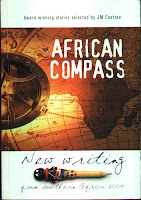
African Compass – Award-winning Stories from Southern Africa selected by JM Coetzee (Spearhead, SA; 2005): The book is the first produced as part of the three-year series of HSBC/SA PEN Literary Award. The targets are young writers who from countries in the Southern African Development Community. According to Nobel Laureate Coetzee: "There is a rich variety amongst the 26 stories." Some stories still bore the marks of school classroom, others were obviously by seasoned hand. Some were sophisticated in style, drawing confidently on the extravagances of contemporary postcolonial fiction, others were still following faithfully the example of Somerset Maugham.
Expectedly, many stories reflect apartheid SA in their themes; Violence, Rape, Racial discrimination spiced with occasional love stories. One is captivated by powerful narrations, tension and the quality syntax which keep the reader glued to the book. However, the pessimism, hopelessness and depression that emerge from the mostly sad stories may not be well appreciated by readers outside SA. The story of rape in "Pictures" by Tebago C Sengfend and that of utter hopelessnes in "Despair" by Bruce Leech are typical examples of the kind of stories that grace the pages of this wonderful collection. In "Pius" by Elizabeth Ann Pienaar, we are led through the thoughts of a man who was shot by armed robbers as he lay dying from the gunshot wounds, while Hum Morris in "The Trucker and the Trucker’s Wife" related the death of a driver and his wife in an auto accident. Good as the collection might read, the question is whether these stories truly reflect today’s South Africa.


 Ike Okonta - co-author of Where Vultures Feast






.jpg)


 Posts
Posts


