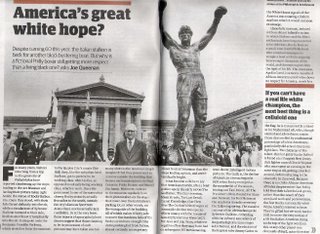
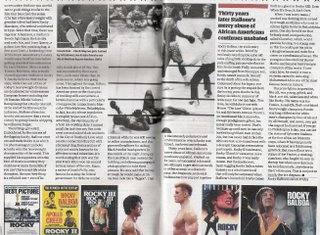
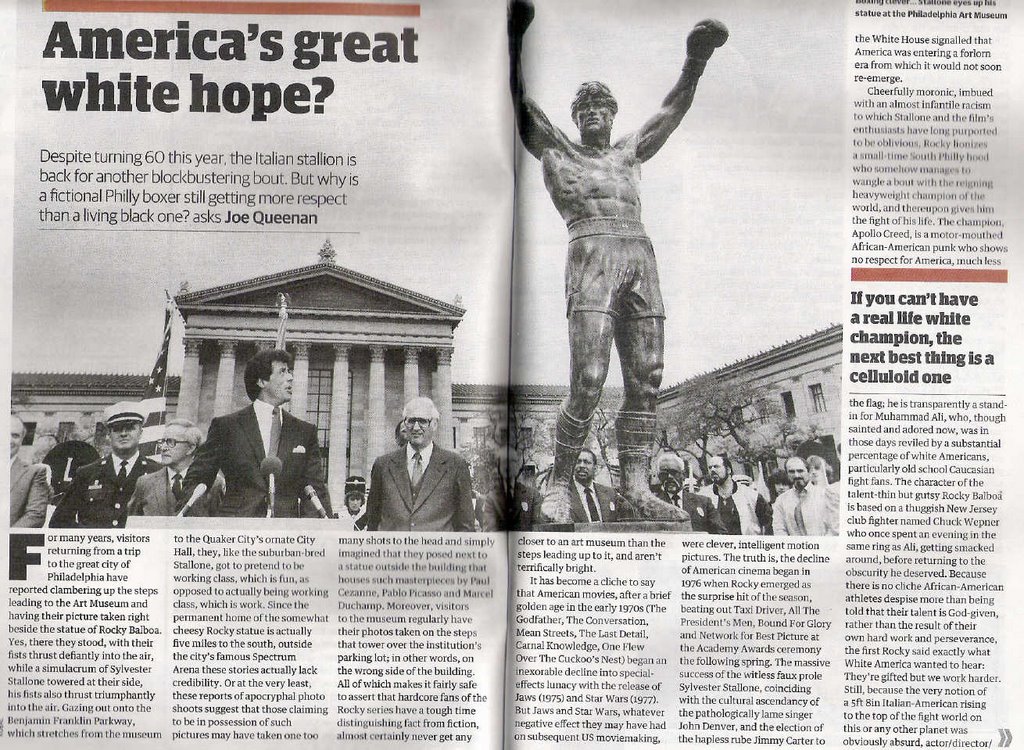
Now, this is where I didn't know I was going with my Muhammad Ali post of last week, but I don't mind continuing the boxing thread in the slightest. Especially when an illuminating article comes along in the shape of Joe Queenan's brilliant piece in The Guardian's Guide section of yesterday. With the sixth instalment of the Rocky series of movies coming in its star, Sylvester Stallone's 60th year, Queenan examines the racial insult the movie has been to African Americans for 30 years - and it was like scales fell off my eyes. I knew the cinematic defeat of Dolph Lundgren in Rocky IV was a deal a blow to America's cold war enemies in Eastern Europe. But Queenan now tells us that those on the receiving end of Rocky's most hurtful blow have always been closer to home. The critic unravels the racial politics of Philadelphia when the first Rocky was released. The film's Best Film Oscar also began the decline of American cinema. But to return to the racial concern, Queenan points to the significance of Apollo Creed in the early Rocky movies:
Cheerfully moronic, imbued with an almost infantile racism to which Stallone and the film's enthusiasts have long purported to be oblivious, Rocky lionizes a small-time South Philly hood who somehow manages to wangle a bout with the reigning heavyweight champion of the world, and thereupon gives him the fight of his life. The champion, Apollo Creed, is a motor-mouthed African-American punk who shows no respect for America, much less the flag; he is transparently a stand-in for Muhammad Ali, who, though sainted and adored now, was in those days reviled by a substantial percentage of white Americans, particularly old school Caucasian fight fans. The character of the talent-thin but gutsy Rocky Balboa is based on a thuggish New Jersey club fighter named Chuck Wepner who once spent an evening in the same ring as Ali, getting smacked around, before returning to the obscurity he deserved. Because there is no cliche African-American athletes despise more than being told that their talent is God-given, rather than the result of their own hard work and perseverance, the first Rocky said exactly what White America wanted to hear: They're gifted but we work harder.
So there you have it: Apollo Creed was Stallone's lampooning (on behalf of white America) of the 'loudmouth' Ali.
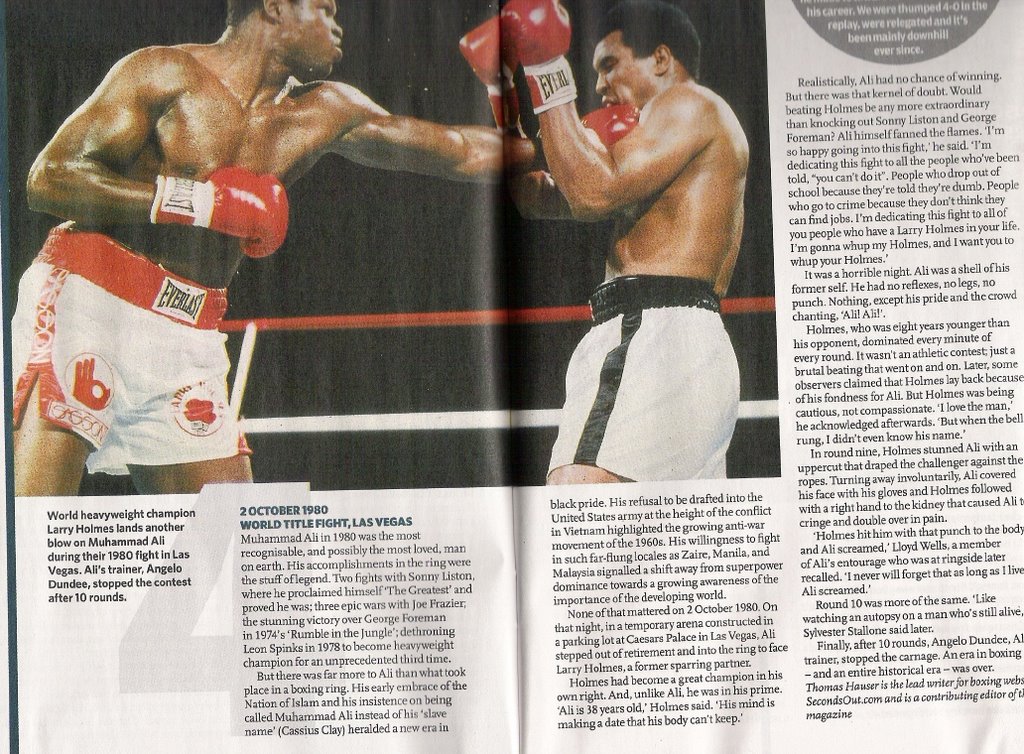
Central to Queenan's piece is the question: "Why is a fictional Philly boxer still getting more respect than a living black one" - thirty years and counting? If the character of Rocky Balboa is based, as we are told, on "a thuggish New Jersey club fighter... who once spent an evening in the same ring as Ali, getting smacked around" - then we can conclude that in Stallone's mega successful movies, the undeserving hoodlum gets his own back, and smacks Ali around.
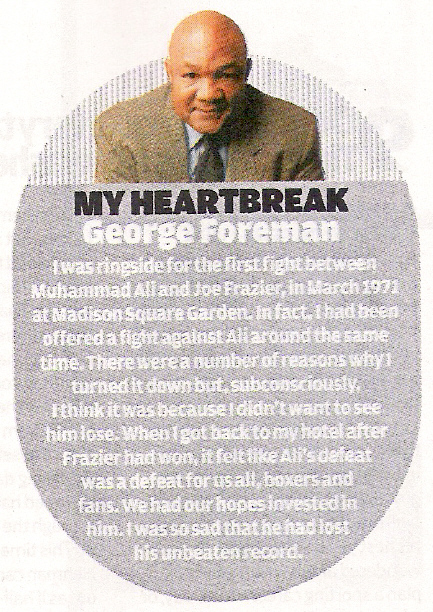
But that's not the half of it. What hurts the most is Joe Frazier (a man I never thought would could inspire racial hurt in me); the boxer lies at the heart of Queenan's central question. Hear him:
When I was in my teens, I worked in a clothing store owned by a tough ex-Marine who used to referee fights in North Philadelphia gyms. One day he told me that he had joined an organisation called Cloverlay, which would provide funding to a young man so that he could quit his job in a slaughterhouse and train for a career as a professional boxer. The young man knocked out Buster Mathis and became heavyweight champion of the world. Three years later, he would crown a majestic career by defeating Muhammad Ali in one of the most famous bouts in history. The prize fighter in question, like Ali, was young, gifted, and black, not old, talentless and white like Rocky. His name was Joe Frazier. A real-life, flesh-and-blood heavyweight champion, Frazier was long vilified as the white man's champion by fans of Ali and by Ali himself, and never, ever got the respect he deserved. If you go to Philadelphia today, you can see the statue of Sylvester Stallone at the foot of the Art Museum steps, where it has temporarily been relocated as a fundraising gimmick. But you will not see a statue of Joe Frazier, a working-class hero who fought his way to the top but who is now down on his luck financially, anywhere in the tri-state area. This is not just an insult; this is a disgrace.
So there you have it. If you go to the cinema to cheer on Rocky Balboa's antics in 'Rocky VI', pause a moment to think upon this and if you will, spare a thought for Joe Frazier.
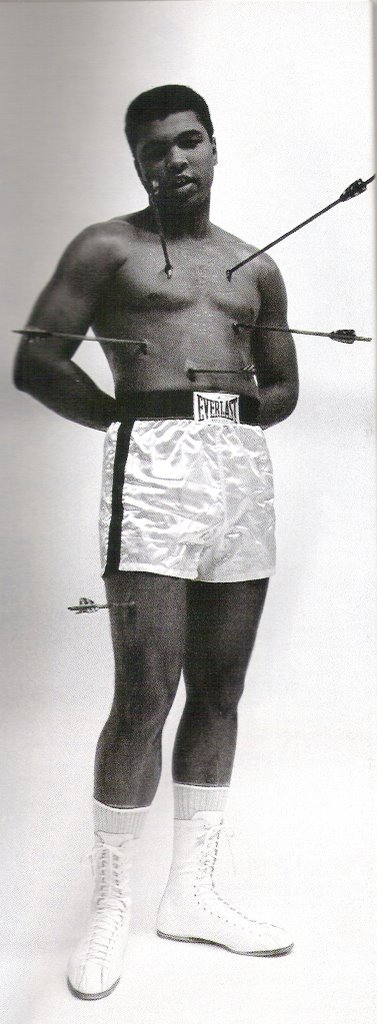
 Muhammad Ali (b. January 17, 1942) is 65 today. See photo galleries commemorating the life and times of "The Greatest" - Photo Galleries 1; Photo Galleries 2; Photo Galleries 3.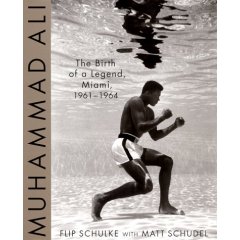







.jpg)


 Posts
Posts

