Writings of the general word's body

Showing posts with label Darfur. Show all posts

Monday, October 02, 2006

Darfur Down

My Endgame in Darfur post the other week generated quite of few comments on Renegade Eye's blog - some negative, some positive. One of the 'comments' is this poem, Darfur Down, by the man behind the blog, Poetic Justice - Dont burn the flag. Wash it!


Darfur Down


The plains are quiet under the forlorn Sudan
The people wilt like flowers planted beneath the sand
From rape and murder and starvation

Of unfed mouths
Unfed hope
Love
Care
Humanity

Consumed by the Janjaweed
Ravaged by the Baggara
Descendents of grand tribes
Lost

And moving

Down
Roving the sands
And hopeless sun
Stopping only to
Plant gardens

Down
Push the black seed

Down
Into the empty guts
Of Darfur

Down
Again
Darfur

Down

The hunters raid
The rapists thieve
The murderers slay
Lacerating fatality

Down
Upon the child’s teeth

Down
Upon the mother’s bones

Down
Upon the father’s strapped back
Trickling

Down
Oozing

Down
A growing lossInfection
The seeds of genocide
Blooming

Down
Flowering

Down
The zenith of rot
Rising down
Now a wailing
Weeping
Desperate
Sobbing
Fearful
Bawling
Hopeless
Howling

O! Baggara!
O! Janjaweed!
O! America!
O! World!

Tempests of butchery
And burials

Burials don’t rise

Burials don’t sprout up like flowers

Blooming to fragrant air

Burials grow
Down
Descending

Down
Into the dark

Seeking
The deep fetid dwelling
Of hopelessness

Of greed

Of starvation

Of shrieking hell

Of the decomposing stench
Heaving Heaving Heaving
Down Down Down
Swelling upon the child’s lips

Down
Across the mother’s breasts

Down
Through the father’s hands

Down
Over the nation’s love

Down
Upon the world’s hope

Down
Down
Down
Down
Down
Down
Down
Down
Down
Down
Down
Down
Down
Down
Down
Down
Down
Down
Down
Down
Down
Down
Down
Down
Down
Down
Down
Down
Down
Down
-Stop-

© mrp / thepoetryman

  • Reproduced with permission

Monday, September 18, 2006

Suffer the Little Children

Who will cry for me?
I died
Drenched in blood
Open wounds on my head
And legs
Cut down
On my first day in school
Who will bury me?
My friends
They died
Blown up
Bloody parts
Strewn around
Dying for what
We do not know
Who will weep for me?
I died
Famished
Belly distended
Flies clustered
Over my face
Gunfire and screams
The last sounds
I heard
Who will mourn for me?
My mother
She lies senseless
Protected by her grief
Who will grieve for me?
My father
He is long gone
To fight war for his God
Who will wail for me?

©
Mshairi

  • Suffer the Little Children was written for the Global Day of Action on Darfur. Reproduced with permission.

Sunday, September 17, 2006

Endgame in Darfur

* * *

“Never Again” is the mantra we hear over and over again, when people talk of the horror of the 1994 Genocide in Rwanda. Then, the World (and in this sense, the World is the International community and the ones who hold the balance of power, led by the US. The World of course is also the United Nations, which to its eternal shame, was able to do absolutely nothing in Rwanda). Yet the World acted in Yugoslavia. More people were killed in Rwanda in 100 days, than in over 9 years of the Yugoslavia Campaign. As Romeo Dallaire once said: "The World is Racist".

We all know what happened in Rwanda in 1994. I will never forget the television news footage of bloated human bodies floating like mutant mushrooms upon Lake Victoria. So many. So many were they, that one couldn’t even see an inch of water in some places. How can I ever think of Lake Victoria again without re-imagining that nightmarish footage?

Now it is Darfur. The World again is being its (or is it her?) old useless self. The World is being racist again. Not only are the people being killed in Darfur as black as night, they are Africans - a terrible thing to be if you want the World to care about you.

What is more, the Dead, Dying and Displaced of Darfur are Muslims. I don’t know which is the worse thing to be in the current World order - African or Muslim. The people of Darfur have a terrible Double Whammy of an albatross round their necks.

In the last few days, the anxiety over Darfur is choking. Sense of asphyxiation worsened by helplessness and the horror of what we know: that time is running out. And why this anxiety? After all, Darfur has been with us for some time. An estimated 200,000 people have been killed in Darfur since 2003. The World has been busy twiddling its thumbs.

And so the new anxiety. And how inadequate a word is ‘Anxiety’. But what word should we grasp and attempt to speak, to express the unthinkable?

And is the new ‘anxiety’ because Hollywood liberal George Clooney spent 5 days with his father in Darfur in April, and in the last few days urged the US government to do something about “the first Genocide of the 21st century”?

Or is it because earlier today, faith leaders in Britain (remarkable, in light of Pope Benedict’s grossly unwise remarks about the Prophet Mohammed; Pope John Paul II, how irreplaceable you were!) - Anglican (Church of England), Islam, Jewish - led by Cormac Murphy O'Connor (leader of the Catholic faith in Britain) prayed at the door of 10 Downing Street. A prayer/letter was also read on behalf of Archbishop Desmond Tutu - you can’t have more moral integrity than that… [I don’t know whether the last few sentences comply with the rules of composition, but what is composition in the face of genocide?]… All these faith leaders came to express their anxiety at the front door of power in London earlier today. They were met at the door of Downing Street by Baroness Amos (don’t know why Blair himself couldn’t do it). We are told that Blair has written to fellow European powers urging action in Darfur. I don’t know that Blair’s gesture is not just another case of twiddling thumbs.

And the anxiety… African Union Peacekeepers have to leave Darfur by September 30. The Government of Sudan (in effect, an Arab government in the North) has refused to agree to a UN peacekeeping force in the region. They are adamant in this stance.

And the fear now, is that the government and its Janjaweed are planning The Final Solution to the Darfur 'Problem'. Genocide! And the World twiddles its useless thumbs. When it’s all over and done with, the World will again chorus: Never Again.

The World is Racist.


* * *

Salih on the Sudan


I'm sorry, I don't feel able to blog the usual stuff today. I've been thinking about Darfur in Southern Sudan.

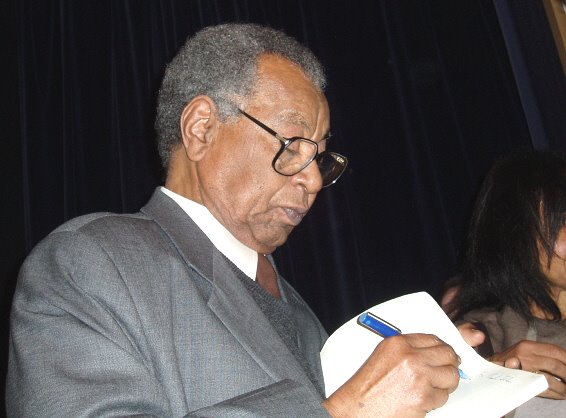
I'm reminded of Tayeb Salih, Sudanese writer of Season of Migration to the North - the book considered to be the most important Arab novel of the 20th Century. I photographed him (above) During African Visions at the British Library last October. My article on the Salih event was published in The Guardian, Lagos, on Sunday 9th April 2006. He had some things to say about the Sudan. The piece is reproduced below...


Recalling Tayeb Salih at African Visions
By Molara Wood

The 5th African Visions Literature tour, organised by the Africa Centre in London, took place at the British Library over a weekend late last year. With diverse writers from across Africa taking part in various events, timetable clashes were inevitable. And for an hour on the afternoon of the second day, one could either hear Malawian poet Jack Mapanje reading from his collection, The Last of the Sweet Bananas - or catch a discussion with Sudanese writer, Tayeb Salih.

The Salih event was a rare opportunity during African Visions to hear a writer that straddles the divide between Africa and the Arab world. And with the situation in Dafur, Salih, an Arab from Northern Sudan, would come with a particular perspective. Any disappointment at missing Jack Mapanje was soon forgotten by members of the audience as they fell under Tayeb Salih’s considerable gift of the gab. Salih would often speak on and on in mesmerising tones only to then stop and ask: "What was the question?"

Born in 1929, Salih is the author of Season of Migration to the North, the book selected by a panel of Arab writers and critics in 2001 as the most important Arab novel of the 20th Century. In an event tagged in Arabic as ‘Hiwar Ma’a Al-Tayyib Salih’, the author was in conversation with Dr Ahmed Al-Shahi, a social anthropologist and author who specialises in Sudan and the Middle East.

Introducing Salih, Al-Shahi observed that: "Some people say, is he Sudanese, an Arab or an African; he is very international… We can all be grateful to Salih for enabling us to know how it feels to be Sudanese." He added that in Salih’s books "we are told that life in the rural area is graceful and beautiful."

Tayeb Salih discussed what he called the "mosaic of the Sudan", asserting that: "The Nubian civilisation was not an echo of the Arab civilisation; it was a civilisation in itself. Then the Arabs came, [then] the English, the Ottoman and God knows what. Sudan is really a mound of civilisation and I approach it like an archaeologist… layers of civilisation. I am very grateful to have been born in this area."

"The favourite colour of the Northern Sudanese is not white or brown - it is black. Akhbar is black. Later in America they said: ‘black is beautiful’. With us, beauty is in being black. Sudan was Christian for centuries. Then Islam came - it was not imposed [but spread] over time through inter-marriage. They have never thought that religion is something to fight about." Salih argued that the Sudan was "a harmonious society - no exaggeration. Anyone who lived there in the 40s, 50s, and 60s will agree. Sudanese Jews - we didn’t know they were Jew until they emigrated to Israel - we’d always thought they were Sudanese!"

"I was re-reading Achebe recently. I was amazed at how much of the rituals had crept to the Sudan. The Sudanese get the essence - the African essence. What is Africa anyway? We tend to oversimplify; the oversimplification comes because of political conflict." Chinua Achebe had been instrumental in getting Salih’s work published in the African Writers Series, and the Sudanese spoke of his friendship with his Nigerian counterpart. "There is a great fondness between my humble self and Achebe," he disclosed. "It’s the same world in my work and Achebe’s. Of course there are differences, but deep down, it’s the same society."

Salih returned to the Arab/African question. "People these days fuss too much about whether one is Arab or African. The Northern Sudanese have solved this problem; to them, one is either blue or green." The Arabic language, he pointed out, has a wonderful approach to the racial issue when it comes to its treatment of colour in people. "The words ‘black’ and ‘white’ do not exist in Arabic… people are red, blue or green, which is a very good way of solving the issue. We don’t conform to the stereotype of the Arab. [When you read the] history of Arabs in the Peninsula, they were not white or black; they were blue and green. I hope the day will come when people will move away from stereotypes."

However, having declared that: "I don’t believe in Arab superiority," Tayeb Salih was somewhat controversial in his view of the conflict in the Sudan. "Our brothers in the South wanted to make a case that they were oppressed but [they were] not oppressed in the way they describe. Then they went on to say that the Northern Sudanese is intrinsically racist, which is not true." He added that: "We are Africans because we are in Africa - we also have Arab blood. We look African, for God’s sake." A member of the audience probed further about Southern Sudan. "The word is racism, really," the author cut in. "You are trying to say the Arab in the Sudan are racist. I don’t believe so. If you believe that, then you are very mistaken, my friend."

Asked how he got his first break with the BBC by a lady in the audience who complimented his voice, Salih replied: "I am very flattered that you liked my voice." He had been working as a teacher in Rufah when he saw a BBC advert for an announcer and, having had problems getting higher education, he "felt London could help, I got a letter and so here I am." He continues to write in Arabic because "English is not my language. In Arabic, I can take risks, so why bother, when there are good translators?"

Growing up in his home country under British rule, "we didn’t know the British were our masters - can you believe it? - because they were so rare, we only saw one in a blue moon." The author said he would have liked to go back and live in the Sudan, but "we know that something unattractive has occurred. With due respect to the [Sudanese] Ambassador (in the audience), I don’t want to say anything nasty, but something horrible was done."

Nevertheless, Salih remains very proud of being Sudanese. "It is a matter of principle to me - what some would call a question of identity. I have lived [in Britain] for a long time, married here and I have never asked for British citizenship - and I hope the British don’t feel insulted. But it is really a stupid thing on my part because the Sudanese passport has become very difficult, with all due respect to the Ambassador - it’s not his fault! The Sudanese passport - it changes colour - sometimes it is blue and yellow."

Tayeb Salih then went on to share a traveller’s experience that would ring true to most Africans - Nigerians especially - who travel through Western airports. "The worst is when you try to enter America. They do horrible things to you. They make you go naked into paradise!"