Writings of the general word's body

Showing posts with label Chimurenga. Show all posts

Monday, March 31, 2008

Chimurenga 12/13: Dr. Satan's Echo Chamber

Chimu People on the 164-page double edition, out now

The latest issue of the Cape Town based cultural and literary journal, Chimurenga, is a double-take on sci-fi and speculative writing from the African world, collectively titled “Dr. Satan’s Echo Chamber”. The title of the double-issue is drawn from a dub mix by the late Jamaican producer King Tubby.

Chimurenga 12 is a collection of dystopian faction, which challenges, relentlessly, and throws rocks at the windows of the world. The issue features writing and art by: Allan “Botsotso” Kolsky, Koffi Kwahule, Joao Barreiros, Olufemi Terry, Doreen Baigaina, Stacy Hardy, Akin Adesokan, Nnedi Okorafor-Mbachu, JG Ballard, Emmanuel Dongala, Blank du Blanc, Jean Malaquais, Liesl Jobson, Peter Kalu, Dominique Malaquais, Basim Magdy, Jean Lamore, Femi Rage Dawkins, James Sey, Minnette Vari, Teju Cole and Rana Dasgupta.

Chimurenga 13 documents the making of several Afrofuturist projects, from the speculative engineering of Abu Bakaar Mansaray to the film-work of the Black Audio Film Collective and Jean-Pierre Bekolo, and dub/death-work of King Tubby. The issue also features: Angolan composer and theorist Victor Gama’s object-oriented music writing; John Edwin Mason on the making of Abdullah Ibrahim’s “Mannenberg”; Lionel Manga on future-present Douala; Baudouin Mouanda on SAPE; Pume Bylex on his paintings; Eyal Weizman on walking through Palestinian walls; Luca Frei on the Beaubourg underneath Paris and a discussion between Sartre and Nkrumah staged by the Sharzhad Collective.

Since its very first issue in 2002, Chimurenga has received excellent reviews; writers, poets, scholars and journalists, among numerous others, have lauded its originality, the quality of its content and its willingness to tackle subjects other publications might consider too difficult or controversial to address. It is widely viewed as one of the most interesting and important publications available in post-apartheid South Africa and is fast gaining supporters abroad. Award-wining Kenyan writer and founder of Kwani, Binyavanga Wainaina, says “Chimurenga is the finest literary magazine in Africa”. Vanity Fair calls it “an uber-cool, multilingual journal spinning a funky mix of art, culture and political writing from and about Africa”. Chimurenga is available at bookstores across South Africa.

ISSN 1683-6162

To order or subscribe to Chimurenga, please contact:
email: chimurenga@panafrican.co.za; phone: +27(21)4224168; fax: +27(21)4241673
Or visit our website

Sunday, January 14, 2007

Have you read...?


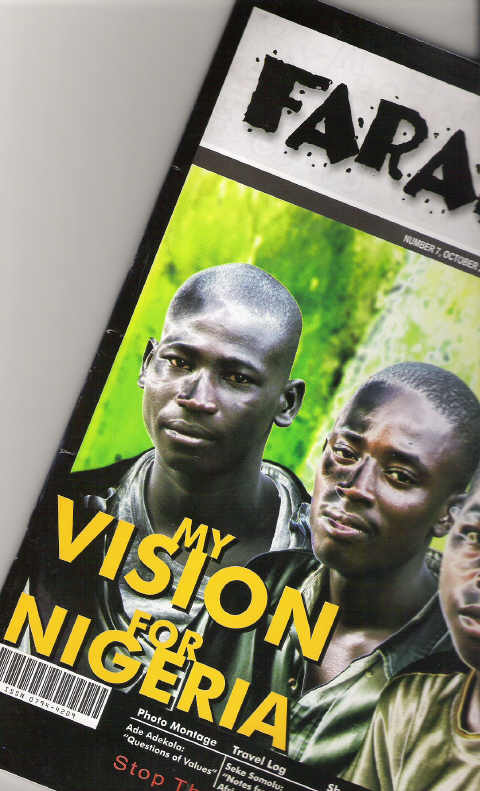
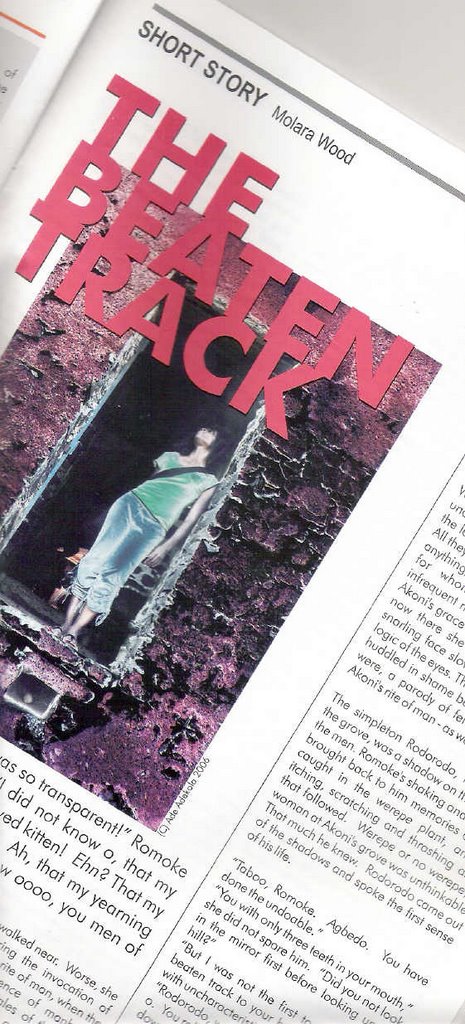
This is Farafina vol 7, guest edited by Okey Ndibe and with a pack of contributors including Ogaga Ifowodo, Patrice Nganang, Marcia Kure, Helon Habila and Patrick Wilmot. And there's myself in there too (with my story The Beaten Track).

Published in Lagos, Farafina (meaning 'Africa' in Bambara) is doing from West Africa what the journal Chimurenga ('liberation struggle'/'revolution' in Shona) does from South Africa - and which Wasafiri ('Cultural traveller' in Kiswahili) has been doing from London for over 20 years. And let's not forget Kwani? (meaning the equivalent of the Yoruba/Nigerian 'bawo ni?' - how is it?).

Interesting names, all - but must reads. Definitely.

Monday, December 04, 2006

Chimurenga Vol. 10

The 10th edition of Chimurenga Magazine is out now and will have its official launch at the Kwani LitFest on December 14. Here's what Chimurenga's editor, Ntone Edjabe, has to say about the new edition...

Chimurenga Vol 10: “Futbol, Politricks and Ostentatious Cripples”

The new issue of Chimurenga is, yes, about football. And politics. But no, we are not talking about soccer as a capitalist apparatus, or as a substitute for war, or about South Africa’s ability to successfully host the 2010 World Cup, or about Fifa’s global developmentalist rhetoric – the writing and art actively side-step football clichés and branded discourses.

We chose instead to scope the stadia, markets, ngandas and banlieues to spotlight narratives of love, hate and the wide and deep spectrum of emotions and affiliations that the game generates. Because, after all, if you want to pitch it hardcore political, the playing field is the only area that Fifa does not and can not fully control – everything else is board-room approved.

But. Power, board-roomed or otherwise, must be confronted. Hence the issue is framed by two perspectives from Latin America, sure to inject some criticality in 2010 euphoria: the reader will enter the Argentinean fish-tank (where militants disappeared for death or brainwashing) during the 1978 World Cup, for an ethical exploration with activist Graciela Daleo, and emerge for a deep breath with Gustavo Esteva, who extracts the essence of the Zapatista movement as a radicalisation of democracy.

Between these you will find Of Fabric and Football – a travelogue in 5 parts that delivers idiosyncratic and powerful points of view on the ‘beautiful game’. Binyavanga Wainaina, with an acerbic tongue and an ironic eye, captures the chaos and transactions, the passions and textures of Togo, Ghana, and the Entire Continent Everywhere during the 2006 World Cup. Knox Robinson writes of the relationship between player and space; Diouf and Leopold Sedar Senghor stadium in Dakar; Eto’o and Yaounde’s drinking spots; Drogba and Houphouet Boigny airport in Abidjan (read an excerpt in today’s Sunday Times Lifestyle). Simon Kuper (Football against the Enemy) conducts an off-centre interview with bush war veteran, Liverpool great and droll football manager Bruce Grobbelaar (and other Whitemen who run football in Kaapstad). Peter James Hudson time-travels to 16thC Spain and its infamous Catholic-inspired inquisition. Novelist Patrice Nganang establishes, in Camfranglais, football violence (and the rivalry between the country’s top teams Canon and Union) as a metaphor to explore political violence in Cameroon in the early 90s.

In a stand-alone piece Peter Alegi (Laduma! Soccer, Politics and Society in SA), investigates the 2001 Ellis Park football disaster in Johannesburg, concluding with a meticulous indictment of the soccer bosses’ and the government’s roles before, during and after the tragedy.

Poetry finds its expression in two poems by Adriano Sousa (against futebol coaches who should be bullfighters); a poem by Molara Wood (for Marc-Vivien Foe) and poem by Gabeba Baderoon (on God and the Athlone Stadium). Filmmaker Lindiwe Nkutha gives a nuanced short story of hate in the dusty locale of a South African township while Julia Napier evokes the bodylove for the game in her short story about a female footballer.

There is a Tricolour Triptych – head, body and corpses. Firstly, Grant Farred produces a Derridean reading of Zidane’s world-stopping head butt. Secondly, a conversation between Achille Mbembe and Zidane’s teammate Lilian Thuram in the aftermath of the famous coup de boule. Thirdly, in a story of bones, Dominique Malaquais relocates the remains of Frantz Fanon.

There’re two pieces on football and cinema (sort-of):

First, maverick Serbian filmmaker, Emir Kusturica (Time of the Gypsies; Underground), in a conversation with Diego Maradona, the best player EVER and the subject of Kusturica’s documentary-in-progress, about Bush Jr, Castro, John Paul II and the poor of Argentina. And Philippe Parreno, co-maker of the acclaimed Zidane: A 21st Century Portrait, talks with Cyril Neyrat about the conceptual, political and technical motivations and processes in the making of the film.

The art and photography are delivered by Buyaphi Mdledle, Gerd Rohling, Andrew Dosunmu, Phillipe Niorthe, Joseph Francis Sumegne, Kwesi Owusu-Ankomah, Kate Simon, Nicola Schwartz, Joel-Peter Witkin and the Cuban Ministry of Information.

The cover is “Table Head (Evora, Portugal)” by Nicola Schwartz

Writing. Art. Politics. Who no know go know.