Writings of the general word's body
Saturday, December 18, 2010
Nwaubani, Ngugi and the Nobel
My own reading of Nwaubani’s ‘In Africa, the Laureate’s Curse’ was predictably complicated. I am a great admirer of Mario Vargas Llosa (a worthy 2010 laureate) and many other Latin American writers, people in whose works I’ve found a world closest to that of the Yoruba, from among whom I’ve sprung.
That said, I wanted Ngugi to win the Nobel, it meant a lot to me. He has written great, visionary works. He’s an ideological writer, and without ideological grounding, a writer is just piffle, in my view. He has also demonstrated great courage over many decades and suffered terribly for his art and convictions. Ngugi’s ‘Decolonizing the Mind’ is one of the great theoretical works of African literature, or any literature for that matter. After reading it, you cannot be indifferent; you must take a stand, either you are for or against. I have always had great sympathy for Ngugi’s insistence that we should write in our mother tongues, controversial though the larger body of African writers say it is. And one cannot take from Ngugi the fact that he has put his writing post-1986 where his mouth is: writing first in Gikuyu then translating into English (he’s written his latest memoirs in English, but that is a matter for another day).
Ngugi has produced indestructible works in many genres: drama, novel, essay. ‘The Trial of Dedan Kimathi’ was a memorable playtext in my secondary school days. And what of ‘Weep Not Child’, which apart from introducing Njoroge and co, made me want to discover Walt Whitman’s ‘On The Beach At Night’ for myself? These are among the foundational works of my formative years. We used to chant the titles of Ngugi’s books as though they were mantras. I once thought that if I ever saw Ngugi, it would be like seeing man on the face of the moon. Great, almost mythical writer, who one later had the privilege of seeing in the flesh; and to see the radical writer so human, so aged, almost frail (from the detentions and cigarette torture burns). A beautiful mind surpasses the limitations of the physical body.
And to later discover 'A Grain of Wheat', ‘Petals of Blood’, ‘The River Between’ and of course, ‘Decolonizing The Mind’. Had Ms Nwaubani read enough Ngugi, she would never have written the following: ‘There’s actually reason to celebrate Mr. Ngugi’s loss.” There’s nothing to celebrate about Ngugi missing out on the Nobel, and it’s difficult to see how the prize going to someone else becomes a “loss” for Ngugi.
Furthemore, it’s baffling that, nearly 25 years after Nigeria bagged her own Nobel through Soyinka, a Nigerian writer saw nothing wrong in suggesting that a Kenyan should not get the prize. Ngugi, Soyinka and Achebe have since the 60s formed the great tripod of the humanising literature of Black Africa. Soyinka has his Nobel, Man International Booker winner Achebe has been celebrated to the heavens for ‘Things Fall Apart’, and suddenly it’s a Nobel for Ngugi that will spell the death of African writing?
Nwaubani’s argument is deeply flawed; and it is regrettable that someone with a platform like the New York Times to postulate about Africa, chose to use her new-found international voice in this manner. The author of ‘I Do Not Come To You By Chance’ must realise that it will not be by chance that her argument will play into Western prejudices about Africa and African writing. ‘Oh, let’s not give another African a Nobel because, knowing no better, they’ll only copy themselves.’ Might as well go the whole hog and cite Shakespeare’s Iago: “These Moors are changeable in their wills."
Arguing for the emergence of new styles of writing, Nwaubani lumps Achebe, Soyinka and Ngugi into a questionable sameness, purveyors of what she calls “an earnest and sober style”. But what is so “sober” about Soyinka’s plays, or his prison memoirs, ‘The Man Died’? Or indeed Achebe’s ‘A Man of the People’? Have the likes of Helon Habila, Chimamanda Adichie, Sefi Atta, Lola Shoneyin and Uzodimma Iweala come to prominence simply because they ‘copied’ Achebe and Soyinka? And which of these two has Nwaubani herself copied? Of the supposed sobriety of the triumvirate, Kinna says on the blog, “Soyinka is far from sober. And what of Ngugi’s ‘Wizard of the Crow’, which successfully mixes humour, satire and fantasy and is, in my opinion, one of the most entertaining books by an African author. Is sober the new word for old?”
The part of Nwaubani’s argument that has provoked the most consternation, is the suggestion that literature in the indigenous languages serve only to exacerbate “tribal differences”. She declares, “This is not the kind of variety we need.” Chielozona Eze issued an early rebuttal to Nwaubani’s “cowardly ideas, the core of which sought to suggest that it is separatist for a writer to write in his native language or even to claim that he is a writer from his ethnic group.” As for Carmen McCain, a Hausa literature enthusiast, writing in indigenous languages “is exactly the variety we need.”
My own imaginative universe has been formed to a significant extent by the works of D.O Fagunwa, which I devoured as a child and still marvel to read today, novels that form the bedrock of Yoruba literature, books which might not have had the same power written in English. And what of Dostoyevsky, Tolstoy and others, whose immortal works were not originally written in a Western European language? What of ‘One Hundred Years of Solitude’, ‘Love in the Time of Cholera’ and other works by Gabriel Garcia Marquez? Their initial publication in Spanish has done nothing to prevent them being read the world over through translation.
I suspect Adaobi Tricia Nwaubani could not have intended to be understood as saying a writer should not identify with an ethnic group. The bio on the UK edition of ‘I Do Not Come To You By Chance’ informs that the author “grew up in the eastern part of Nigeria, among the Igbo speaking people” – a construction that reads more like an ethnography citation from 70 years ago, but which nonetheless serves the purpose. But if Ngugi must be denied just so we don’t write Igbo, Hausa or Yoruba literature, it’s fairly standard that Nwaubani’s New York Times piece is a hard sell.
*
Monday, March 01, 2010
Ngugi in London

In an event tagged ‘Ngugi Wa Thiong’o in Conversation: A founding father of African Literature’ (and who’s to argue with that?) The Travel Bookshop presents the acclaimed Kenyan author for his only London event for ‘Dreams in a Time of War: A Childhood Memoir. There will be book signings after the event.
Venue
The 20th Century Theatre
291 Westbourne Grove
London W11 2QA
Date: Sunday March 7, 2010
Time: Doors open 6.30pm for 7.
Tickets: £10 (booking essential)
Contact
The Travel Bookshop, 13-15 Blenheim Crescent, London W11 2EE,
Tel: 0207 229 5260 / Email: post@thetravelbookshop.com
Monday, January 14, 2008
Ngugi on Kenya
Writers must sometimes feel like the Greek prophetess Cassandra, gifted to see the future but fated not to be believed. What is unfolding in Kenya could as well have been lifted from my novel Wizard of the Crow where the ruling party and the opposition parities engaged in Western-sponsored democracy become mirror images of one another in their absurdity and indifference to the poor.
The picture of men and women burnt down in a church where they had gone for refuge still haunts my mind. A child running away from the fire was caught and hurled back into the flames.
One of the few survivors was quoted as saying: "But they knew me; we were neighbours. I thought Peter was a friend - a good neighbour. How could Peter do this to me?"
I had heard the same puzzled cry from Bosnia. I had heard the same cry from Iraq. I had heard the same, same words from Rwanda: "We were neighbours; we'd married into each other. How could this happen?"
And now I hear the same cry from Eldoret North in my beloved Kenya. For me this burning of men, women and children in a church is a defining single instant of the current political impasse in Kenya.
And this must be separated from accusations and counter-accusations of rigged elections by the contending parties.
Rigged elections is one thing - it can be righted by any mutually agreed political measures - but ethnic cleansing is another matter altogether.
~
- Read more from Ngugi wa Thiong'o.
- Kenyan writers on the Kwani Blog (thanks to Potash for the link).
Wednesday, June 06, 2007
Ngugi Casts Literary Spells

Monday, May 14, 2007
Word from the Mutha

Word From Africa - a London-wide celebration of the languages of Africa - takes place @ various venues between 2 - 10 June. There's some 2000 languages spoken on the African continent apparently (I'd hazard there's more). But don't worry if you don't speak 1, 2 or more of these languages. All are encouraged to come along anyway, because events will be in English or in translation or with commentary.
As for Music, organisers are confident it won't need translating.
Word from Africa kicks off with a full day of free events @ the British Museum on 2nd June.
- On 2nd June, Ngugi Wa Thiong'o (a passionate advocate of writings in African languages; and he has put his own writing/books where his mouth is) will give the keynote speech. Very appropriate.
- Poetry from Sudan & Somalia
- Music from Zimbabwe & Cameroon - and a talking drum performance by Nigeria's Ayan Ayandosu
- Helon Habila & Chuma Nwokolo will be discussing how their native languages influence their writings. It's a pity the programme records both writers' native language as Igbo. Incorrect. Nwokolo is Igbo. Habila isn't.
- 4th June - and there'll be a Zimbabwean Writers' Evening @ Borders, Islington. Valerie Tagwira will be reading from her novel, The Uncertainty of Hope [title reminds of 'The Redundancy of Courage']
- And London-based Ghanaian Nii Ayikwei Parkes will host an African Writers Evening @ The Poetry Cafe in Covent Garden - on 8th June. Ayikwei Parkes will be keeping company with giants soon on the London Underground. He is one of 6 African poets whose work will be read on tube trains during June. Others include Wole Soyinka, Leopold Sedar Senghor & Niyi Osundare. Giants, yes.
And so on and so forth. Lots more writers & artists including Wangui Wa Goro & Blessing Musariri.
More information on Africa Beyond.
Monday, August 21, 2006
Literary Wizard
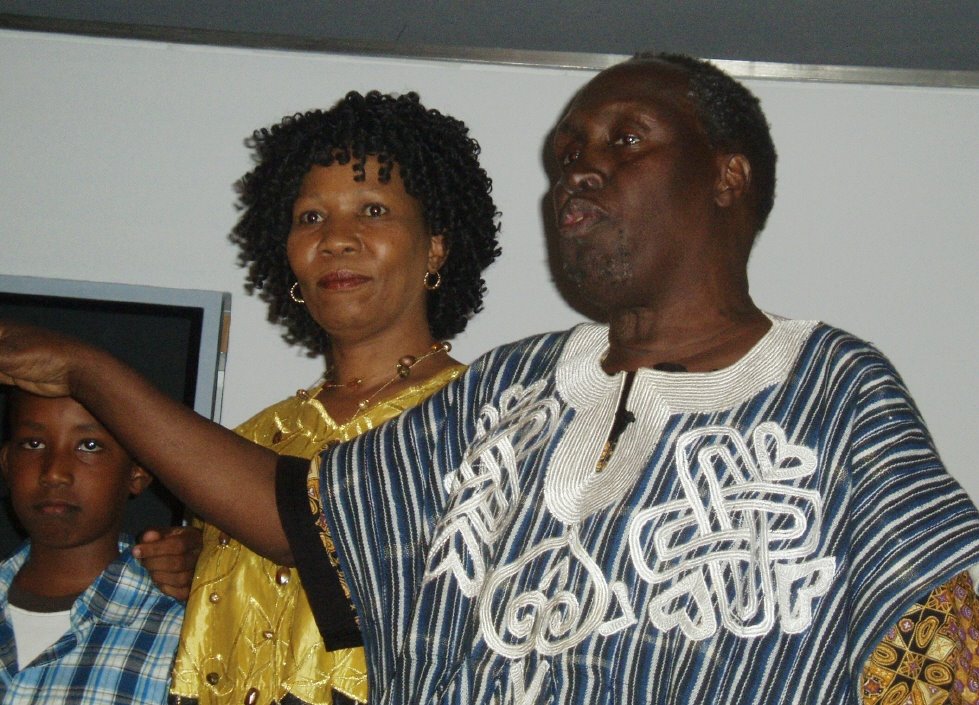
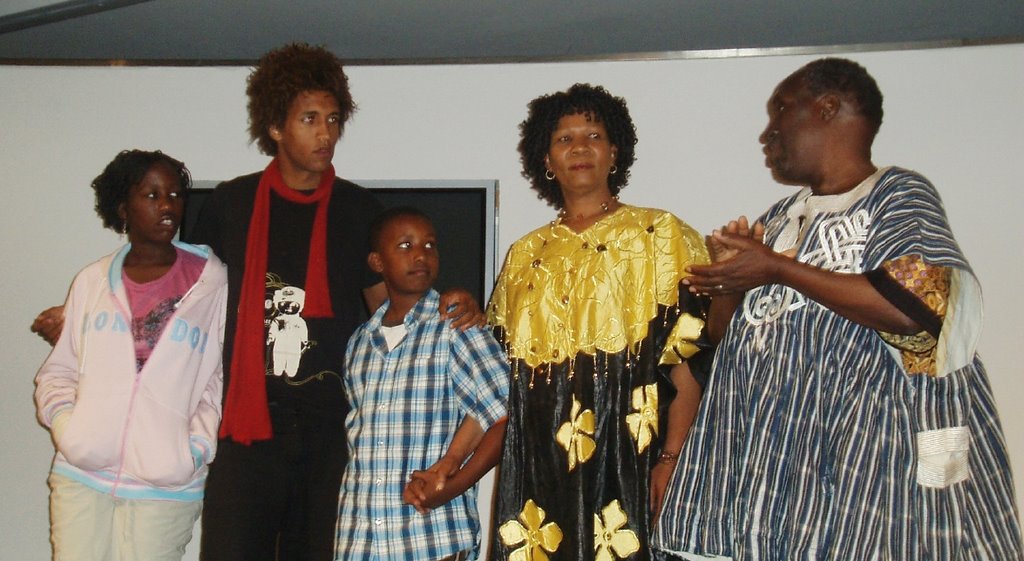
Ngugi wa Thiong'o at the book reading of Wizard of the Crow on 10th August. The author considers England his second home, and was once a resident of Islington, North London. Here he is with his wife Njeeri, a day before the 2nd anniversary of the attack they suffered on return to Kenya. The author's young son, Thiong'o (who got to say a few words on the night, thanking the audience in an American accent for coming to honour his father) is next to Njeeri. Ngugi seemed to want to make the event a celebration of life and survival, bringing his family along to the event. Lucky for the audience, they got five Thiong'os for the price of one. Ngugi explained that his younger children had only been spared the attack because, as luck would have it, they had chosen to go and spend the night with a relative.
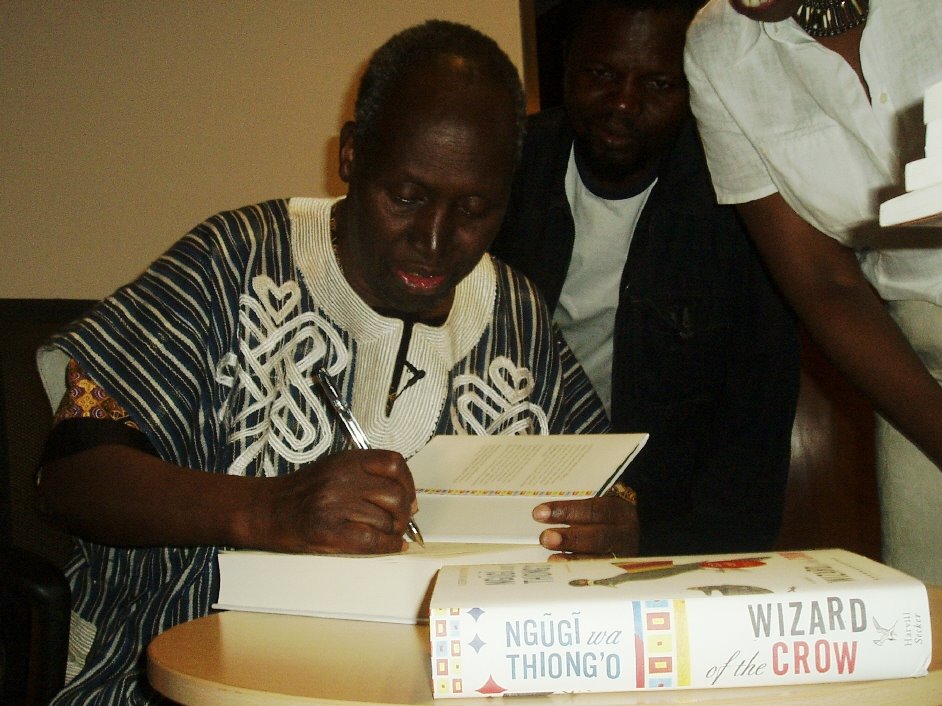
Ngugi autographs a copy of Wizard of the Crow for a reader lucky to be the first in line, a neverending queue for autographs at Congress Hall.Thanking the blog reader who sent me the link to this piece on Ngugi...
"Moi used to say, 'I can forgive anybody but Ngugi'," says the 68-year-old novelist today at his home in Irvine, where he is a professor of English at the University of California. At just over five feet tall, with a ready giggle, he is hardly the portrait of a steely revolutionary. When Moi agreed to abide by term limits, and his hand-picked successor lost in the presidential elections, Wa Thiong'o realised that he had a
chance to come home. It was good timing. Wa Thiong'o had just completed a six-volume satirical novel called Murogi wa Kagogo, a ribald satire of a fictional African dictator. It was also the longest novel ever written in his native Gikuyu language.-read the article.
- Images: taken @ Congress Centre, London, 10 August 2006; by MW
Ngugi wa Thiong'o
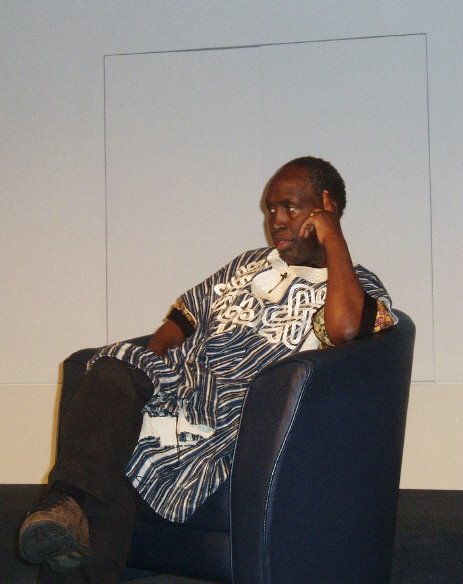
On Thursday 10th August, Ngugi wa Thiong'o kept a date with lovers of African literature, at a reading and discussion of his new novel, Wizard of the Crow. Here he is at Congress Centre, London.- My account of the evening is published today...
Wizard of the Crow: Ngugi Reads in London
By Molara Wood
On August 11 2004, Kenyan writer Ngugi wa Thiong’o, who had made a triumphant return to his country after 22 years in exile, was attacked by four men. One of Africa’s greatest writers, he was beaten and burned with cigarettes on his face; his wife Njeeri - was raped.
Ngugi (as he is popularly known) had told an interviewer beforehand: "In a spiritual sense, I have never left Kenya. Kenya and Africa are always in my mind. But I look forward to a physical reunion with… my beloved country." The novelist hoped to get in touch with the ‘everyday’; instead, he found what he later described as "a nightmare".
Almost two years to the day, 68-year-old Ngugi has made another return, this time to London - to read his new novel, Wizard of the Crow. He calls England his "second home"; he was very visible there in the 80’s, having left Kenya on exile in 1982. He co-directed his play, The Trial of Dedan Kimathi at the Africa Centre, London, later leaving for the United States in 1989. Fittingly for a writer of Marxist leaning, the appearance was at Congress Centre - the UK home of the Trade Union Congress.
Many had bought copies of Wizard of the Crow at the door, and were already leafing through the work as they waited for Ngugi. In the audience was Sarah White who (along with the late John La Rose) is acknowledged in the 766-page book for an active role in the Kenyan struggle; Ngugi also thanked them on the night for campaigning for his release from prison during the late 70’s. Also in the audience were: Professor Biodun Jeyifo; and Caine winners Brian Chikwava (2004) and Segun Afolabi (2005).
Anchoring the event was a long-term friend of Ngugi’s. He spoke briefly about the author’s life and times, his books, awards and stellar academic positions (Ngugi is currently the Distinguished Professor of English and Comparative Literature; and directs the International Center for Writing and Translation at the University of California), describing him as "one of the major essayists of our time". However, the essays are largely unpublished, and "it is as a writer that we know him."
Wizard of the Crow, though voluminous, was described as "extraordinarily readable", competing in size and scope with Dickens’ Nicholas Nickleby.
Ngugi read two passages. The first, features a black character suffering from white-ache. "Let me explain," Ngugi offered. "Some have headache, some have stomach ache, but this individual has white-ache." The second passage, about love, was timely, "especially as my wife has come." The audience turned to catch a glimpse and applaud as Njeeri wa Ngugi walked to her seat. Following were the couple’s three children. Things went quiet for the second passage, read by Ngugi in limpid and mesmerising tones.
"Art is for me a very important calling - not a means to politics, but politics is part of art," he declared in the discussion that followed, adding that, to him, art encompasses everything about being human. The politicians in Wizard of the Crow however, are all about power and have no appreciation for art.
The title derives from a standard reference in Kikuyu storytelling. "When I was young, we used to hear stories of sorcerers so powerful that a glance from them could make a bird drop from the sky." Ngugi’s earlier novels were moulded after the realism of the 19th century English novel, having been educated reading the likes of Jane Austen. Later novels are a departure. "Realism is good in giving a portrait of society, but it is also limiting. When I started writing in Gikuyu, I realised that the orature of African tradition is not limited in space or time."
Ngugi bade his farewell to the English language with the theoretical work, Decolonizing the Mind. His novels in Gikuyu include Devil on the Cross (translated into English by Ngugi himself) and Matigari (translated by Wangui wa Goro). The author self-translated Wizard of the Crow,
partly because "it is very long." He is also committed to the process "because I believe in translation. When I abandoned writing in English, I received a lot of criticism." However, "I wanted to show that to write in an African language does not mean the work is excluded from readers in other languages."
Translation allows him to have a dialogue with culture, as he negotiates between the mischievousness and tonality present in Gikuyu, but non-existent in English. In Gikuyu, "If two women meet and one is dressed well, they don’t compliment each other, instead they mock. ‘Ah, why are you dressed like that… are you going to a wedding… where do you think you are going?’ What they are really saying is: you look nice."
In Wizard of the Crow, Ngugi focuses more centrally on women than in his earlier work, with a female character through whom he addresses "the question of women’s power." Looking over to Njeeri in the audience, he encouraged her to take a bow, musing: "And I must say, having been married to a very strong woman…" it was imperative to take this approach in novel.
Ngugi reflected on the now infamous attack. "We got real power from what you call ‘divine intervention’ because we were able to resist them and that is why we are here today." Asked later about where he stands now spiritually, he replied: "I believe in the spirituality of human assistance." Wizard of the Crow is also a conversation between religions, touching on systems of belief including: African traditional religions, Eastern mysticism and Islam.
There was an "overwhelming reception" from ordinary Kenyans on the author’s return in 2004. "Even more overwhelming, was the reception after the attack… my wife, when she walks on the streets, people cross the road and tell her: ‘thank you for returning.’" When Njeeri went shopping with security men in tow after their ordeal, market women stopped the guards at the entrance, saying: "We will protect her here." According to Ngugi, his wife had "this wall of women, guiding her through the market." He concluded that: "Such overwhelming support outweighs the appalling attack on us by people opposed to what we stand for."
Wizard of the Crow is set in the fictional Republic of Aburiria. Ngugi avoided choosing a specific African country in order "to connect with the post-colonial dictator." The author suggested that despots like Pinochet, Aquino, Mobutu and Amin are "a creation of Western democracies", moulded as such - and "function as a part of the Cold War." The post-colonial dictator "embodies what Nkrumah called, ‘power without accountability.’"
The realism of Ngugi’s earlier novels would not suffice for such a dictator, who is often seen (thanks to propaganda) as "having born before the beginning of the world!" Wizard of the Crow is published in four volumes in Kenya. And in "a privileging of the oral", the book receives ‘oral reviews’ before any comment in print, so that "sales owe much to the oral reviewer."
The author wrote Weep Not Child, The River Between and The Black Hermit, while still an undergraduate at Makerere University. He also wrote a column (As I See It; as James Ngugi) for a newspaper, edited a journal, "and I still wrote my essays on time!" Ngugi likened this to similar achievements by Achebe and Soyinka during the same period. "This phenomenon is placed in the culture of the sixties," he believes.
Reminding that the end of the 50’s into the 60’s occasioned "the high noon of the anti-colonial movement, the independence of Ghana and Nigeria; labour movement in the Caribbean; civil rights in America… we were responding to that energy." Rather than any notions of genius, he credits the "youth and passion" of the 60’s for the literature that emerged from Africa at the time.
According to Ngugi’s discussant, that ‘youth and passion’ is still evident "in the mature writer of Wizard of the Crow."
- Ngugi wa Thiong’o was at Congress Centre, London, on Thursday 10th August. Wizard of the Crow is published by Harvill Secker, UK.