skip to main |
skip to sidebar
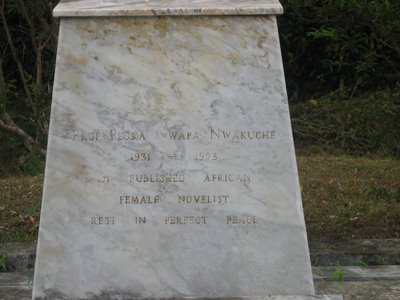 I read Flora Nwapa's books Efuru and Idu as a child and I was fascinated by her descriptions of a blue lake. Last year, I visited relatives in Ogwashi Uku, Delta State. My uncle took me to see many of the different rivers and lakes surrounding Ogwashi. This reawakened a desire to see Flora Nwapa's blue lake, Lake Oguta. After some arm-twisting on my part, a few days later, I set out for Imo State with 3 others in my uncle's old 504. We arrived at the lake and it was even more beautiful than I'd imagined. Since we were in Oguta I felt I had to pay my respects to the woman who opened doors for many African women writers. We visited the Nwakuche compound and although none of the family were home, the groundskeeper listened to the story of how we came to Oguta and let us see the grounds and take a picture of Flora Nwapa's final resting place.
It wasn’t the lure of repealed taxes
that drew her to the movement,
it was the sight of hundreds of women
wielding cooking implements;
pestles raised skyward
in a declaration of war.
It was the power she felt
coursing through her body
as she joined the marches, chanting,
the look of respect in her husband’s eyes
when she returned home each night.
Spurred on by the kicks from within her swollen belly
this humble trader, weaver of cloth,
joined the assembly of women
surrounding the district officer’s house
waiting for their demands to be met.
Day after day, the African sun
fried scalp exposed between cornrows;
a little agony ignored for the cause.
The day came when the district officer had had enough;
the women intercepted on their way to his house
by a platoon of men who walked tall,
just like the women’s fathers,
but bore proof
of the absence of kinship
in barrel-curved hands.
She had never moved so fast in her life
but could not outpace the source of the whine,
gritted her teeth at the moment of the sting,
but kept on running.
When the burning continued,
she put her hand to her left shoulder,
laughed at the red, sticky liquid;
she had never felt so free.
But the baby wouldn’t wait.
She felt the hands supporting her,
then nothing at all.
The sound of the angry wail
drew another laugh from her.
She uttered her first words to her daughter:
“You were born to fight,”
and on that morning in 1929,
before her eyes shuttered,
the women smiled the wide smiles
of those who know sorrow
will yield to their grit.
© Omolola Ijeoma Ogunyemi
- Eyewitness appeared in the Indiana Review, Volume 27, Number 2, Winter 2005. Reproduced with permission.






.jpg)


 Posts
Posts

