Writings of the general word's body

Showing posts with label Zadie Smith. Show all posts

Wednesday, February 13, 2008

Zadie Smith "hypocritical", book people say

Last week Zadie Smith said...
“Most literary prizes are only nominally about literature. They are really about brand consolidation for beer companies, phone companies, coffee companies and even frozen food companies.”
.
That was in her note explaining that, of the 850 entries to the Willesden Herald short story competition, none was good enough for the £5000 prize. Turns out the writers weren't the only ones scratching their heads.
.
The Sunday Times broke down Smith's comments thus
Although she does not name names, the prizes to which she is referring are clear from the types of company she mentions. The beer company must be Whitbread, which until 2006 ran the successful Whitbread book awards. Smith won its first novel prize in 2000 for White Teeth, which was then made into a Channel 4 drama series.
.
The phone company must be Orange. In 2006 Smith won its prize for fiction with On Beauty. It is a women-only award. The coffee company must be Costa, a division of Whitbread that sponsors a series of book awards. The overall Costa prize (there are also five category prizes) was won last month by A L Kennedy for her novel Day.
.
The frozen food company must be Iceland, which sponsored the Booker prize before Man, the hedge fund firm, took over.


And publishing figures have a thing or two to say about Smith's comments.
.
Ion Trewin, organiser of the Booker Prize: "Her remarks are absolutely ridiculous. Why has she been happy to accept money from these prizes and sponsors, whom she now attacks? And I’d also like to know if her publisher is going to put her forward in future for literary awards.”
.
Joanna Trollope: “Actually these prizes rescue some books which could simply end up on publishers’ slush piles. So Zadie Smith, whom I think is a good writer, is very wrong. Also, in an increasingly philistine country the more that art and commerce can and do come together, the better.”

.

  • The Telegraph said publishing figures have branded the author of White Teeth "hypocritical".

Tuesday, February 05, 2008

Willesden Herald Competition Stunner

If you are one of the 800 entrants for the 2008 Willesden Herald Short Story Competition, well, better luck next year. The £5000 prize judged by Zadie Smith will not be awarded this year because organisers and Ms Smith, er, judged - that none of the stories was good enough.

Extract from Zadie Smith's statement
For I have thought, reading through these entries, that maybe the problem with this prize is that my name is attached to it. To be very clear: just because this prize has the words Willesden and Zadie hovering by it, does not mean that I or the other judges want to read hundreds of jolly stories of multicultural life on the streets of North London. Nor are we exclusively interested in cutesy American comedies, or self-referential post-modern vignettes, or college satires. To be even clearer: if these things turn up and are brilliantly written, they will not be ignored. But we also welcome all those whose literary sympathies lie with Rimbaud or Capote, with Irving Rosenthal or Proust, with Svevo or Trocchi, with Ballard or Bellow, Denis Cooper or Diderot, with Coetzee or Patricia Highsmith, with street punks or Elizabethans, with Southern Gothic or with Nordic Crime, with Brutalists or Realists, with the Lyrical or the Encyclopedic, in the ivory tower, or amongst the trash that catches in the gutter. We welcome everybody. We have only one principle here: MAKE IT GOOD. So, let’s try again, yes?


And no doubt many will "try again", for the chance to be judged 'good enough' by Zadie Smith. For now, they're just stunned at the news, a real anti-climax to the competition whose winner would have collected the prize this month, as well as a real boost to their writing careers. There is speculation about the existence of a shortlist, but not even that has been made public thus far. Dissapointed writers have been leaving comments on the Willesden Herald blog. An update has also been posted on the site.


~
*
Update: Wednesday 6th February 2008
With the furore that greeted the decision not to award a prize to any of the entries (we now know there were 850 short stories from all over the world) and the non-publication of the shortlist, the organisers have now released their last word on the matter. They decided, after all, to publish the 'shortlist' of 10 writers, and to share the cash prize £500 apiece between them. But first,they had to go and check that the shortlisters were cool with this, given the negative reactions to yesterday's announcement. Meanwhile, some speculated as to whether those shortlisted would wish to be forever known as writers whose stories were so "mediocre" that no top prize could be considered. We now know the answer: the 'shortlisted' writers did not want the 'honour'; in the main, they said NO to both publication and £500 cash.
.
From the Willesden Herald update
In response to the negative comments left about the decision not to award the prize, Zadie Smith decided that the money should be split, to help counter the suggestions that the short-listed writers were somehow ‘mediocre’. There was no intention at all of suggesting such a thing and any close reading of Zadie’s statement will show this to be false. Being the best out of 850 entries is no small feat.
.
It is worth mentioning that there are two standards here that we can look to:
• to be the best of a batch; and
• to be worthy of first place in a competition which celebrates outright excellence.
.
The latter is a much higher aspiration than the former; however, the former is something to be proud of.
.
When the decision was made to split the prize money, the short-listed writers were contacted again and most of them said that they did not want their names or stories to appear and did not want any prize money. They told us to fuck off. Which is fair enough.
.
In conclusion, many writers agree that if the organisers did not consider any of the stories worthy of the not inconsiderable cash prize, they had every right not to award it. Some, however, have issues with the handling of the result's announcement.
~
*
Update: Thursday 7th February
More on the fallout from the Willesden Herald's own 'Super Tuesday' - and the writer Kay Sexton has revealed herself as one of the "infamous 10" who were "not good enough" for Zadie Smith.
.
"My story and I still think we’re 'good enough'" - she insists.
.
"I'm old and egotistical enough to have confidence in my own opinion, rather than Zadie's."
.
Hear hear.
~
*
Yet another update - Thursday 7th PM
The unawarded prize money will be donated to charity. And there's talk of the competition being wound up. Should that happen, this year's fiasco would have been the death knell...

Monday, September 03, 2007

Zadie on Zora

Zadie Smith wrote about Zora Neale Hurston's Their Eyes Were Watching God in Saturday's Review, ahead of the publication of a new Virago Modern Classic edition (Hurston remains on the ascendant; I have a 2003 Virago Modern Classic of the same book. It's to be a VM classic for the repeated time, it seems). Smith contends with the potential limitations of critical perspectives on Hurston, which insist that only a black woman can fully identify with her writings. Smith seems bent on departing from the path taken by Hurston champions like Alice Walker, talks all around it, and then concludes that in fact, her own very personal reaction to Their Eyes Were Watching God - is precisely because, like many have argued in the past concerning Hurston, "She is my sister and I love her."

Excerpt - In the high style, one's loves never seem partial or personal, or even like "loves", because white novelists are not white novelists but simply "novelists", and white characters are not white characters but simply "human", and criticism of both is not partial or personal but a matter of aesthetics. Such critics will always sound like the neutral universal, and the black women who have championed Their Eyes Were Watching God in the past, and the one doing so now, will seem like black women talking about a black book.

It feels important to distance myself from that idea. But by doing so, I misrepresent a vital aspect of my response to this book, one that is entirely personal, as any response to a novel shall be. Fact is, I am a black woman (I think this was the point my mother was trying to make) and a sliver of this book goes straight in to my soul, I suspect, for that reason. And though it is, to me, a vulgar absurdity to say, "Unless you are a black woman, you will never fully comprehend this novel", it is also disingenuous to claim that many black women do not respond to this book in a particularly powerful manner that would seem "extra-literary". Those aspects of Their Eyes Were Watching God that plumb so profoundly the ancient build-up of cultural residue that is, for convenience sake, called "Blackness" (as, say, Kafka's The Trial plumbs that ancient build-up of cultural residue that is called "Jewishness") are the parts that my own "Blackness", as far as it goes, cannot help but respond to personally. At 14 I couldn't find words (or words I liked) for the marvellous feeling of recognition that came with these characters who had my hair, my eyes, my skin, even the ancestors of the rhythm of my speech. (While working in Florida, Janie and Tea Cake befriend the "Saws", workers from the Caribbean.) These forms of identification are so natural to white readers - Of course Rabbit Angstrom is like me! Of course Madame Bovary is like me! - that they believe themselves above personal identification, or at least that they are identifying only at the highest, metaphysical levels. His soul is like my soul. He is human; I am human. White readers often believe they are colour-blind. That is, until they read books featuring non-white characters. (I once overheard a young white man at a book festival say to his friend, "Have you read the new Kureishi? Same old thing - loads of Indian people." To which you want to reply, "Have you read the new Franzen? Same old thing - loads of white people.")

Monday, June 18, 2007

An Orange Revolution - in words & images


Chimamanda's Night of Glory
By Molara Wood


As widely predicted, Nigerian writer Chimamanda Ngozi Adichie triumphed at the 2007 Orange Prize for Fiction on Wednesday night, winning the award for her second novel, Half of a Yellow Sun.

Going to the Royal Festival Hall venue of this year's ceremony, one could be forgiven for missing one's way. The prestigious centre of the arts on the banks of the River Thames had been closed for some time, and scaffolding was still up around the building and doorways were sealed. Guests had to walk around the building. But once they got to the functioning entrance, it was splendour all the way. The Royal Festival Hall would be officially re-opened to the art-going public in just two days, but the Orange Prize Ceremony allowed a magnificent preview.

Two Olympic style flames burned on either side of the expansive orange carpet that led from the sidewalk into the venue, up the wide stairways and all the way to the Ballroom in the belly of the Royal Festival Hall, where it was all going to happen. It was already teeming with people, with more arriving by the minute. Made up mostly of writers and book lovers, it was at least a more representative crowd than the Shortlist Readings, which took place the night before in the Purcell Room, part of the same South Bank Complex that includes the Royal Festival Hall.

The Shortlist Readings of Tuesday 5th June saw a sold out audience made up of mostly middle class white women. And very few men. As for the blacks, there were only five; four women and one man. The reading went well, but the night ended on a sour note for Chimamanda Ngozi Adichie, who finished signing autographs only to find that her bag had been stolen. The author lost her personal effects and, painfully, a notebook in which she had written preparatory notes for her next novel.
But when Chimamanda arrived at the Orange ceremony, nothing in her bearing betrayed the upsetting loss of the night before. Wearing a cream dress with a bold red midriff sash made from the same material as her headwrap, she looked every inch a winner. It was a long road from the 2004 Orange Prize, for which Chimamanda was short-listed, for the first time, for her debut novel, Purple Hibiscus. She was relatively unknown then, and left empty handed as Andrea Levy scooped the prize. Much has happened since, and Chimamanda is now a bonafide literary celebrity in her own right on the international stage. And in the run up to this year's prize, British bookmakers William Hill and Ladbrokes made her the odds-on favourite to win. Chimamanda, still only 29, was the woman to beat.
'
As the ceremony began, Orange Prize co-founder and honorary director Kate Mosse, took the stage to declare that this year's was one of the best-selling shortlists ever. The paperback edition of Half of a Yellow Sun alone has sold 187,000 copies in Britain since its release in January. With a line-up including Kiran Desai (short-listed for her Booker Prize winning novel, The Inheritance of Loss) and Xiaolu Guo (for 'A Concise Chinese-English Dictionary for Lovers'), Mosse told the gathering that this was also the most international shortlist ever, "with representatives from every continent."

Flying the flag for the whole of Africa, Chimamanda watched as the preliminary awards were announced. A trio of shortlisted authors, Guo, Rachel Cusk (Arlington Park) and Joanne Harris (The Observations) kept each other company nearby. Desai, wearing a stunning Indian sari, was further away in the gathering. Completing the shortlist of six was Anne Tyler (for Digging to America) who was not present. According to the chair of the judging panel Muriel Gray, Tyler is "notoriously reclusive and never leaves Baltimore." Representatives stood in for Tyler at the reading and at the award ceremony.
The Orange Award for New Writers came first, and it went to Karen Connelly for another war novel, "The Lizard Cage", set in Burma. As she read a prepared speech, I leaned over and asked Chimamanda if she too would read from a note on winning. The author replied that she had no speech prepared. "Being favourite is the kiss of death," she said. "I will not be surprised if I do not win."

We didn't have long to wait, because Muriel Gray was soon back on the stage to announce the big prize. "There is absolutely nothing controversial about this year's shortlist," she declared, informing that the judges (including seasoned profiler of African writers, Maya Jaggi) were unanimous in their choice of winner.

Then Chimamanda's name was called out, to sensational reactions in the Royal Festival Hall Ballroom. The author went on the stage to accept the limited edition winner's bronze statuette known as the "Bessie" drawing laughs when she declared herself happy to take home "this little thing with its cute breasts." She mentioned that, "Writing is the only thing I really care about," and added that she had to go and make a call to her family in Nigeria. Chimamanda's editor, Mitzi Angel, later described the author's onstage performance as "poised" and "controlled" - adding that, "She does the same in her writing. She is always thinking, and she cares deeply about her country. She will become one of the most important writers in the world."

In the razzle and dazzle of cheers and press photographs that immediately followed, Kiran Desai was the only shortlisted writer who got the chance to congratulate the new Orange prize winner before she was whisked away from the gathering for media formalities. Others would have to wait until her return, but the Nigerian writers who had come to support their own, were allowed to accompany her through a series of behind-the-scenes interviews and photo-calls. The Nigerian party comprised scholar/writer Wale Adebanwi, journalist Tolu Somolu and myself; all three of us were at the Orange ceremony three years before, when Chimamanda first appeared on the shortlist.

Poet Odia Ofeimun, fresh from his participation at the 12th International Poetry Festival in Cuba, had stopped over in London to attend the Orange ceremony. He said of Chimamanda's win, "It is a confirmation of what the world always knew, that good literature comes from Nigeria. She is a very good representation of the best that comes out of the country." Ofeimun added that, "There is this wise old woman's way to her youthfulness, which makes it imperative that we listen to her. The great thing is that she is very young and has a huge future ahead."

Adebanwi, who interviewed Adichie on the publications of both her books, said, "I am very excited because I knew it was only a matter of time for Chimamanda to win a big prize." He observed that, "She's got the capacity to tell the traditional African story by the moonlight with a refreshing modernity that is extremely powerful. We should be proud of her." Adebanwi felt that the theft of Chimamanda's handbag was strangely prescient. "Maybe losing her bag was an indication of a new story. What was taken away yesterday has been returned in a wonderful way today."

Chimamanda herself had seen the bag's loss as a bad omen. "I was thinking: this is not good." Winning the prize however, made her "very happy." She had come off the stage before realising that she didn't thank some people publicly, especially her editor Mitzi Angel. "Writing is something you do alone," Chimamanda said, "and it takes other people to help make things happen. I've been very fortunate to have Mitzi who understands my work."

The feeling is mutual for Mitzi, who never doubted that Chimamanda would reach the heights. "I feel very privileged to be publishing her." Asked if it had been a risky venture taking on a then little known Nigerian female writer, the editor replied, "I don't think of it in terms of risk. If someone's a good writer, it will become obvious to everyone. To me, Chimamanda was ahead of her game."

The author's publicist, Michelle Kane, had a strong feeling that she would win. "She is an extraordinary voice. It was time for her to be recognised and it was shown tonight. And she won it!"
And won it, she did. Asked what she thought her Orange triumph means, Chimamanda replied, "I hope it will open more doors, not just for Nigerian writers, but for African writers. I hope African writers will see this and think that they can do it too. I remember when I was looking for a graduate programme in the US, and I saw that Edwidge Danticat had been at the same place; I immediately felt that since she had been there, I would be fine too."

The Orange Prize recognises excellence in women's writing, and the author's mind went to her fellow Nigerian female writers. "We are taking over from the men!" she declared.

We the Nigerians present had unrestricted access as Chimamanda gave radio and television interviews. She answered questions and posed for photographs while we sent frantic text messages to writers and artists in Nigeria to communicate the news. Kate Mosse came in with the winner's £30,000 cheque, a part of the ceremony that had been accidentally missed out on the stage. And so we were among the few witnesses to the belated presentation of the cheque, which made it all the more special.

Prize-winning Zimbabwean writer Petina Gappah phoned through on my mobile and became the first to congratulate the new Orange winner by telephone. And there was still that phone call to the Adichie family to be made. But first, it was back to the ceremony in the Ballroom. Among those waiting to congratulate Chimamanda and talk with her, were: Zadie Smith (2006 Orange winner), Andrea Levy (2004 winner), Jackie Kay, Margaret Busby and John Agard. There was a wonderful evening ahead and - as many predicted on the night - a great future. In the end, it seemed clear that Chimamanda Ngozi Adichie's Orange Prize triumph had never really been in doubt.

  • Words & images © MW

Monday, January 15, 2007

To the Reader


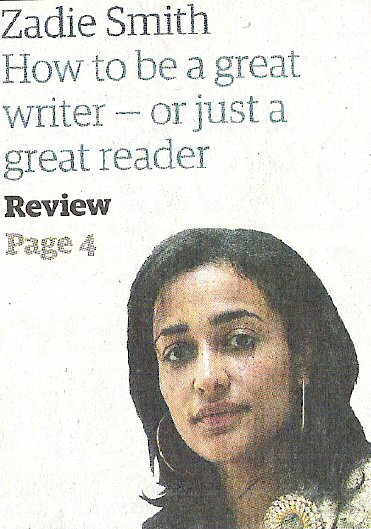
Zadie Smith has written her tips on how to be a good writer & reader - or rather, how to 'fail better'. More tips to come next week. She ends for now with a word for the reader: gotta work.


Excerpt
10. Note to readers: a novel is a two-way street

A novel is a two-way street, in which the labour required on either side is, in the end, equal. Reading, done properly, is every bit as tough as writing - I really believe that. As for those people who align reading with the essentially passive experience of watching television, they only wish to debase reading and readers. The more accurate analogy is that of the amateur musician placing her sheet music on the stand and preparing to play. She must use her own, hard-won, skills to play this piece of music. The greater the skill, the greater the gift she gives the composer and the composer gives her. This is a conception of "reading" we rarely hear now. And yet, when you practise reading, when you spend time with a book, the old moral of effort and reward is undeniable. Reading is a skill and an art and readers should take pride in their abilities and have no shame in cultivating them if for no other reason than the fact that writers need you. To respond to the ideal writer takes an ideal reader, the type of reader who is open enough to allow into their own mind a picture of human consciousness so radically different from their own as to be almost offensive to reason. The ideal reader steps up to the plate of the writer's style so that together writer and reader might hit the ball out of the park. What I'm saying is, a reader must have talent. Quite a lot of talent, actually, because even the most talented reader will find much of the land of literature tricky terrain. For how many of us feel the world to be as Kafka felt it, too impossibly foreshortened to ride from one village to the next? Or can imagine a world without nouns, as Borges did? How many are willing to be as emotionally generous as Dickens, or to take religious faith as seriously as did Graham Greene? Who among us have Zora Neale Hurston's capacity for joy or Douglas Coupland's strong stomach for the future? Who has the delicacy to tease out Flaubert's faintest nuance, or the patience and the will to follow David Foster Wallace down his intricate recursive spirals of thought? The skills that it takes to write it are required to read it. Readers fail writers just as often as writers fail readers. Readers fail when they allow themselves to believe the old mantra that fiction is the thing you relate to and writers the amenable people you seek out when you want to have your own version of the world confirmed and reinforced. That is certainly one of the many things fiction can do, but it's a conjurer's trick within a far deeper magic. To become better readers and writers we have to ask of each other a little bit more.

Read all the tips...


Update 22 January
Fail better, read better...
"I have said that when I open a book I feel the shape of another human being's brain" - from the concluding part of Zadie Smith's tips.